This week’s episode features two segments.
G20 Finance Track in Asheville this month
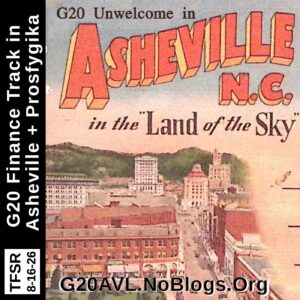
First up, you’ll hear Jeremy and Sea speak about the upcoming G20 Financial Track gathering of Finance Ministers and Central Bankers happening in Asheville at the end of August this year. We speak about the G20, neoliberalism, and some of the organizing happening locally. More info available at G20AVL.NoBlogs.Org
- Transcript
- PDF (Unimposed) – pending
- Zine (Imposed PDF) – pending
Squatted Neighborhood of Prosfygika
Then you’ll hear a segment form the June 2026 episode #103 of B(A)D News: Angry Voices from Around The World by the A-Radio Network. In this audio, members of Crna Luknja from Ljubljana, Slovenia, speak with participants in the autonomous, squatted neighborhood of Athens, Prosfygika, a name which translates to Refugee. The audio was recorded on May 28th , so likely the situation has shifted and you can find more information and updates at SaveProsfygika.GR/index.php/en/ for English. According to a statement from June 24th found on that website, the hunger strikes of Aristotelis Chantzis and Suzon Doppagne were suspended following municipal statements in line with movement demands. Check the Materials page for statements, photos, audios and documentaries from and about the community.
Announcements
Mutual Aid in Spokane in the wake of massive fires
A comrade sent some fundraising links for mutual aid, particularly for undocumented community members and folks at the Colville Tribal Rez north of town where fire damage has been extensive. Check our show notes for links.
Asheville Anti-Surveillance Week of Action August 16-22
CAMS (Community Against Mass Surveillance) is doing a week of action against mass surveillance alongside the nationwide DeFlock week of action. Check our show notes for the local schedule of events in Asheville.
SCHEDULE FOR WEEK OF ACTION:
Aug 16-22:
Sunday 8/16 – Week of Action kickoff & potluck: coalition building, info and resource sharing, and organizing for week of action and beyond, 1 to 3 pm, Home Hub Pavilion, 27 Balm Grove Ave., W AVL, rain or shine (covered outdoor space and access to indoor spaces).
**Tuesday evening 8/18 – online panel and Q&A with local and national experts, 7 – 8:30 pm.**
Friday evening 8/21 – Infoshare, Q&A, Speak Out + dance party, 6 to 10 pm, location TBD.
. … . ..
Featured Track:
- TFSR by The Willows Whisper
- Beatbuster by The Willows Whisper

. … . ..
AVL G20 Transcription
Bursts: Would you care to introduce yourselves to the audience with any names, pronouns, affiliations, or locations that’d be helpful for the listeners?
C: I’m going with C. As for affiliations, I don’t know if I have any. Pronouns of she and her.
Jeremy: Hey, I’m Jeremy. My pronouns are he and they. We’re with a group of folks who got together to do some community education around the G20 when we heard that it was coming to Asheville. Speaking for myself, I knew that the G20 and these financial summits are bad, but if you’d ask me why exactly, I don’t think I could have really explained it. I wanted to try to learn as much as I could to spread that analysis to the community.
Bursts: I’m happy that we can go on this journey of discovery with you both, because I know you’ve been doing a lot of research into this. So, what even is the G20, or the G8, for that matter? What does an organization like that do, and why are anarchists and others who are interested in international solidarity, ecological issues, and class warfare concerned about groups like the G20?
Jeremy: The G20 is a summit of global financial leadership to plan global economic policy. It’s basically a meeting of elites to talk about how they’re going to exploit the working-class, maintain and expand global capitalism. It exists as a reform that came out of a crisis of legitimacy in the neoliberal global capitalist structure. You mentioned the G8. There was a formation after the end of a system called the Bretton Woods System. It was placed to limit international financial speculation, and it ended under the Nixon administration and this opened the door for international financial speculation. The G7, which is another formation that’s similar to the G20, consists of the countries with the seven largest economies, which are mainly Western. It’s Western European countries, the United States, and Japan – who made up the G7. The G8 was basically the G7 plus Russia. Russia was added after its liberalization, after the fall of the Soviet Union. Then Russia was kicked out again in 2014, and the G8 went back to being the G7. I think that anarchists, anti-authoritarians, and people who are in solidarity with working-classes all over the world pay attention to these summits because this is really where the rich plan how they’re going to set policies that are used to control populations, extract wealth, oppress the working-class people, and prevent international solidarity. I think that it is a time when we should be thinking about how we can rebuild international solidarity between working-class people to fight what these capitalists are doing.
Bursts: If the G20 is a sort of reform of the G7 or G8, and it includes countries that were former colonies, does that reform reflect a democratization of global finance or of these decisions that have an impact on such a large proportion of the world? Was this an opening of the gates to the rooms where decisions are made?
C: So it was definitely intended as a neoliberal reform to do that, but that is not the case. What it really just does is reinforce austerity measures. The G20 does encompass over 80% of the world population’s GDP as well as pollution in the world, but what they do is just try to force austerity measures on the Global South. They do this with the help of the IMFand World Bank, which are also invited to the finance ministers’ and bank governors’ summits that we’re going to see in Asheville. So it isn’t really democratic. It was trying to say that it was more democratized, but Africa is put in as just the entire continent in the African Union. There was one African country that was in it, which was South Africa. They hosted last year’s G20, but they’ve been excluded this year due to a thing that I have a Trump quote here for: “To put it more bluntly, the South African ANC are killing white people and randomly allowing their farms to be taken from them.” He and Rubio have also stated that they are “sheltering Hamas sympathizers.” It is just racist rhetoric trying to make false claims about white genocide and so on. So it’s still an incredibly racist and elitist forum.
Bursts: There’s probably an element there because South Africa, as a former apartheid state, stood up and made statements to the international court and the international community more widely decrying the genocide in Gaza as well as the ongoing apartheid in Israel. Besides the white genocide claims of certain Afrikaners and the white supremacist movement, I guess that’s probably the other element of it. It seems like a lot of the wheels are being turned and strings are getting pulled still by some of the same actors that have always pulled the strings.
C: Absolutely.
Bursts: You mentioned that Asheville is going to be hosting finance ministers. Is it called the “Financial Track”? What is the upcoming event in Asheville, and why was this fair city chosen to host a gaggle of Central Bank ghouls?
Jeremy: Let me also add a clarification to the last question. When we think of the G20 as a sort of reform to the G7 system, which still exists, we have to be clear about who it was a reform for. Giving these other countries a seat at the table was not an effort to give the working-class or the people of those countries a seat at the table. In the 90s the policies set under the direction of the G7 system destroyed a bunch of economies. They created a bunch of financial crises: the Mexican Peso Crisis, they instigated the fall of the Soviet Union, as well as a follow-up crisis of the Russian financial system; and the Asian Financial Crisis. Where they screwed up caused a lot of damage to a lot of rich people all over the world. This is giving the rich people of those countries, the financial leadership of those countries, a seat at the table. That’s what the G20 is about. The G20 Finance Track is actually how it started. The original G20 summit was first held back in 1999, and it was literally held a month after the Battle of Seattle resulted in an early end to the WTO summit in Washington. The Political Leaders Summit didn’t start until 2008 under the Bush administration. This year, the Leaders Summit is happening in Miami in December. The Leaders Summit started in response to the housing bubble that was popping, and the G20 came to a consensus at that summit in 2008 to reaffirm neoliberal principles and to bail out the bankers. This, of course, resulted in the Great Recession. C, would you like to talk about why it’s being held here?
C: Yeah, I’ll try to answer that.
Jeremy: Thanks.
C: Typically, the process for choosing cities involves cities or regions volunteering or putting up offers. This did not apparently happen here, according to some people who asked the city of Asheville if they did that. They were told by the federal government, and the rationale the government gave is that it’s meant to highlight resiliency post Hurricane Helene. At the time of this announcement, I believe, and correct me if I’m wrong, the federal administration was withholding over 170 million dollars in FEMAfunds for recovery. It’s basically just them trying to say, “Look, we can choose a place that was the poster child of climate-change-caused-crisis, and say it’s not that bad.” I don’t know exactly what convinced the Asheville government to agree, other than maybe being told around the same time they got more funding for a real-time Intelligence Center, or it is perhaps related to the tourism industry. That is more in the realm of speculation, but it’s definitely coming with an increase in surveillance from the federal trend.
Bursts: So you mentioned the withholding of FEMA funding. There was a decision after Hurricane Helene, or maybe rather after the election and with the new Trump administration taking office in 2025, that FEMAwould be restructured so that redistribution of emergency aid after a natural disaster, for instance, would go through the White House and be at the discretion of the Oval Office. I wonder if that model falls in line with the model of neoliberalism that’s being promoted by the G20. And I wonder if you have the numbers or the experience that you want to speak to? How has the recovery in this region been since the storm? Is it a poster child for a success story?
Jeremy: I think that’s a good question. It’s sort of funny. Here I’m just going to read a quote from what Treasury Secretary Bessent stated. He said, “I am proud to spotlight that the United States will host the G20 Finance Ministers Summit and central bank governors in Asheville, North Carolina. The selection of historic Asheville reflects the Trump administration’s commitment to the revitalization and resilience of Western North Carolina, which continues to rebuild after the devastating impact of Hurricane Helene.” A lot of people in the community are obviously very upset by, because we got little to nothing from the federal government. The government was extremely unhelpful at every level. Everybody here knows that it was people, their neighbors, and community groups that have done the recovery. I don’t have the numbers in front of me, but we still have a ton of newly unhoused people that are the result of Hurricane Helene. It hasn’t gone well by any measure, and so it’s a slap in the face to tell people that this is about Helene recovery. Though when you consider what neoliberalism is all about and what they are promoting at this summit, it is perfect for them, because it is a demonstration that these elites can come to this beautiful tourist mountain town. They can have a retreat, have a nice weekend where they can have their meetings despite the fact that they did nothing to help us. Despite the fact that there are still so many poor and working-class people who are struggling here, so many unhoused people, and they will at least, they assume, still get to have their nice vacation here.
Bursts: Yeah, and besides people being made newly homeless, there was also a destruction of a good portion of the percentage of the housing stock around western North Carolina. That in itself will increase the cost of living and the market cost of rents as well as for purchasing housing afterwards. If there are fewer houses available, the market will increase the costs. To be fair, it’s not just the Trump administration. Hurricane Helene hit during the election period, but it was still the Biden administration up until the top of the year. There were a few months left under Biden’s administration, where the recovery was super slow in the region.
Jeremy: That’s a good point. Certainly, this formation and this neoliberal ideology are bipartisan and have maintained a continuity between all the administrations of this country. I want to add a projection here from the president of the much-hated Tourism Development Authority. They say that there will be approximately 500 attendees and that it will generate 1.5 to 2 million dollars in direct spending and that this is somehow good news for people here. It’s going to be held at a luxury resort, the Grove Park Inn. Who is this going to benefit? This is going to benefit a small handful of rich people in the tourism sector. It is not going to benefit the people of the area in general.
Bursts: The term ‘neoliberalism’ was used; it gets bandied about. You’ve talked about some of the institutions globally, for example, bringing up the Bretton Woods Agreement. People may be familiar with the three organizations that really are the powerhouses of that period, which are still in existence – the World Bank, the IMF, and the WTO, which acts as a court. I wonder if you could talk a bit about how what you’re saying is translating in terms of the economic impact on the local community. What are the values behind neoliberalism, and how has it played out to perform in real-world settings?
Jeremy: Yeah. It is a term that I think is widely misunderstood and can just stand in for a lot of things we don’t like, which is not a helpful way to use words. I think it can be summed up with this: there was a title of a book called Freedom for Capital, Not for People. I think that accurately sums up the political program of neoliberalism. It’s often referred to as ‘free market fundamentalism’. This is the idea that capital needs to flow, that financial speculation is a good thing, that deregulation is a good thing, that austerity measures are good for the economy, and that governments should not be spending money to help their populations. They should be spending money to support businesses. And the way that the IMF and the World Bank have played into this system is that these institutions reside in the US – the center of empire – and financial speculation has been used to create financial crises in other countries. Often, these are those who are perhaps not as open to US investment and US interests as the businesses and our capitalists in this country would like. So, first, you destroy a country’s economy and create a financial crisis, and then the International Monetary Fund and the World Bank can dangle aid money to bail out the bankers and the governments of those countries in exchange for implementing neoliberal economic policy reforms or structural adjustment reforms, which involve implementing austerity measures. It involves deregulating markets, selling off nationally held assets (oftentimes to US business interests), and making the world free for US capital.
Bursts: And the countries that are participating – it’s not like they started on an equal footing with setting up this organization and the rules that it imposes. I’ve heard people talk about ‘neo-colonialism’ as a way of describing the post-colonial, post-1950s wave of recapturing by first-world capital or Global North capital of the economies and the institutions and resources held within the industrializing or formerly colonized parts of the world. Is that a fair assessment?
Jeremy: Yeah, I think the two are very much connected.
Bursts: Could you all talk a little bit about what resistance to G20 summits has looked like historically or in recent years and what you know about what’s planned in Asheville or later this year in Miami?
C: Most of the resistance is super well documented, at least as resistance-to-summits goes. As for the Leaders’ Summit, like the one that is happening in Miami, I believe there was another Final Straw episode about this a while ago, it’s worth noting that these are National Security Special Events. They bring police and law enforcement officers and agencies in from all over the country, spearheaded by the FBI and the Secret Service. There are several larger ones where I saw the number 18,000 police flowing into town, I believe. Some large examples of resistance have been Hamburg, Germany, Pittsburgh, Pennsylvania, and Toronto, Canada, where there were mass movements against these summits. These often did manage to disrupt, not in a quite Battle of Seattle way, but in a very significant way.
All of these summits, regardless of whether they are the massive Leader Summit or the like we have here in Asheville, the Finance Track, are going to come with increased repression and surveillance. We are already seeing this in Asheville with the development of the real-time intelligence center, putting up more Flock cameras and more ALPRs. We are seeing our unhoused community get hit with more and harder charges, like enhancements for having a screwdriver on your person, making it like attempted breaking and entering. And jail’s already overcrowded. I believe that downtown patrols have doubled over the summer, and Pisgah View Apartments is now under 24/7 patrols. So we’re seeing the repression start early, and we are not really seeing a reason why it would leave after the summit does.
Jeremy: As far as resistance in Asheville goes, we have a website that I’ll promote again at the end, G20avl.noblogs.org. We’ll promote any public events that we hear about on there. The main thing that I’ve heard about so far is there’s a group that’s called the WNC Alignment Table, which is organizing a series of events in response to the summit. The WNC Alignment Tableis a group of local activists and political organizations that are working together to address issues impacting our most vulnerable communities and build collective power. They’ve got a weekend of programming for the weekend of the G20. They will be having an info session on Thursday the 20th, and then there will be some demonstrations and a press conference on Friday the 28th. On Saturday, there’s going to be some more demonstrations, and on Sunday there’s going to be a WNC Community Summit that’s specifically focused on Helene recovery, since that’s one of the stated reasons it’s being held here. They’re going to be honoring groups that actually did work to help the community during Helene and who continue to do work. This organization’s events are going to be linked on our website. If anybody wants more information, they can also go to linktr.ee/wncalignment. That’s got a bunch of resources as well as their list of events for the weekend.
Bursts: Rolling back to C, who brought up the National Special Security Events. If anyone’s interested, that show from a couple of months ago was a Christian Williams show. C, can you talk a little bit about what’s expected for the footprint of the financial summit here? I’ve heard that there is going to be an increased number of law enforcement from various agencies here. Can you talk a little bit about what is feared in terms of immigrant populations and undocumented neighbors? About the homeless sweeps that have been going on – what’s expected to continue around those? Changes in jurisdiction – I heard someone saying something about federal property? How is it going to be for those communities, or what’s expected or feared for those communities and also for non-targeted populations that live in the areas where finance ministers are going to be transiting, staying, or meeting?
C: It’s likely that the other jurisdictions will be at a very significant and still alarming number. As for our vulnerable communities, we are likely going to see a large uptick in license checks and checkpoints. We already know that Buncombe County Detention Center is a major way that WNC is transporting people into ICE detention, and this is a very big risk for our local immigrant communities. We are already starting to see an uptick in arrests of unhoused people, and we expect to see a greater uptick in sweeps of encampments and such. Basically, they want to show this as “Wow! Look how well we did cleaning up the storm.” They are going to try to make it look like the city is rich by pushing the people that they don’t like out and into detention. There is a risk for everyone that is marginalized that they will be swept away in this sense by checkpoints and encampment sweeps. These are definitely the most vulnerable populations here and the ones that can use the most community support. As for federal jurisdiction, Jeremy, do you want to talk more about that? Do you have more notes?
Jeremy: I don’t have a lot of information on this. This is something that I’ve heard from people who were trying to get more information about this event and who have been talking to city leadership, city council, and city managers. What somebody was told by the city is that the Grove Park Inn property is going to be designated as federal land. Now, what exactly that means, honestly, I’m not sure of. I can just speculate. I would imagine that it’s to give federal pigs jurisdiction over the area and to elevate consequences for anybody who is arrested for attempting to disrupt the event on the property or anything like that, but I really can’t say for sure.
Bursts: There was a list of described events that are on the Poor People’s Campaign alignment table, which is going to be linked at the noblogs for the pop-ed group. There’s the blog, but are there any ways that you could suggest that people learn more about how the policies of international institutions like the G20 impact their daily lives and organizing even outside of these local summits and the pressure that they put onto communities that host them? Jeremy, I don’t know if that video is going to be online, or we could just point to the slideshow or whatever at the website, but are there any other resources, podcasts, articles, books, or anything like that that stem from ongoing education that either of you can think of?
Jeremy: I think it’s a difficult question to answer just because it’s such a big question. The way I’ve started to think about this is that every time I was with somebody and they were reading the news and saw something horrible happening in their community related to developments in local government or whatever and asked themselves, “Why are we living in the stupidest timeline possible?” I think it almost always connects back to this stuff. This is part of a very large and long-running program to destroy our lives that goes back since the end of World War II and even before that. I guess as far as educational resources, we do have the website that I already mentioned, G20avl.noblogs.org, that we will have more educational resources on. We’re hoping to get a recording of a presentation that we are doing for the community that goes into the history of not just the G20, but neoliberalism and how it has created problems.
If people want a book to read, the book The Shock Doctrine by Naomi Klein is a pretty good summary of how these things connect. It’s a good book to check out, and we’ll have some other books linked on the website that go into more depth and details. Another thing is to look at the resources linked on the WNC Alignment Table’s Linktree that point to the rationale given by our own political leaders for why the G20 is happening and what is on the agenda for the G20. One of the things on the agenda is building data centers. They want to make sure that countries are open for building data centers. I think at this point data centers are even less popular than ICE. Across the political spectrum, everybody hates data centers. They are destroying the environment, and why are they doing that? They are doing it for policing and surveillance technology primarily, as well as for AI infrastructure. Right now, Flock cameras as well as ALPRs and facial recognition—all of these surveillance tools—depend on this infrastructure. It’s pretty easy for people to make the connection of how this affects their daily life. There is a community group in Asheville called CAMS, Communities Against Mass Surveillance. People might want to check out that group and consider getting involved in that. I would also just suggest getting involved in organizations that are aligned with your values in your area. If you are in the Asheville area, check out Firestorm.Coop and look at their event calendar. They host a lot of great community events.
I was just skimming the G20 agenda right before we got on this call, and another thing that I didn’t notice previously on the agenda, right at the very bottom, that might seem pretty innocuous is promoting financial literacy. That’s something that in the past I might have just seen and thought nothing of really. I want to shout out the work of Dr. Jared Ball, his book The Myth and Propaganda of Black Buying Power, as well as Black Liberation Media and I Mix What I Like. I think he’s done a lot of work to analyze how this concept of financial literacy is a really important tool for counterinsurgency. There is so much stuff on social media and the internet. Our popular culture is saturated with the notion that people need to work really hard for their money, that you’ve got to grind, and you’ve got to get a second job. It’s shown that if people are poor and struggling, it is their fault for not understanding finance. In reality, it is the fault of the elites who are organizing the G20 and who are intentionally planning to extract wealth and exploit us. That’s the reason people are poor and struggling. It’s not because people are not working hard enough. So it’s a pretty noxious thing to see on the list of things on the agenda that they’re promoting.
Bursts: C again. Any follow-up?
C: That was an awesome, comprehensive answer. Just touching on resources. The G20avl.noblogs.org does have a list of resources. I agree with everything else, especially talking about ways to plug in and getting involved with groups that align with your values; that’s so awesome. If you can’t find a group that is doing what you want, or if it’s not working for you, just go out and do it. I very much believe that a lot of these issues seem like they need a seat at the table to stop, and I think we don’t need the table at all. Do what you want. You can help your neighbors without a seat at the table, and that will make the table less relevant.
Jeremy: One thing that I might want to highlight here. You mentioned before that South Africa was dis-invited from this summit and that the stated reason is this white genocide conspiracy. I think that it’s important to note (and you may have already mentioned this) that the United States has stopped accepting refugees from any country except for white South Africans. I think it’s notable to make the connection between the economic policy that is set by this organization and mass migration. Because a lot of the migration that has been coming into the United States for decades is the direct result of this global financial policy destroying the economies of those countries. The United States destroyed the economy of Mexico in order to force them to sell communally owned land to US corporations, and this drove massive poverty in Mexico. It’s one of the reasons that the Mexican Coke that you see in the grocery store comes out of a factory in Chiapas outside of San Cristobal de las Casas, which is the highest poverty area in Mexico. The United States is destroying the economies of these countries and then trying to crack down on immigration.
C: These policies are completely “freedom for capital, not for people.” This freedom for capital creates crises, which then lead to debt and more crises, which then are capitalized on. It’s this endless cycle that ends with the upward flow of capital and people subjected to being part of an underclass because everything is taken from them due to not their decisions at all but the decisions of finance ministers. Remember, all of the people that are coming to Asheville are unelected officials. This is purely money acting for money’s sake, as close as it gets.
Bursts: One other point that I heard Jeremy refer to before the recording is the WTO protests. When the WTO protests happened, there was dialog from elements of the statist left about increasing the voices of formerly colonized countries within the framework of the WTO so as to democratize the institution. Brazil, South Africa, and India were three of the most recent hosts of G20 summits. I don’t know if you have any insights into what impact or voice those host countries have within the G20 or if they were able to make any changes in the policy. Do they have an impact? Is their voice heard? Does the voice of a country like India under Modi represent an opening of the gates or democratization of international capitalism?
Jeremy: That’s a great question and something we have a little bit of information on in our history presentation, which we’ll hopefully have online sometime soon. This is where it’s important to remember that these financial leaders, these states, they are not the people. The past three G20 summits that have been hosted in Global South countries have attempted to shift the agenda somewhat to bring in some issues that are of interest to those countries. This is why, under the Trump administration, they are trying to roll that back out. In those countries they have still done sweeps. They have done mass arrests of poor people. They have been generally repressive of their working-class populations and were very unpopular. I think the biggest organization that has consistently maintained a line against the G20 summits is the International Federation of Trade Unions, and I actually have a quote from an organizer in India in response to the G20 summit being held there. They had massive protests where they burned effigies of financial leadership, and they also had a lot of sweeps there. This quote is from a union leader in India, Sarwan Singh Pandher; he says, “We are against this summit, as the decisions taken by G20 countries have always been anti-middle-class and anti-below-the-poverty-line populations. India is a developing country, and so efforts are always made to exploit its labor and natural resources by imposing pro-corporate policies.”