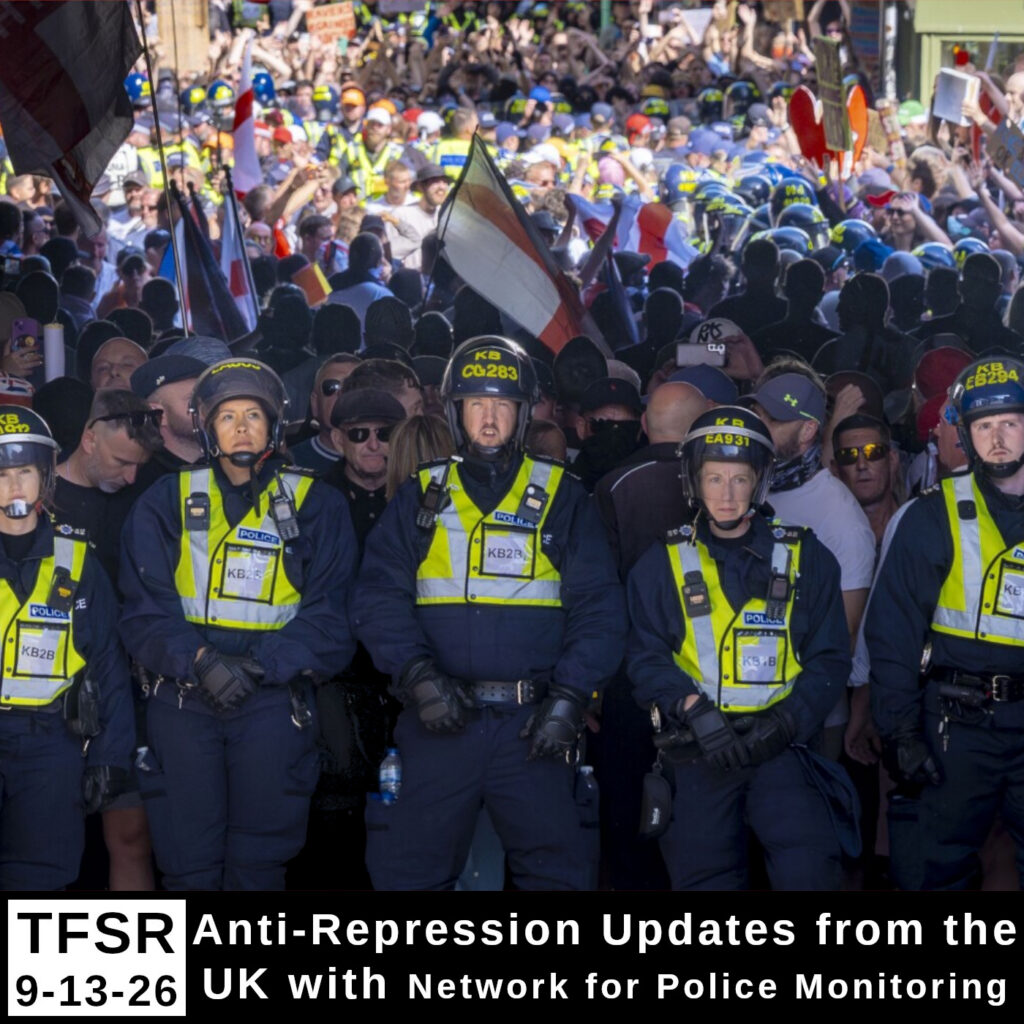
This week, we’re sharing a conversation with two anti-repression organizers in the UK who are both associated with NetPol, or the Network for Police Monitoring as well as other defendant support projects. For the chat we speak about the sort of work their orgs are involved in, changes in sentencing amongst protestors, increasingly violent police suppression of antifascists counter-demonstrating (and greatly outnumbering) anti-immigrant crowds, the Filton Palestine Action cases and more. We hope you enjoy and you can find some links in the show notes on where to find more of Maya and Andy’s work.
- Transcript
- PDF (Unimposed)
- Zine (Imposed PDF) – US-Letter size (8.5in x 11in)
- Zine (Imposed PDF) – A4 (rest of the world)
We recorded this interview several weeks ago, before Palestine Action was proscribed by the US as a Specially Designated Terrorist Entity and has had sanctions applied to it by the US State Department, so it’s notable that we can legally not suggest anyone offer material support to Palestine Action thanks to the Anti-Antifascist US government as they could be punished under US law.
- NetPol (including the ‘One Day In…’ protest reports): https://netpol.org
- Green and Black Cross: https://greenandblackcross.org/
- Freedom Press Youtube channel featuring Andy: https://www.youtube.com/watch?v0NhHF0q6c&list=PLwiOksFHbOqSHpyVrlT5FrVaov3IpoWu_
- Keep up on the Filton Cases: https://filtonactionists.com/
- Save the SpyCops Inquiry: https://ucpi.uk/
- SpyCops clearinghouse: https://www.spycops.co.uk/
- Bristol Defendant Solidarity: https://chuffed.org/project/bds
- Guardian article on the death of Nicholas Stone on demo in Bristol: https://www.theguardian.com/uk-news/2026/may/19/watchdog-investigate-death-man-after-police-contact-bristol-protest
- Our 2020 SpyCops interview: https://thefinalstrawradio.mayfirst.info/post/2020/11/29/uncovering-spy-cops-in-the-uk/
- Our 2021 interview on the Kill The Bill protests in Bristol: https://thefinalstrawradio.mayfirst.info/post/2021/10/21/support-ryan-roberts-and-killthebill-bristol-defendants/
. … . ..
Featured Track:
- TFSR by The Willows Whisper
- Beatbuster by The Willows Whisper
. … . ..
Transcription
Andy: Who wants to go first?
Maya: You go, Andy.
Andy: Okay. Evening, all. As we say in Britain Land, for other viewers, this was the opening of an old police show in Britain called Dixon of Dock Green. I’m Andy. I became an anarchist when I was a happy little student back in the 1980s. But by the time I got to about 30, I realized that I was rubbish at fighting and I was getting too slow to run away. So I got involved in legal support, initially with something called the Legal Defense and Monitoring Group that has sadly gone down the tube, but was one of the groups that helped set up Netpol in 2010. Maya will tell you all about Netpol. I’m currently involved in the Green and Black Cross, which takes its name from the Anarchist Black Cross prisoner support group from Czarist Russian days, and does a variety of legal support things, legal observers on demonstrations. We have a website, and we do Know Your Rights talks and things like that.
I’m also in the Activist Court Aid Brigade, which is a happy little acronym that also stands for “All Cats Are Beautiful,” “Always Carry a Bible,” and I leave the rest of the imagination to the viewers. We do the court support side of things, which usually is just going along, but also giving advice and occasionally being a McKenzie friend, which is someone who sits in court with people who haven’t got legal representation, and general advice to the movement on the various legal changes and updates that are constantly flowing over our heads.
I’m a he for all purposes, but I’m not particularly bothered what you call me, as I have been called by other genders, names, usually in a disparaging way, by the police. I’ll leave that to the imagination as well. That about sums me up. Although I will say that I have done various radio things with Dissident Island before doing legal updates, and currently I try to do some with Freedom Press, which is an old anarchist newspaper, now unshopped, which I used to work in. Occasionally I appear on that.
Maya: Cool, thanks. And thanks so much for having us on, Bursts. I’m Maya. I use she/her pronouns. I have been involved in legal support groups for about six years, so I’m a little bit newer to this. But I am predominantly here in the capacity of my role at Netpol. I’m the research and operations coordinator, which means I oversee our research, which is probably the most exciting bit in my opinion, and also the day-to-day running of Netpol, which is probably the least exciting bit. We are the network for police monitoring. We were initially set up, I think, in 2013, following the G20 protest in which newspaper seller Ian Tomlinson was killed by the police. Essentially, we’ve been working to document and challenge police repression ever since. We’ve grown year on year. It was my colleague Kevin Blowe who was the only paid staff member for a very long time, and we now have two other staff members, including myself.
I also have another job at a very small intermediary trust called the Article 11 Trust. We fund anti-repression work, including Netpol, and also lots of the organizations that Andy’s just mentioned, and also lots of other smaller protest rights and anti-repression projects. The legal support work that I’m involved in includes legal observing in Manchester, which is where I live, with Green and Black Cross Manchester. I’m also involved in some defendant support work with Bristol Defendant Solidarity, which is a bit of a hangover from living in Bristol. And then I also work quite closely with Great Manchester Tenants Union. Until very recently, I was on the central committee there.
TFSR: Awesome! Thank you both so much for being a part of this conversation. Andy had mentioned the McKenzie Friends, which, for listeners in the U.S. audience, our biggest audience, if they caught that, it may be a little surprising that people will go into court without legal representation, because we are constitutionally obliged to be able to have representation that’s assigned by the court if we can’t afford our own.
Andy: It’s not only that you are not entitled to it here, but there is a test for legal aid, which is both financial and what is called the “in the interest of justice” test, which basically means that your case needs to have some legal complexities that they think that an ordinary person can’t explain themselves. It usually works out that you will be eligible if you are involved in more serious offenses, but if you are down for what we call ‘summary offenses’, which I suppose best translates as misdemeanors. The distinction in English law between felonies and misdemeanors was abolished in 1967, but we have a higher level of courts, crown courts, where you’re entitled to a jury, and we have a lesser magistrates’ court system that can imprison you for up to six months. There you don’t get a jury at all, and it’s much harder to get legal aid. That’s the first of the international comparisons. We’ll probably have a few, which will surprise people as we go along.
Maya: The big thing that I focus on at Netpol as a researcher is our state of protest report, which essentially attempts to capture the last year of protest policing and trends in repression. We do these mostly because there’s very little sustained mainstream reporting on state repression, and very occasionally, you’ll get some of the most shocking incidents in the news. But then this endless cycle of shocking, miserable news moves on. There’s also a really practical problem for movements in that activists are quite often completely burnt out looking at fighting the next crisis. There isn’t necessarily the time or the capacity to document what happened six months ago. We like to think of the reports as providing a movement memory that could easily be lost otherwise, and building that narrative that can take stock of trends and look at what’s changed and identify some of those patterns that might not necessarily be caught if you’re focused on individual incidents.
I’ve been at Netpol for just over a year, so the last report was actually my first, and that was titled “How Repression Became Routine,” and that deliberately built on the first report, which was titled “This Is Repression,” essentially making the argument that lots of the trends that we saw in that first report have become very normalized and very much embedded into everyday public order policing. In terms of what I’m up to at the moment, there are lots of little responsive projects taking place, but the big thing is starting to think about what the huge amount of evidence that we’ve collected over the past year means, and what those different cases tell us about where repression is going next. Spoiler: it’s going nowhere.
TFSR: Quick follow-up on that: is the lack of reporting on incidents of police violence simply a culture of the media in the U.K.? I am sure there are class values or whatever by who owns the media and what have you, and their professional relationships with the state authorities. But how much of that is influenced by the libel laws in the U.K. and the ability to report instances of violence that haven’t gone before a court, or being afraid of being pulled before a court for the claims?
Maya: Quite a lot of the time, the incidents could be reported without moving into that territory. It’s probably a combination of that, and as you said, the interests in terms of the ownership of media, and also, like I said, just the news cycle that means that things are very quickly brushed over.
Andy: It’s again the legal differences. Libel law in Britain was terrible for a long time. You got shut up for making all manner of accusations that were completely true. Under the old criminal libel system, you could actually be convicted of criminal offenses of libeling people with true things about them. Fortunately, since 2013, under the Defamation Act, things are now much better. But we do not have the level of protection that you have in the First Amendment for free speech. We have an incorporated law from the European Convention of Human Rights; Article 10 guarantees freedom of expression, but it is not as robust. We do have what’s called a strict liability rule, contempt of court, where reporting on any case in which proceedings are active, basically from the point someone is arrested, through to about a year after their conviction, unless there’s an ongoing appeal. If anything you do prejudices the case in that period, you can be beat up [UK slang for a disingenuous, media-driven outcry – Editor]. Now, of course, that does not prevent government ministers and indeed the last prime minister, Starmer, literally saying that the suspects probably did it or were dangerous because they seem to be totally immune to the law as it stands. I always remember from the American example of Charles Manson trying to hold up the newspaper in which Nixon said he was guilty in court to try and get the trial abandoned, but it didn’t work very well for him. And probably for the best.
TFSR: So that’s probably what caught Tommy Ten-Names, when Tommy Robinson was speaking about some of the court proceedings that were ongoing at the time and “reporting” about what was going on. He was pulled under what you’re referencing right now.
Andy: Yeah, he did. It’s quite a complicated case that gets shuffled around a lot, but he was incredibly blatantly breaking.
Maya: Just to come in on that really quickly, the other obstacle that we sometimes face when talking about these things publicly is that in cases of the more serious instance of police violence, you might have people undertaking civil cases against the police, and in those cases, lots of people are very hesitant about speaking about their experience publicly because of how that might prejudice cases.
TFSR: Thank you. Andy, did you want to talk about some of the other or more in-depth work that you’re doing, or do you feel good about where we’re at?
Andy: I hope that people get the general gist, but perhaps you did prompt me on one thing. It’s the lack of automatic legal representation, and even when you’ve got it (because it’s publicly funded for most people, at least most of our clients) the amount of time that the lawyers can put into the case is very limited. An enormous amount of what we do is the background stuff. That includes the explaining what’s happening to the family and friends in the courtroom, the taking the late night phone calls when people are worried about it and they thought they haven’t done this, and talking them through what it’s like to be a witness, what the court setup is – all the practicalities that the lawyers are simply not got the time to do. It is different because most lawyers have never been arrested. Some of them have, and some of them, as we’ll come to shortly, may be going a little worse in that respect. It’s always much more helpful if people are being supported by someone who has been through that process themselves and knows what being on the bad end of the truncheon really involves.
TFSR: As I’ve said before, being that the show is mostly speaking to and responding to questions of movement and repression in the U.S., we kind of ignore things that go on elsewhere. But having anattention towards more internationalism in our struggles and solidarity, and to learn as our adversaries do from movement in other national contexts. I was hoping to speak with you all and get updates about a handful of subjects in the context of the so-called U.K.
First up, in 2021, the U.K. Parliament debated and passed the Police Crime Sentencing and Courts Bill, aka the Bill, in the midst of huge demonstrations across the country against the Bill, and following outrage over the police murder of Sarah Everard, and only a year after massive worldwide anti-police murder demonstrations and uprisings in 2020. The law passed, many demonstrators were arrested, and some were sentenced to years in prison. I wonder if someone could speak a bit about the context, the Everard case, the impacts of the bill, and where those prisoners are at—very small topic, very simple to address.
Andy: Every few years there’s a new horrible bill with more policing powers. The expression “kill the bill,” which was the highlight of the show, has been used multiple times before. The first big one I was involved in was the Criminal Justice Bill that eventually became the Criminal Justice and Public Order Act 1994. These things happen, and there are a variety of changes that were brought in, particularly into the conditions that the police can impose on demonstrations.
Most of them were first introduced in the Public Order Act of 1936 to deal with Mosley and his Blackshirts. They got largely codified and expanded in the Public Order Act of 1986, and then the PCSC, and then a new Public Order Act in 2023 did even more damage. We’ve been a bit through the courts as some of the things have been ruled unlawful by the courts because they were brought in by the government in a sneaky way to avoid proper scrutiny by Parliament, but they have been brought in a new Crime and Policing Act this year.
Forgive me if I sound slightly jaded on the new legislation one, because there’s always new legislation. One difference is that we still have quite a large amount of old legislation. People are still being arrested in this country for causing a breach of the peace, and the courts can deal with them under the Justices of the Peace Act of 1361. We’ve had one little victory this year in which finally the Vagrancy Act of 1821 has been repealed, which allowed the police to simply arrest people for not having a house, or for begging, or for doing anything basically that felt like it.
What the Police Crime Sentencing and Courts Act, as it is now, really did provoke was that it had a popular resonance; people felt that it was really going to infringe. A lot of awful rumors went about that all protests would be basically banned about it, because no one has the patience to read – except for us, eh, Maya – all the blooming legislation in its fine detail. A lot of our work is to stop myths and rumors, ‘campfire law’, as we call it outside, or ‘pub law’ if you spend too much time drinking in bars. What came out of that is protest, of which the biggest and one with the most bad consequences was the one in Bristol, which- if Maya goes now…
Maya: Yeah, I see this period as my entry into this sort of work. I had a family member who was a Kill the Bill defendant, and it’s also around the time that I started doing defendant support work. I’d always had quite abolitionist politics before then, but I feel like this was my real entry into the more hands-on work. It’s interesting because I do end up coming back to this period all the time in my work, and it does feel seminal in terms of consolidating police power. Although, as Andy says, lots of the legislation is much, much longer standing. Whether that’s Thatcherite restrictions on movement and protest, the war on terror, or much earlier, but it feels since then this slippery slope that we’ve been on has felt a bit steeper.
What we saw was protests threatening these deeply embedded power structures, whether they were racism, misogyny, or state power – you’re you’re seeing this legislation emerge in the context of, as you said, Bursts, the Black Lives Matter movement, the women’s justice movement that emerged around Sarah Everard. People en masse were confronting that structural inequality, and they were demanding accountability. That meant that the police were not only in this oppositional role of managing, suppressing protest, but they were also its target. Then this bill was drafted in response to the size and threat of these movements, and of course people mobilized against that. It was a very unique context in the sense that it took place mid-COVID, and there were these emergency regulations in place that granted the police more broad powers than ever really to restrict assembly. Within these powers, you saw huge levels of discretion which allowed the police to essentially act as both lawmakers and law enforcers and choose when they deemed extremely violent, punitive, I would go as far as to say cruel policing, to have been appropriate. There was this automatic justification in place for the actions, regardless of how disproportionate they were because of this threat of COVID.
I was at quite a lot of those protests in Bristol, and I remember the Monday after the big demonstration, which took place on March 21 on the Saturday, and that all kicked off outside Bridewell Police Station. On the Monday, we’d gathered on College Green in Bristol, and we’d had this sit-down demonstration specifically against the anti-traveler parts of the bill, the restricted movement, because that was another big element, as well as protest restrictions. Honestly, the violence was unbelievable. I saw people being smashed in the face with the sharp edge of shields, tents with people’s belongings being set on fire, male police officers tearing off women protesters’ clothes. And this was against a group of protesters who were on the floor singing. It felt like there was no way there wasn’t punishment for what had happened at Bridewell a couple of days before. I think you have this toxic mix of discretionary powers, ambiguous lockdown regulations, and this sense of political impunity that was spurred on by the police having been able to get away with extremely violent policing. This meant that they were essentially allowed to treat all protests as illegal.
In terms of the trial itself, there is so much I could say, but everything about it was awful. Of course, we know this political label of riot was applied to lots of the Kill the Bill defendants. People were handed down these shocking sentences to make examples of them. People were tried individually, so they didn’t have the chance to provide this collective defense or justify their reasons for protesting. That also had a huge psychological impact on a lot of people. It made lots of predominantly young people, lots of inexperienced protesters, feel very alone. Of course, we still have people who are serving sentences for that Saturday. The longest sentence handed down was 14 years, and countless people will likely feel the impacts of this for the rest of their lives.
That’s without even going into the media cover-ups, the parliamentary inquiry that had no teeth. Some of the things that were included in the police witness statements, I see now both the bill and its impact, and especially the impact that it’s had on some of those people that fought against it, as very central to a lot of our work now.
TFSR: Andy, do you have any additions as well to that response?
Andy: A little bit on the law side. In England, we do not have by any means as many people in jail as in the States. Sentencing is much less. But the Bristol one was a big shock to those of us who’ve been involved in protest stuff for a long while. Riots in English law are a specific offense, and they are very, very rare. For one reason, there was something called the Riot Damages Act of 1886 that said that if there had been a riot, it must be the fault of the police for allowing it to happen, and that businesses and people whose property was damaged could claim compensation from the police. It’s been updated to the Riot Compensation Act since. And that put off the Crown Prosecution Service, which is the federal prosecutor, from charging riot in the vast majority of cases. Even really big, famous riots, the Poll Tax Riots in 1990, had a handful of riot cases. Most things were charged as violent disorder, which has half the maximum sentence that riot does. So that was a shocker, and typically people were getting things in the range of around five years for riots.
Riot might sound quite bad, but you don’t actually have to hurt anyone or damage anything. You’ve got to make a person of reasonable firmness fear for their safety, and there be at least 12 of you. If you actually do anything – and the 14-year one was for “arson with intent to endanger life,” which consisted of setting fire basically to a piece of cardboard – then you can see that the police violence was very excessive. You can have a look at the videos on site. In terms of it being a riot from the point of view of the people protesting, it really isn’t. There is just not what you would expect when you hear the word riot, i.e., people pelting the police with heavy rubble and bricks and so forth. It’s just not there. Maya brought up what we call “blading,” which is the use of riot shields to hit people with the edge thereof, which can be done in a number of ways. But if you imagine sticking out your left arm, if you’re right-handed, the police shield will be on your left arm, and it will roughly sit above the arm, and point that towards someone’s face, and imagine that an average police officer is slightly taller than your average protester. You’ll see that the edge of the shield will go right about where between your mouth and the bridge of your nose. Occasionally, if you’re short, your eyes, and if a cop sticks out their shield like that, it will whack you right in the teeth, your nose, your face. I’ve been very lucky to avoid that over the years. But I’ve seen people who’ve done it, and it is not nice.
TFSR: Maya, thank you so much for sharing your experience. I forgot to say, but I really appreciate that. We can point people towards the individual ongoing prisoners’ support sites after in the notes to the show, unless you have any groups that are doing that support work in particular. I know there’s an ABC in Bristol. I don’t know how active they are these days. I had spoken to a couple of their members as the convictions were rolling through back in 2021 or 2022.
Maya: There is a Bristol Defendant Solidarity-organized crowdfunder which goes towards the work of BDS and ABC. I’ll share that link with you afterward.
TFSR: Oh, that’s the BDS that you were referencing. I thought that might be Boycott, Divest, Sanctions.
Many listeners will be aware of the protests by Palestine Action and repression of activists accused of not only partaking in sabotage in solidarity with the Palestinian people, but also those just claiming support of Palestine Action. “In May, four activists were accused of sabotage against an Elbit factory in Bristol in 2024, and known as the Filton 4.” So it wasn’t that they were handed down sentencing?
Maya: They’re being tried in groups. Some of them have been sentenced, but quite a few of the trials are still ongoing or yet to start.
TFSR: Okay, but there was a case where the judge didn’t inform the jury. The jury wasn’t informed that there was a possibility of a terrorist connection relating to the Sentencing Act of 2020 that could be applied towards the sentences of the people, which is a huge enhancement in the possible sentences that they could receive. Right?
Andy: Okay. Here’s the boring bit. This is again slightly different from the position in the States. When there is a jury trial in this country; the jury has no role in what sentence someone gets. So they can’t even recommend a sentence, as happens in some cases. If they ask during a trial, then the judge will simply say “That’s not your concern. I follow the rules on sentencing. There is sentencing guidance counsel, and each offense has a maximum penalty.” Then it is up to the judge to work out what you should get if you are convicted. If you don’t like that, you can try to appeal to the courts of appeal, which will usually turn you down. But very occasionally, you may get some reduction. So, for all cases, this creates a bit of a strange situation. Sometimes a jury will know what you’re going to get if you are convicted by their own general knowledge. If you are tried for murder in this country, you will get a sentence of life imprisonment. How long you actually serve of that is up for question. But everyone on a jury will know that will be the sentence. For the Filton case, by the way, there are four trials. We have had one, which we’re going to talk about. There is one currently; the jury is out deliberating. By the time people hear this, it will either be good news or bad. There are two more: one in September, and one next year. Really stringing it out; everything is massively delayed.
Sometimes people will have an idea about how long people are likely to get from what they have heard. Strangely enough, in this country, lawyers can be called up for jury service, which is bizarre. In fact, judges can. Lord Wolf, when he was Lord Chief Justice, sat on a jury. Bizarre; it makes no sense. But we presume that jurors in general will not have read through the Sentencing Act of 2020 that consolidated previous laws, including what was in the Counterterrorism Act of 2008, and has later been amended by the Counterterrorism Act of 2021, which makes special provisions for terrorist offenses and offenses which have a terrorist connection. There is specific offenses of committing acts of terrorism, a variety of them, that include holding up placards, for example, showing support for terrorist groups, which we’ll come to a bit later, but also any other offense that carries a two-year prison sentence or more – which is most things except for dropping litter, shoplifting would count, and in this case, criminal damage is the one that does count – Can be found to have a terrorist connection by the judge. The judge decides that after they’ve had the verdict.
In the Filton case, we had a good idea that the judge was considering it because they said so in the run-up to the trial, but the jury weren’t told. The jury would have presumably been under the impression that if they were convicting the people, and one person was convicted of causing grievous bodily harm, that was a far more serious thing than the criminal damage, and it wasn’t. That is what everyone is so upset about: we honestly believe, and there is a rule in this country under the Juries Act 1974, section 20C, that you aren’t allowed to discuss the deliberations that a jury makes. They can’t tell us; they would be in trouble themselves if they talked about it. But everyone presumes that they thought, “Yeah, well, they did damage it, and they’re going to get a slap on the wrist, and they probably should be doing some community service, painting fences or something to make up for it.” They’re a bit surprised they all got six years in jail plus.
The good news is that now a huge amount more people know about it. For the follow-up trials and future trials, hopefully juries will be thinking about that because the upside of juries not being told or having any influence over sentence is that they do not have to explain why they acquit or convict. They simply return a verdict, stand up, and say guilty or not guilty. Don’t even pass a note to the judge in this country. This is very boring. We’re hoping that the backlash from that will make people think, and this is one of the things that, if we take Maya’s political life as a timescale here, six years ago there was a case that went to the Court of Appeal of people who’d been jailed for sitting on trucks for a couple of days, trying to stop a fracking development. They were sent to jail for 15 months. The Court of Appeal, and then Lord Chief Justice – we have good old-fashioned titles for our top judges; we even have a Master of the Rolls and Attorney General. What would you have?
TFSR: We have the Attorney General. It’s not that special. But Master of the Rolls, that sounds, yeah, the highest baking position you can get.
Andy: Government official here as well. The Lord Chief Justice, Lord Burnet, turned around and said, “Oh, this Britain.” Paraphrase his judgment a little here. “They should have got a suspended sentence, but since they’ve spent a month or so in prison, I’ll give them a conditional discharge. They can go.” And we thought, “Oh, this is good.” A year later, he had a wonderful defendant called James Brown up for climbing on a plane in a climate protest. That person, by then, he was getting a bit fed up with protests because there was a big expansion in Extinction Rebellion and a lot of climate things, and he got six months, and we said, “Oh, that’s terrible! He hasn’t actually hurt anyone. He’s done a non-violent protest, and he’s gone to jail.”
A few years later, we got a new Lord Chief Justice, Lady Carr. She had a climate-related protest of people who had tried to block a motorway, but didn’t get round to doing it. They got four years. She did also have two people who threw soup over a painting. One of them got two years, and she said that was fine. So there has been incredible inflation over those six years, and we are now at the six years plus an extra year on supervision for the people from the Filton case. Currently in this country we’re having a big row about parole, because in the reverse of the American situation with truth-in-sentencing laws, what has been happening here by governments for many years is that they’ve been scoring political points by increasing sentences and then giving people more time of the sentence on parole to ease the overcrowding problem that they’ve been creating the same way.
The terrorism connection sentences, they are still limited to the maximum set by Parliament for the offense (in the case of criminal damage, it’s 10 years). The amount of time that you serve would be half for a normal case. About to be reduced to a third if the government makes up its mind over the Sentencing Act, and the new prime minister is suffering a wave of right-wing outrage about that at the moment. But we would have expected, and we still expect, that those would have been reduced to a third. If the case has a terrorism connection, they automatically serve two-thirds, and they only get out if they can persuade the parole board that they’re no longer terrorists. That will be easy because they’re not terrorists, but they’ve got to persuade the parole board that they’ve actually given up terrorism, which means support for any violent action, and violent includes damage to property. They will have to absolutely renounce even the prospect that they would support painting things, and that is going to be incredibly hard to do, because they are committed, genuine people, not good liars like your average, honest crook, who’s been trained all their life to lie to the parole board in order to get out. They are hoisted by their own petard, another English phrase, because of their honesty and moral principles. Sorry, that was a bit of a long one.
TFSR: No, that’s great. So, is the terrorism in this instance the prescription of Palestine Action? Is it not saying you are acting on behalf of Hamas or something like that?
Andy: Totally unconnected to the prescription, although obviously it would seem to make sense that if it’s a proscribed terrorist group that there’s a terrorist connection. But no, the provisions which are now in the new Schedule 13 of the Sentencing Act, inserted by Schedule 6 of the Counterterrorism Blah Blah Blah Act, just say that the judge can define something as having a terrorist connection if there is a use of violence, including violence against property, that has an ideological cause to it. Palestine Action was not proscribed when the Filton event happened, so that they would be in the clear from that anyway. But it can be applied to a lot of things, and there is another paint case of people painting Barclays Bank, where the judge is currently considering whether there’s going to be a terrorist connection. And that is wholly criminal damage for all the defendants in it, and we’re waiting to see what will come of it. It’s been a big shock, and lots of people are rightly outraged that they don’t seem to be told what’s actually happening here. Because although in a technical sense the jury wasn’t deceived, the public weren’t deceived, the laws were all there before the Filton thing happened. Just no one expected it to happen to what are essentially peaceful protesters.
TFSR: While we’re on this point of prescription, can you all talk about where the status is with the proscription of Palestine Action? Because it sounded earlier in the year there was a challenge that was being brought to the prescription, and then that was reversed. But there’s an opportunity for a legal reply or a challenge to that. Could you explain that really briefly?
Andy: Okay, we won in the High Court. We’ve lost in the Court of Appeal, and we’re now going to the Supreme Court. We’ve got a rubbish Supreme Court compared to yours in terms of its powers, and it used to be part of the House of Lords, but got hived off in 2006. But it is similar. There are 12 judges. We will get a very big panel. It’s not always 12 who sit. The appeal was refused by Lady Carr, the Lord Chief Justice, but the Supreme Court is hearing it anyway. That should be a good sign, but it may be that they just want to be on telly because it’s a televised hearing, and you’ll get to watch them join themselves, and it’s a big flourish. Lord Reed, who is the president of the Supreme Court, retires in January. Probably wants to go out with a flourish. It’s going to be heard sometime in the Michaelmas term, September to December. Judgments usually follow a month or two after the actual hearing because they are old and working hard writing it up is a pain. That’s roughly where we are. Fingers crossed, but I’m not that hopeful. Let’s see if Maya’s more positive.
Maya: No, I don’t feel particularly positive about it. It’s part of this wider tactic that’s been employed by the British state of painting protest movements as dangerous, so that it’s easier to suppress them. When I was undertaking my research for the state protest report last year, lots and lots of activists spoke about the government’s intent to make the general public feel wary of activists and protest groups, so that public order powers paint this line of safety between the public and protesters.
But again, this isn’t new. We’ve had these foundations in place for a really long time, particularly when it comes to the Islamophobic construction of who constitutes a terrorist in British law and politics. It’s no surprise really that it’s the Palestine movement that’s been the target of this creep of counterterrorism powers into public order policing. We’ve long seen Muslim identity and movements visibly involve Black and Brown people painted as ideological threats. And that’s been really clear in some of the racialized language that’s been used around the Palestine solidarity movement in terms of the security element, foreign influence, loyalty, un-Britishness. I think we’ve seen it codified into law over the past year, and I do think it’s paved the way. As Andy said, it has been so far, but I don’t think the future means that it’s necessarily Palestine Action-affiliated direct actionists who are to be treated as terrorists. It’s paved the way for anyone taking direct action, especially in solidarity with Palestinians, to be treated as such.
We’ve had some really interesting, concerning developments in terms of how the state has interacted with the judiciary. We’ve obviously had the Palestine Action prescription imposed by the Home Office, but then this cloak over some of the legal proceedings. There was a thing called a closed material procedure that was used for part of the judicial review, where essentially security concerns meant that neither the claimant nor her legal team were able to see the evidence that was presented against them. Another really prolific and recent example is the case of Rajiv Menon, who’s a barrister facing contempt of court for his closing speech while defending one of the Thornton 24 activists, which essentially just reminded the jury of their right to acquit on conscience. It’s lots of really concerning things.
Andy: Unless Maya has anything later, his case is on pause as he is appealing the decision to prosecute him, which is again a bit complicated. He now has two kings’ counsel, as they are called, representing him at the court of appeal to try and get him off making a speech in the courts. If they get prosecuted as well, we’re really in indeed. But it’s created a huge amount of worry in the legal profession, particularly amongst criminal defense lawyers and anyone representing a protester, because if you say something that the judge doesn’t like and you get prosecuted yourself, that’s going to make them rein in what they say. But as far as I know, we don’t have a date for the court of appeal hearing on Rajiv yet. To flag up, before he was a lawyer, he was in the Newham monitoring project with Kevin Blow, and that was one of the groups that helped set up Netpol. We’re a little biased in his favor, but we’d be supporting any barrister who was under threat of being sent to jail for a speech they made. It’s unlikely, but in theory he could get two years in jail, plus it will be career-ending.
TFSR: And quite chilling for other people in that same line.
Andy: Absolutely.
TFSR: Across the U.K., there have been a growing number of demonstrations to counter anti-immigrant xenophobes, like Britain First. August 8, there was an anti-immigrant demo called for in Brighton that anti-racists were trying to organize a counter to. This has happened by the time this chat is recorded. Netpol’s been reporting on police violence against anti-racists and anti-fascists, as well as the coddling by police of Britain First and other chuds, notably in Manchester and Bristol. Could you all talk a bit about the reporting of Netpol around these instances? What public conflicts say about the current political temperature in the U.K. and what the police have been doing?
Maya: First, really quickly on the planned demo on August 8. There was a Brighton big far-right demonstration and counterprotest planned. I’m not sure whether that was canceled. I’m not sure whether that was the one on August 8. But we also, on August 8, had a big far-right and then anti-fascist mobilization in Bristol, just for context.
Thank you, Burst, for talking about this. For your U.S. audience, the important context is that we’ve seen this growing far-right and anti-migrant presence in the U.K. over the past couple of years. Quite often these protests will take a few different forms. We have very regular, smaller demos, which are often outside hotels, which are homing asylum seekers and refugees, and then we have these much larger mobilizations by groups like Britain First, but also national far-right and anti-migrant groups. Then we’ve seen some really serious attacks at some of these protests. The racist attacks that took place in Belfast, for example, but also a couple of years ago we saw some of those hotels set on fire. We’ve seen other places attacked, mosques attacked, etc. Then, of course, in response, we’ve had anti-fascist mobilizations. In terms of our work at Netpol, it became very clear towards the end of last year that ever-increasing resources were just being poured into policing anti-fascist groups, putting them under surveillance, etc.
For example, the new masking powers that we’ve seen come in under the Crime and Policing Act, which Andy mentioned, have been used in this space. So, the only two times that they’ve been used so far are in this context. We’ve also seen this particular sequence of police powers that we’re calling the “Bristol dance” because it was seen first very clearly in Bristol, and we’ve only really seen that used against anti-fascist mobilizations. Alongside the expansion or more frequent use of some of these powers, we’re also seeing the really high levels of violence against anti-fascist protesters, and that’s where our reporting comes in, really.
We’ve produced a series of three reports. They look at different protests in different cities, and they aren’t all specifically about anti-fascist policing per se. Two of them are, but one of them looks at a pro-Palestine mobilization in Edgware in London. But they do show very similar patterns. We produced all of these alongside local legal support groups, or police monitoring groups, or movement groups in the case of Edgware. So they’re very much rooted in the experiences of people who were there. For example, I was legally observing at the Manchester protest.
The first report that we looked at was a Britain First mobilization in Manchester. This is the second time that Britain First had marched in Manchester this year. The first demonstration was in February, and that also involved some pretty serious police violence. I won’t go into too much detail because I think this person is taking [a legal challenge] forward. But there were very life-changing injuries as a result of police violence.
At the second demonstration, we essentially saw the police use whatever force they had at hand to keep anti-fascists from obstructing the Britain First march. Essentially, you had Manchester residents who had attempted to march against racist thugs in our city brutalized at the hands of the police. Then, when we were keeping it out of media coverage over the next few days, unsurprisingly, of course, it just didn’t represent any of that. The political response was basically non-existent, so we decided that at the very least we should collect testimonies of participants and evidence and create a record of what actually happened. While I was writing the report, it was about two months later, the great Israeli real estate protest happened. Essentially, selling off Palestinian land. And you had a big anti-Zionist mobilization who were subject to racist, anti-Arab, anti-Semitic, misogynistic abuse and physical attacks by Zionist attendees of the conference and auditors and agitators, etc., while the police just watched on.
A couple of days later, we then saw this carnival against fascism take place in Brighton. It was this big anti-fascist mobilization against a local far-right group called the Southeast Patriots, and again, very very similar to Manchester. We saw the police use all and any methods of force at their disposal in an attempt to clear 4,000 anti-fascist protesters in order to escort 300 far-right demonstrators through Brighton City Center. I do think in any of these protests, it’s completely conceivable that people could have died. We saw a crush in Brighton, and you had even police officers passing out in this crush. We saw these really similar themes in Brighton and Manchester of pepper spray deployed indiscriminately. We saw the use of kettles to trap people and then inflict violence upon them, gendered violence, violence against disabled people, people denied access to medical support after being subject to pretty horrific police violence. I don’t think we saw any examples of people actually being given a chance to respond to orders. There was no clear escalation before force was used. We even saw things like police officers fabricating violence from protesters. We had one testimony that spoke about a police officer saying something, “No, don’t hit me,” before punching a protester, obviously for their body cam.
We saw three of those protests, but really it’s reflective of something much broader about the political environment that surrounds protests in the U.K. at the moment. The way that all protests have been treated is dangerous and violent, and something that needs to be controlled or managed; the concept of violence itself has been stretched to include any protest, which means that the space for acceptable protest is essentially non-existent. So there’s this equivalence suggested between far-right attacks on migrant hotels, for example, and anti-fascists standing in solidarity with the targets of those attacks. This idea that “they’re all bad, both sides” arguments, and once you make that equivalence, violent policing of anti-fascists becomes much easier to justify. It feels particularly concerning because the police are increasingly taking this violent approach in an environment where there are basically no effective accountability mechanisms.
Even at the protests themselves, we saw huge numbers of police not wearing identification. We saw lots of people who were going through official complaints processes be asked fo photo ID. Part of the reason that we wanted to report on this was to counter that lack of accountability and the silence that so often follows these events.
The political impact has been quite limited. In the Manchester report, we concluded with a few demands, and one of them was for a genuinely independent community-led inquiry. We went to this meeting with Kate Green, who’s the deputy mayor in Manchester and oversees Greater Manchester Police, along with a local police monitoring group called the Northern Police Monitoring Project. In this conversation about an inquiry, we were told that anything, including the terms of reference, etc., if it was to happen, it would sit with her. It feels very difficult to accept as genuinely independent when we know that many members of our community have as little trust in the mayor’s office as they do in the police. And also that we have lots of incredibly capable researchers and journalists and organizers, etc. already within our movements. We have had the Brighton report picked up by the UN High Commissioner for Human Rights’s office. We’ll see where that goes. We’ve raised the profile of these incidents in the media. But ultimately the launches were the key part of this. Meaningful change has always come from us. So being able to say to people who were subject to violence that we’ve heard you, we’ve recorded what’s happened, we believe that your experiences matter, they aren’t going to be forgotten – that’s a really important part of the work.
I would encourage listeners to read them because there’s no way that I can capture everything that’s in there. I also just wanted to say it’s important to stress that there was a lot of police violence, but despite that, anti-fascist movements are still massively outnumbering far-right mobilizations, by over 10 times in Brighton. So even in the face of this really brutal policing, there are still huge numbers of people organizing against the far right and doing this successfully. It’s crucial that we hold on to that.
TFSR: That feels very important. Also, just to say, not only for people to be able to read their experience and record it somewhere where it can maybe be brought up later, but for other people who weren’t present and are only witnesses to the media narratives or government narratives about what happened, to be able to see documentation and to promote an alternative counterpower, counternarrative from below is super useful. Sorry to cut you off, Andy.
Andy: No, I was going to ask if you had kettles.
TFSR: They’re illegal in some places, as I understand, but they just don’t call them kettles. That’s another import from the U.K. I started hearing them getting called kettles around the beginning of the Iraq War in 2003. Before that, I don’t know what terms were used, but that’s yeah. Well, we got kettles.
Andy: You’re aware of the German origin? It comes from “Kessel,” which was a Wehrmacht term for an encirclement, from the German word for cauldron. It got adopted by the British police and anglicized as kettle, which has a strange far-right connection. We have had problems with fascists in this country for some years, going back to the Battle of Cable Street that people can pick up. But the revival in the last few years has been frightening. When I was growing up and becoming politically active in the 70s through to the 90s, we were winning the street fight with the far right. They were becoming progressively smaller and outnumbered, and eventually they basically faded away. The sudden revival is really alarming because, in a way, the media is not really picking up on the fascist threat that this is. If there is one good thing about British historical traditions, it is a willingness to stand up to fascism. That is something that we try to draw on, and in cases where there have been trials, I do recall a certain barrister by the name of Menon mentioning an anti-fascist case, “But they were fascists. No wonder they got beaten up.”
The success of British policing in “containment,” as they officially call kettling, is extremely clever, because as opposed to most of our European neighbors, where you tear gas, you water cannon, and you chase people, they found that people were getting excited and by that, whereas putting them in a kettle and leaving them there, I believe that the record stands at around eight and a half hours for when the student protests in 2010 on a cold December night in London.
TFSR: With no bathrooms or water, I’m sure.
Andy: Yeah, it really does put people off in a way that even horrible injuries sometimes [don’t]. It’s hard to get over to people how dispiriting that can be for individuals and the movement. It’s to people’s incredible credit that they’re willing to go out and take those risks because the risks are high. And we’ll come to the particular case of someone who died on a demo quite recently in a moment. But deaths on demos in Britain are rare; they have happened in the past, but they are ones that we could probably name off the top of our head: Ian Tomlinson in the G20, and then you would be going back to the 70s of Kevin Gately in Red Lion Square or Southall, that actually skips my mind. Might come to me later.
Things are very dangerous at the moment because the far right are emboldened, and the police are incredibly hyper, in my view. You are seeing levels of violence from police towards people who are basically peaceful that they used to only use when people were really fighting back. That is incredibly risky because, without meaning to trivialize it, young, healthy people who’ve gone there willing to confront the police or fascists are in a far better position to get away or look after themselves than people who are basically of a peaceful nature, who want to show their opposition to fascism, go to what they think is going to be a peaceful petition, and then the police just lay into them. That is going to lead to a far higher risk than we have seen in the past.
TFSR: That’s heartening that you’re getting responses of 10:1 anti-fascist showups for fascist demos. That outnumbering is heartening. To what you mention, a friend had pointed me to the case of Nicholas Stone, a retired NHS worker. He’s listed as having been 65, and he had died after being cordoned off by police at a demonstration against the so-called Bristol Patriots in January of this year. I wonder if you all can talk about what’s known in this case and any role that Netpol might be playing in seeking justice for his family.
Andy: As they say, there is an inquiry by the wonderfully named Independent Office of Police Complaints that took over from the Independent Police Complaints Commission when they weren’t independent enough, which replaced the Police Complaints Commission, which wasn’t independent at all. Before that, there was a Police Complaints Board. Every few years, they change them when people have worked out they’re rubbish, and they get a new title, and they continue to be rubbish because they are entirely staffed by ex-cops who enjoy investigating themselves. We are aware that the family is represented by the solicitors’ firm of Bernburg Pierce, who people might have come across because the Pierce is Gareth Pierce, famous for the Birmingham 6 case, and got the exciting film about her. She turned up to one of our defendants’ meetings recently, well into her 80s, and still doing stuff. That’s heartening to see.
TFSR: Is that the In the Name of the Father movie? Is that right. Yeah, okay.
Andy: With these things, you just have to hope that the family and friends have all the support that they can. But it is an incredibly uphill process to squeeze any form of justice out of the British state. And even if you get inquiries, they are absolutely set up to kick things into the longest grass you have ever seen, that are high as an elephant’s eye, to quote Oklahoma. We will come into that when we get to the undercover policing. But even when it doesn’t look like you’re succeeding on the official level, it’s the pressure that we can exert, and getting people to change that, that’s the real result that we can hope for from people putting in complaints and asking for inquiries and keeping it in the public mind.
TFSR: Yeah, shifting to the aforementioned inquiry. In 2020, I spoke with Donal O’Driscoll of the Undercover Research Group, who is working to spread information about the spycops scandal, an ongoing government inquiry into undercover police abuses of power and infiltration of political movements since the 1960s in the U.K. It may not be your wheelhouse, but I wonder if you all have any insights into what’s been learned, the limitations of the inquiry, and where folks can learn more. There will be links again in the show notes to some of those projects in the podcast.
Maya: Sure, I’m happy to talk a bit about this. I actually had a catch-up with a member of Netpol’s operations group the other day, who’s a participant in the undercover policing inquiry. Not Donal, but he is also a member of our operations group. I can relay a little bit about what was said then. But I just wanted to start by saying that the inquiry is currently under threat. Just as the last hearing was drawing to a close in the last two weeks of it, the Home Office launched a consultation on the inquiry. They’ve asked all participants to respond to that. The participant that I spoke to yesterday described this as a trap. So, the consultation essentially proposes changes to the terms of reference, which would limit it. There’s some suggestion of making it a non-statutory inquiry, but essentially there are no options in the consultation that wouldn’t give the Home Office data that would empower them to limit it.
There are so many things that have come out of the inquiry that wouldn’t have been accessible if the terms of reference had changed in the way that the Home Office has consulted on it changing; likewise, if it wasn’t a statutory inquiry, it wouldn’t have the same teeth. The participants have all refused to respond to the consultation, and there’s now a campaign running. You can send a letter to the Home Office to let them know that you oppose the inquiry in its current form being scrapped or severely limited. That’s ucpi.uk; we’ll also include that in the links at the bottom. But UCPI for Undercover Policing Inquiry. The deadline for that is September 20. Anyone’s welcome to send a general letter, and there’s a template on there. Of course, if anyone listening is more involved or has a personal stake, then they’re being encouraged to send a more bespoke email.
There’s also something to be said about this coming at a time where the last hearing has just closed and the participants involved are exhausted and traumatized. This just gives them another thing to have to fight in their pursuit of justice.
On the other aspects of your question, the learnings just really talk to why this is so important, and it really has just uncovered the extent of political policing. We knew lots of this, and lots of people had suspicions, but I don’t think there was the understanding of the range of groups that were being spied on. From that, you can infer which groups or causes or interests are deemed as threats to the state. Lots of these groups were essentially policed out of existence. We saw this real direct intent to disrupt political organizing. One of the Special Branch commanders involved said that their understanding of the operation was to disrupt from within. We’ve learned how far lots of the police were willing to go to protect themselves, whether that was straight up corruption or criminal actions of the police themselves. We have had confirmation that they use bail conditions as protest bans, which is obviously directly in contravention of Article 11 rights.
Because of the inquiry, we know the depths that the state went to deceive them. There’s obviously the high-profile element of the deceitful long-term sexual relationships, but other things that we have uncovered by this are the trickery used by the state. Lists of people that were to be surveyed or watched by FIT teams, which were Forward Intelligence Teams (the surveillance teams essentially used to monitor protests, but quite often acted undercover). They quite often included people that they didn’t think were very close to organizing, so that if anyone was to uncover what they were looking into, they’d think they weren’t very good at their job, or they didn’t have the correct intelligence.
We’ve spoken a little bit about this already, but this policing created the language of threat, which justified everything that they were doing. That’s very much the position that we’re in now in terms of protests being framed as a threat. It’s essential that this inquiry is allowed to be followed through. But that’s not to say that it hasn’t had limitations as well. Lots of the live hearings were rushed. Some of the really crucial participants haven’t been able to be heard. One example is Dave Smith, who was a construction worker and a trade unionist; he was spied on. This undercover unit that was looking into him and other trade unionists created this blacklist of union activists who were then denied jobs, and he lost his bid to appear at the inquiry.
There are loads of questions that the participants haven’t been able to ask. And then we also have closed hearings coming up. These are hearings that the public and non-state participants are not party to, and so they’re not told when they’re taking place. They’re quite often held to protect the anonymity of former undercover officers, and that means non-state participants don’t get to see the disclosure about them beforehand. The open process of them being able to see that has allowed participants to challenge information, challenge lies about them, reveal whether police themselves have committed crimes, etc. This is all under the guise of national security and details not being safe to disclose in public. This umbrella term is national security. I’ll send through some resources as well for people to have a look at.
Andy: Now, I suppose your listeners will be looking at me and saying, “Well, why didn’t you detect all these blooming undercover cops that were infiltrating your groups?” I do hold up my hands to that one. The only honest explanation that I can give is that – I was involved in groups like Reclaim the Streets and the Wombles, who were well infiltrated – we simply didn’t believe that we were worth the amount of resources that they seemed to have expended on us, the amount of undercover cops they had in those groups, and we were actually trying to do something. They also had groups monitoring people who were upright citizens doing absolutely bog all. The one that sticks in my mind is there was one of them who we know as Marco Jacobs, and I apologize for using that name because they stole most of those names from dead children. And the effect of that on the families when they found out must be beyond belief. But he was at an Earth First! gathering, and he was asking a lot of questions. I took him aside, and I said, “Mate, I know you’re young and keen, but you’ve got to stop asking all those questions, or people start saying you’re a policeman. And he was.
TFSR: You heard it first. Andy takes responsibility. That is the responsible practice of someone young doing something that might be sketchy. It makes sense to approach them and say, “Hey, this is sketchy,” and also tell people around them: “This person’s doing something sketchy.” If they continue being sketchy, maybe if the practice continues, it makes sense to address it in another way. But maybe they are that thing, but not to take it too seriously as a funny story.
Maya: The other thing that’s worth mentioning about learnings and things that we can take from the inquiry is the practical advice of participants in the inquiry to activists and groups who suspect infiltration now. We had a recent case of suspected infiltration in one of the anti-fascist groups in Manchester. I know that Donal and others were essential in being able to support those groups and advise on best practice around calling out something like this.
TFSR: Well, thank you. That’s such a big subject, and there’s so much that folks have done to document and even bring this forward and raise these questions that I’m excited for any U.S. listeners who are concerned about COINTELPRO and have heard that history; here’s a sister project to it with maybe even wider reach than what you may be familiar with.
Shifting, I wonder if you all have observations on the domestic policing of political dissent in the U.K. outside of what you’ve already talked about, and its international relationships with the U.S. and Israel, for instance. It’s hard for me to really look outside of the boiling fish bowl that is the U.S. to get a good perspective on elite and security state allegiances where they connect. So, if you have any insights about these coordinations and sharing of tactics, the audience, I’m sure, would love to hear it, as would I. If that’s above your pay grade, that’s perfectly fine.
Maya: I can talk a little bit to this, but I would say that it’s also really hard for us to get a good perspective on what’s happening here, because of course, as we’ve already spoken about, everything’s a security matter. Therefore, subject to privileged access. But there have been some really interesting pieces of research looking into this. For the reasons that I just mentioned, it’s been really very difficult to actually uncover direct state intervention. But we do have lots of examples of Israeli corporate influence over the U.K., insofar as you can separate those interests. The two in this case are particularly inseparable because of Britain’s relationship with Israel and how it’s inherently linked to the defense industry and the arms trade.
This is particularly evident around how the threat of Palestine Action was essentially produced and declassified. There was a research organization that picked up on an impact assessment that was produced by a government body that provided strategic comms to the Home Office, and that essentially expressed concern about lobbying by pro-Israel groups and actors. We know that there have been meetings between the Home Office and Elbit. We know that the Attorney General’s Office was in contact with the Israeli Embassy. We know that they provided them with contacts at CPS (the Criminal Prosecution Service), the Met’s counterterrorism unit, and this while investigations into Filton were ongoing, for example.
We have Lord Woolney, who was one of the first to table the idea of proscribing Palestine Action in his report, Protecting Our Democracy from Coercion. He is also a lobbyist and has worked for the weapons industry. He also has chaired Labor Friends of Israel. We have this group, We Believe in Israel, who ran this dedicated campaign around the prescription of Palestine Action that involved allegations that they were being funded by Iran and by the IRCG. These claims were then regurgitated by Yvette Cooper, who was at the time the Home Secretary, and by the media. There’s weight behind some of this influence. We’ve had a group called ADS, which is essentially a trade association representing arms industry actors, contact the Scottish government and ask them to proscribe Palestine Action. We have had Teledyne advisors who also sit in the House of Lords write to the Home Office, asking that the threat of Palestine Action be addressed. There are lots of examples of that corporate influence in terms of direct state influence over political policing. As I said, it’s been hard to uncover.
Andy: It is in a way amazing given Britain’s trivialness in international politics these days. As an arms exporter to Israel, we pale in significance to even Germany, which, for historical reasons, provides a lot, and absolutely nothing compared to the U.S. But there’s still a huge amount of influence going into it. The police, the counterterrorism command, strangely enough, got rebranded. It used to be called the Special Branch, originally the Special Irish Branch to deal with Fenian terrorists back in the 19th century. But they’ve rebranded it as counterterrorism to cover the fact that it’s actually politically driven rather than to deal with actual terrorist outrages. The closest equivalent to the FBI is MI5, Military Intelligence 5, which is the domestic secret service. They basically gave up on domestic subversion after the collapse of the Soviet Union, when we were all getting our money from Moscow, allegedly. Now that we’re relying on Iran, we’re not as well funded as we used to be.
But they have now instituted something called LASIT, the Left Anarchist Single Issue Terrorism Department, which is clearly putting its oar in. We’re not sure whether it is entirely to save their budget. We’ve had prosecutions of someone simply because they had the Anarchist Cookbook in their possession that eventually collapse, and the poor road got done for actually just having some drugs on them. But they are again putting in a lot of resources, and that justification is obviously coming from high up in the British state. The British relationship with Israel, and particularly with the Trump regime, which is to butter it up as much as possible without completely losing the public, is an interesting one. Because the overwhelming trend here is falling support for Israel and a far lesser belief in America being our principal ally and supporter across the political spectrum.
We will see what the long-term developments of that arm are on the Israel-Palestine question. They are probably positive, and I always liken it to the way people in Britain regarded South African apartheid in the 70s and 80s. It started as a niche thing that some people were being annoyed about racism, and it became a generally held view that you couldn’t be blatantly racist anymore. And that is starting to shift. I’m taking a positive view on that, but we’re certainly seeing- well, not seeing- we can feel where the things are happening behind the scenes. They’re having to work a lot harder to do that. But certainly, we’ve never seen such blatant expressions on the streets by Zionist groups in the past. That is another new development.
TFSR: Just on the concept of LASIT, I hadn’t seen that before, but that’s interesting. The Trump administration says lots of things about lots of people, but Rubio making a statement at an international conference that they just hosted about far-left terrorism and using this as a way to ramp up the possibility of a second Bay of Pigs against Cuba, and domestically attempting to bill anarchists, anti-fascists, and the far left as being terrorist organizations that have connections to these now listed groups in Greece and Germany. It’s a big hullabaloo here. But it’s interesting to make that connection to LASIT. I want to read more about that because I do have concerns about the international ideological connections, even if the U.S. isn’t taken seriously by the Home Secretary or by the U.K. government (and that’s fine because they are dangerous clowns). The rhetoric with that phrase of LASIT sounds very reflective of what the U.S. is attempting to rhetorically justify here, domestically.
Andy: I just say that they do have a nominal investigation into the far right, which is called ERT, the Extreme Right-Wing Terrorism Department. I haven’t seen them actually do any investigating of that, but it’s there on the books for listeners to look up.
TFSR: I couldn’t tell if you just vomited slightly or if you were naming the program. I’m sure they’ll take it the same amount of seriously that they’re taking the investigations into the far left, because it’s about extremism. I wonder, as we’re closing out the conversation, if there is anything else you want to talk about and mention any terrible trends for people in the audience to pay attention to. If not that, then any projects you want to shout out. I’ll link again to places where you’re working right now in the show notes, but feel free to drop their names again for the listeners.
Maya: I am thinking this continuing trend around securitization and increasingly seeing counterterror frameworks introduced to police or kept being used to police political dissent. I don’t think that the judiciary has ever been this neutral counterweight to state power. We’ve always seen the illusion of judicial independence mobilized to legitimize political decisions that have already been made by the state. Nowhere is this clearer than in national security and counterterrorism rulings. I do think we’re seeing this boundary stretch more and more and more to accommodate state repression. That’s something we can look forward to.
On your question around how listeners can support, I would say that there is space for anyone in resisting repression, regardless of your ability to absorb risk or your risk appetite. Local police monitoring groups, training as a legal observer, reading GBC’s resources, reading our reports, sharing them with comrades, and just getting out there and doing it as safely as you can.
Andy: I was going to do the send-off from an American cop show, Hill Street Booze, where the sergeant says, “Be careful out there to everyone.” I thoroughly recommend that…
TFSR: It just sounds like a threat coming from a cop. Thank you both so much for this conversation and for all this information and for the work that you’re continuing to do. I really appreciate you taking the time for this long, informative, and enjoyable chat. Thank you.
Maya: Thanks so much.
Andy: Thank you.