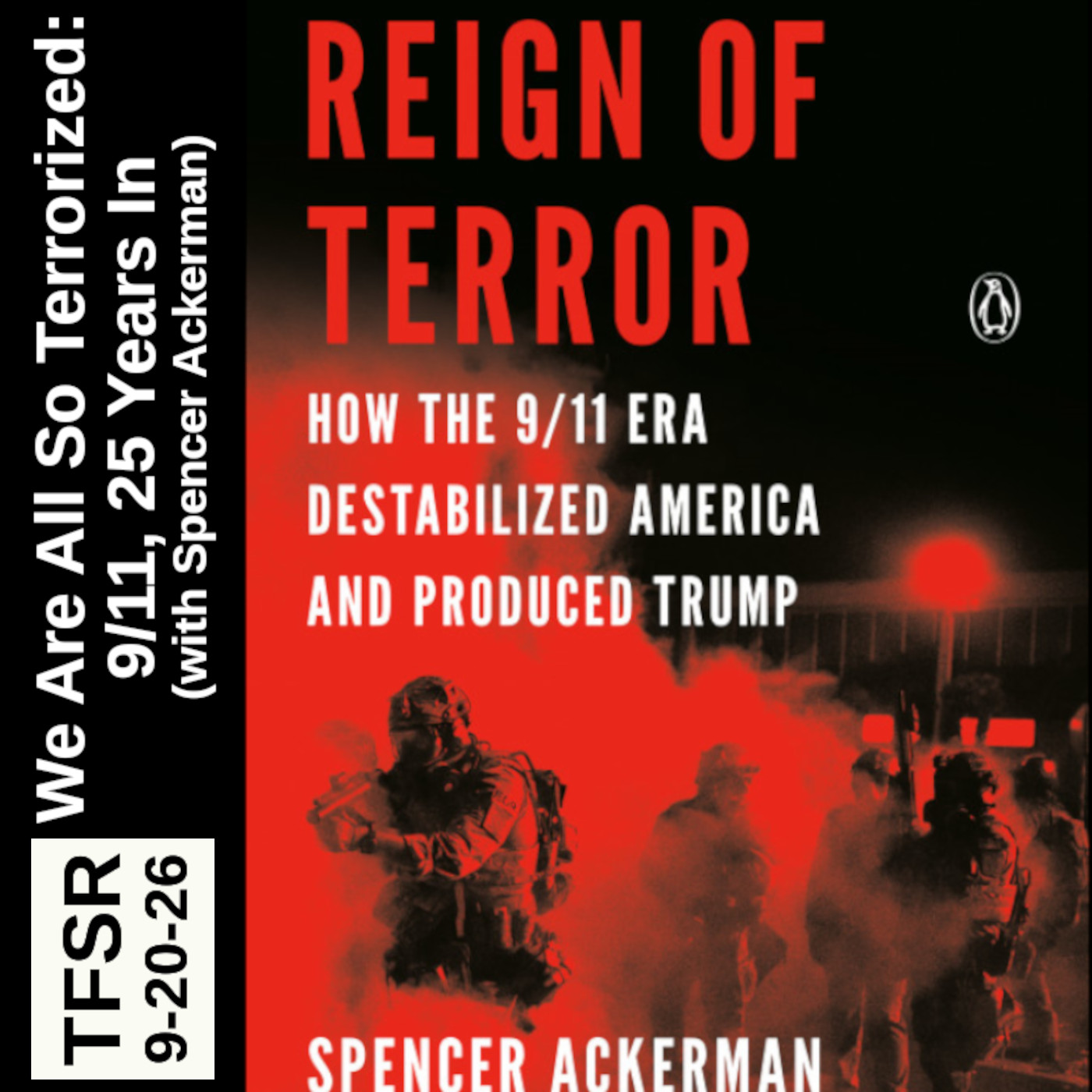
This week, you’re hearing our recent interview with journalist, author and comic creator Spencer Ackerman about his 2021 book, Reign Of Terror: How The 9/11 Era Destabilized America and Produced Trump . This felt like a fitting chat to record as we approach the 25th anniversary of that event in the dystopian second administration of that reality tv boss Donny J Trump. In the chat we cover some of the topics in the book, like the legalistic and lingustic wrangling of subsequent administrations to expand US exceptionalism to international standards of war and human rights around captured prisoners, expansions of domestic spying and generally how the state of emergency created in 2001 has been used by Democrats and Republicans since to lay the ground work for the naked imperialism abroad and racially eliminationist policies in the US.
- Transcript
- PDF (Unimposed) – pending
- Zine (Imposed PDF) – pending
I definitely suggest you check out Forever-Wars.com for more of his journalism and find announcements there for the pre-order of his comic book No One Escapes the Dialectic coming out in November and the upcoming pre-order for his book The Disappeared: A Father, A Son and the War On Terror, scheduled to come out in March of 2027.
. … . ..
Featured Track:
- TFSR by The Willows Whisper
. … . ..
Transcription
TFSR: We’re joined by Spencer Ackerman, author of Reign of Terror: How the 9/11 Era Destabilized America and Produced Trump, published in 2021 by Viking, and Pulitzer Prize-winning journalist at forever-wars.com. Thank you so much for taking the time to chat, Spencer. I really appreciate it.
SA: Hey, thank you for having me.
TFSR: Is there anything else you want to say as far as introduction for yourself?
SA: No, that’s good.
TFSR: Okay, happy almost 25th anniversary of 9/11. It’s an auspicious period.
SA: Thank you.
TFSR: The subtitle of the book really lays out the thesis. Could you talk a bit about the book, what perspectives you were trying to bring to the readership at the time, 20 years after the September 11th attacks occurred?
SA: There were lots of things I was trying to bring forward in terms of our understanding of the war on terror. Some of these had been longstanding criticisms in socialist, anarchist, and other left-wing circles but hadn’t made their way into any embrace in more mainstream understandings of foreign policy. I’ll just run through a couple of them. Just to say, I don’t think this book is so stunningly original. The virtue of the book, to the extent that it exists, was to present a clear and coherent framework about what the war on terrorism is and its relationship to both American society and the deepening generational acceleration of repression in this country.
A couple of things I wanted to do with this: I’m professionally a reporter who focuses on national security and foreign policy. In the circles that I tend to report on, or at least had primarily focused on by that point in my career, there was not really an explanation for why the war on terror was the way it was, or what its relationship was to American history. Very much a derivative effect of treating 9/11as the beginning of history in terms of a departure of American foreign policy was the idea that the war on terror was an organic or popular demand from 9/11, and not a manufactured one by American elites to move in a direction that U.S. foreign policy had been trending in for a while and accelerating: the repressive and extractive elements of it that provoked 9/11 in the first place.
As well, there were a lot of people in elite politics, particularly in more technocratic circles: practitioners of the military, the intelligence agency, the broader “national security” community, to the degree that such a thing is really not a euphemism and is more just an extended circle of people united in professional interests. What they did not pay attention to was that all of the uglier and more repressive elements of the war on terror manifesting domestically in the United States, as well as the brutal elements that manifested what we might call down range on the fields of battle of the war on terror, bore any relationship to one another. Particularly during the late Bush and early Obama years, after the war on terror shed its millenarian and scatological skin because of how disastrous the Iraq War developed. It was seen often as a technocratic enterprise, something that sat outside of politics and accordingly outside of history and was simply the rational way to organize a foreign policy aggressively around the defense of the United States, whatever that needed to mean at any particular time.
I wrote this during the first Trump administration and it was published in the first year of the Biden administration. What I wanted to show, particularly in the age of Trump was that this long turn in American public life after 9/11 created the conditions in a variety of ways. Sometimes it was by commission, as in the introduction of a public enemy in terms of a civilizational understanding of Islam. Also through neglect in terms of what the technocratic elements of the war on terror ignored about that presentation of Islam. Also inflicted through its institutions created after 9/11 on not just the rest of the world, but also here at home. I was pushing against the idea that the war on terror occurs outside of history and occurs outside of politics, as opposed to being shaped in really intimate and distinct ways by both.
That the development in terms of both the politics of the war on terror, the institutions of the war on terror, the authorities of the war on terror, and the lack of accountability for the failures of the war on terror serve fascist purposes. They serve what we see presently on the streets as practiced by ICE. ICE, of course, is a creation of the war on terror, but also shows it in a stage-by-stage way. So many people at the time of the first Trump administration didn’t really consider the war on terror as anything that could have possibly contributed to the way America had turned.I wanted to show through the book that things like ICE raids had been going on. They increasingly expanded in terms of both ambition, respectability, and targets. That lurch, that expansion, a lot of which, at least some marginalized voicesrecognized was coalescing immediately after 9/11, manifested throughout the war on terror, and Trump is able very easily to take advantage of this already-seated form.
What also helped him was another thing that I felt the national security-based resistance to Trump in elite politics was really missing, which is their complicity, which was the ways in which the institutions of the war on terror were disasters. The operations of the war on terror were disasters, primarily human disasters. If you look at the Costs of War Project at Brown University, the total, both direct and indirect, death toll of the war on terror is estimated between 4.5 and 4.7 million people. This is based on epidemiological models, as well as the really absent specific data about who was killed throughout the course of these two decades. Other metrics that are relevant here have to do with the creation of tens of millions of refugees, first in West Asia, and then into Europe and into the United States. I wanted to show that all of this nativism was empowered to start, and that the elite institutions created under the rubric of responding to 9/11 preventing further terrorism in the United States became this engine of unfreedom, baked in from the design. It could not be separated from the ways in which its failures specifically discredit the elites that view themselves as the necessary guardians of this apparatus in order to keep it oriented in a proper technocratic direction.
The war on terror is treated by the security state and by elite politics, oftentimes through neglect by popular politics, as something outside the sphere of contestation. There are good reasons for that. U.S. foreign policy has never been particularly democratic. All of the institutions of the state that were created after 1947 through the coalescence of the Cold War are meant to keep the public out: the national security state, the creation of the Pentagon, the consolidation of the Department of Defense, the creation of the National Security Agency a few years later, the creation of the CIA, and so on. They are meant to ensure that we, if we have to live in a nation state, don’t have a sense that it is our democratic right as people to control what that nation state’s orientation toward the outside world should be. Instead, it’s been designed to recognize and serve and be responsive to the prerogatives of elites, political elites, economic elites.
Instead, that has yielded disaster after disaster. The war on terror bears the imprint of the Cold War in that it serves as a second-time farce in terms of the way that it understands its enemies to be both existentially oriented, overwhelmingly powerful, and yet subhuman. Also that they are inside the borders of the United States and corrupted by the institutions and apparatus of liberalism: the courts, the press, the human and civil rights apparatuses. The degrees to which military elites and political elites in both parties sign on enthusiastically to the war on terror both discredit them in an environment in which they’re already seen as widely discredited after the financial collapse of 2008. But also, what we’ve seen so far, once they are that discredited because they never got around to abolishing the authorities, institutions, and, in a lot of cases, the operations of the war on terror, they can be appropriated by those on the nativist right to use those institutions that they said they declaimed in order to suit their prerogatives, not to ultimately get rid of them.
I think this is one of the things that overwhelmingly distinguish the nationalist right from the socialist and anarchist left. They’re not about destroying these notions. They’re about discrediting their leading practitioners, who they feel are inhibiting the enterprise, then orienting and suborning the enterprise so that it serves those fascist prerogatives. Maybe we can say more about this later, but we’re also entering an escape velocity of the synthesis between economic oligarchs and the national security state in the way that organizations like Palantir have inserted themselves as a really important layer inside the operations of the security state, its surveillance operations in particular. You’ve seen the resistance that’s been inspired by it. That is a working-class resistance beyond left or right, beyond these very stale categories, against the Flock cameras, against the idea that we should be constantly surveilled.
Different kinds of contestation have worked in mainstream politics to both ignore, co-opt, and channel into a lack of effectiveness that popular desire to be done with the security state, to be done with the constant and expansive intrusions into our day-to-day lives. But also we’re now seeing how the very corporations that, in large part if not outright originate with the war on terror, like Palantir does, that are accelerated by the war on terror and the rise simultaneously of surveillance capitalism, now look toward a political domination expressly predicated on crushing what avenues of democracy remain for the people and using the institutions of the United States increasingly toward their purposes. Thus they are auguring a future of a techno-feudalism in which the state provides fewer and fewer services and opportunities for more and more of its people, but offers a subscription-based understanding of citizenship, something that’s more a customer or a user base, and retains the repressive apparatus of the state as a means of suppressing contestation of it.
When I wrote this book, there wasn’t really that holistic understanding of the war on terror. It was often seen as distinct operations. Here’s the war in Afghanistan. Here’s the war in Iraq. Here’s the expansion of NSA surveillance. Here’s the Patriot Act and its transformations of what sorts of data law enforcement can access without a judicial warrant. Here’s the transformation, you might say, the emergence of the immigration enforcement apparatus, especially domestically in the United States, further and further into the interior under the rubric of combating terrorism. There wasn’t a political theory of the war on terror. There wasn’t a way in which you could understand the war on terror as a comprehensive thing that basically ate America alive while promoting its most nativist voices and providing them with a way of attaining and sustaining power.
TFSR: You covered a lot in there, so I appreciate the fullness of that. As a national security journalist, it makes sense for you to have a wide-angle view from above of these big pictures. That’s a thing that the book did really interestingly: it gave a chronological narrative that shows the weaving of these different political characters and how the war on terror developed domestically and on foreign lands, and how people reacted to it.
To zoom back in though, one person whose story your narrative checks in with is Adham Hassoun, a Lebanese-born Palestinian who was swept up by the global war on terror’s enemy combatant status and was imprisoned for nearly 18 years. Could you talk a bit about his struggle through various prisons and cases over the three different presidencies and what shifting U.S. legal precedents you describe through his story in the post 9/11 U.S.
SA: One of the things that I had found difficult in writing this book was putting a face to the Patriot Act. Making the Patriot Act not seem like an abstract series of expanded authorities for surveillance and for detention. And then I found Adham. I found him through a lawsuit that his attorneys, both at the ACLU and at a law school in Western New York, had filed that was unique in the history of the war on terror. His case at the time that I encountered it was a habeas corpus petition to get him out of ICE detention, through arguing that he was being punished for a crime that he had been convicted of, served his sentence for, and since been freed from. But instead of going free, he was put in ICE detention in accordance with a never-before-used section of the Patriot Act that, at the time of the Patriot Act’s passage nearly 20 years before this happened, was an enormously controversial measure that hadn’t gone into effect until Adham. It was a measure that authorized indefinite detention for what it called non-citizen, non-deportable people, which is to say stateless people, which is to say, primarily, in effect, Palestinians.
It was basically a provision that if you were not an American citizen and you were a Palestinian, or I suppose you could be a Kurd, or perhaps a Uyghur Muslim. There are surely other cases that one could think of, but most directly applicable, it would be for Palestinians. Because of a determination that could be renewed every six months by the Secretary of Homeland Security, essentially you could be kept in an ICE detention center without being sent to any place because he’s non-deportable and he’s not a citizen of anywhere, as long as the Secretary of Defense considered him a threat. As someone who had been convicted of a terrorism offense at that time, the acting Secretary of Homeland Security was just rubberstamping that he was a threat. This provision, which had never been tested in court, was taken to court to force a resolution on the constitutionality of this measure. It was not necessary to submit any evidence that Adham had done anything illegal, had done anything to threaten the United States. Indeed, how could he? Since 2006, he had been a prisoner of the United States in places that may be familiar to some of your listeners, like Terre Haute, the ADX facility in Florence.
And what was Adham imprisoned for? What was he convicted of? Why was he in prison? What act of violence had he committed? Well, he hadn’t committed an act of violence at all. Instead, he was pretextually apprehended in June of 2002 in Florida because the Patriot Act had banned an organization–a charitable organization, a Muslim charity–that he had written checks to while that was still legal to do. The last check that he wrote, and ultimately one that was used to detain him, was one written shortly after the Patriot Act went into effect. Now, why did Adham really go to prison? He went to prison, in his telling, because once he was placed in detention with the threat of this Patriot Act penalty hanging over him, now that he had been criminalized for four years, he did not see trial. During that time, while he was in immigration detention, as had happened to hundreds if not thousands of people around the country in the months and year or two after 9/11, he was pressured by immigration and by the FBI to become an informant, to become part of the extensive apparatus. Mother Jones magazine measured in 2010 at something like 10,000 people who had been put in subordinate positions, either through entrapment or through leveraging an immigration status or other positions of fear to inform on Muslim communities for the government.
Adham wouldn’t do that, but Adham had known, associated with, and communicated with José Padilla, whom the United States charged as a terrorist, even though ultimately most of the most serious charges, including material connections related to any act of violence between José and Adham, were dropped. Nevertheless, they were tried together, and a jury in 2006 was not about to exonerate a known associate of Padilla. That was why Adham was sentenced. He was not even accused of committing an act of violence and ultimately his sentence was somewhat reduced. But for reasons of the Patriot Act, and as well the culture that had grown up of the war on terror around it, charges like that would be enough to send people to the higher maximum-security facilities for, in Adham’s case, 15 years.
When this man emerges, he goes into ICE detention immediately, and that seemed to sum up to me in a human way more powerfully than in any abstract way, the course of the war on terror, the purposes of the war on terror and the trajectory of the war on terror. More of it was moving away from the overseas conflict to rooting out non-white immigrants in the United States, and essentially treating them as if they were threats to national security. The easiest way to do this was through calling them terrorists, treating them as terrorists. We’ve been seeing since the domestic support for the resistance to the Israeli genocide of Palestine, in which you’ve seen ICE take people off the streets and put them in detention facilities on the way to deportation proceedings for nothing other than advocating for Palestine.
That’s why I wanted to highlight Adham’s case and use it to show, throughout the development of the war on terror over 20 years, how one person who experienced it all confronted it as it was happening.
TFSR: It was a really powerful telling and very insightful. Flipping subjects a little bit, I’m interested also in those linguistic side steps more than just euphemism, like “enhanced interrogation” for torture or “enemy combatant” for prisoner of war,“rendition” for capture and imprisonment, that are designed to avoid conflicts with things like the Geneva Convention or other obligations of the post-World War II world. In an Orwellian sense the acceptance of these terms shifts expectations, again setting precedent, and does a lot of the heavy lifting for the authoritarian push to evade or topple the few legal checks and balances that the executive increasingly leans on with national security. I wonder if you could talk about some of the attempts at these gymnastics that developed over the global war on terror, and how we’re seeing them enacted today with the inability of the judiciary, for instance, to be able to hold Trump’s regime to any responsibilities.
SA: Sure. You mentioned some of the most important ones. Enhanced interrogation is a kind of torture that isn’t actually torture. That’s meant to signify a more effective way of interrogating someone and to cut off the idea of someone challenging the premise that interrogation is a way to actually yield reliable, valuable information and that the enterprise for which it’s put to use is valorous. It’s presumed to be so, and accordingly, the meansthat are employed for that end are considered justified. It’s just that the ends justify the means in the service of state power.
Another important one is targeted killing instead of assassination. This one is really wickedly hard. These are the drone strikes that take out – I don’t even want to say – a specific person because most often they don’t take out either just one person or even the intended person. Sometimes there isn’t even necessarily an intended person. It’s rather that this happened during the Obama years, especially for perceived militants in western Pakistan and eastern Afghanistan, as well as in Yemen, Libya, and Somalia, where it’s accelerating to this day in Somalia, especially without much attention. But this one is wickedly hard because oftentimes it frustrates the concept of assassination because it’s not targeting a specific person, let alone a leader in a distinct organization. It was often used against, as I mentioned before, a pattern of behavior perceived by the intelligence agencies and considered to be reasonably commensurate with a picture of a so-called terrorist, of the leader or even foot soldier, a member of Al-Qaeda or an Al-Qaeda affiliate.
Another one that’s super important today that I would really encourage people to think about very strongly when they hear about what is often called “third party deportations” that the United States is conducting. That’s an extraordinary rendition. This is something intimately familiar from the war on terror. A rendition is a process of capturing someone and giving them to either their host country or a country where they’re being sought in connection with either a security threat or even a specific crime or set of crimes, but not for the purposes of rendering them to a legal process. That’s an extradition. A rendition sends them there for the security agencies to do with them as they see fit. Sometimes that will be for the purposes of a subsequent indictment or an unsealed indictment or something like that. Other times it’ll simply be for detention and for interrogation. An extraordinary rendition is when a country’s security agencies send someone to a third country to the custody of that third country’s security agencies for the purpose of detention and interrogation, which is to say torture. I would submit to you that what we’re hearing about people from Vietnam, people from Afghanistan, people from Cuba, people from all sorts of countries who are put on planes and taken to the Democratic Republic of the Congo or South Sudan, those have often been called third-party deportations. It is an innovation under the second Trump regime, but it’s not unfamiliar. This is an extraordinary rendition.
These people are, at this time, just not security threats. They’re just simply people to be disposed of by the security apparatuses of aligned countries that the people subjected to this have ever set foot in. This is an extremely serious development. It’s something that reflects the lack of accountability for all of the lawlessness of the war on terror that it’s gotten to this point. I would submit that, over the past few years, given the right-wing efforts through the courts to get rid of birthright citizenship, this soon won’t be reserved for people who were born outside the United States. This will be a tool once they convince the Supreme Court to repeal birthright citizenship, and then they can denaturalize at will. So this is a really important development. It’s not just the linguistic development, but the euphemism that surrounds it often prevents us from understanding just how dire this development is. That has been a feature, to get back to your question, of the war on terror from the start: to mask the violence, to mask the lawlessness, to make it seem both inevitable and justified by virtue of the fact that it has been turned on first the so-called terrorist and now the so-called illegal immigrant.
TFSR: Yeah, that’s very well put. And with the Department of War, as it’s called now, targeted drone strikes and interdictions in the Caribbean, too. We see an expansion again using the language of terrorism, narco-terrorism in this case, with a sense of impunity, right?
SA: Yeah, this is just murder. I can’t really think of any other way to rephrase it. First, this was done to manufacture consent in a really half-assed way. Even saying this was to manufacture consent is probably imposing too much intentionality on it. It was to jit up a pretext and, to some degree, an intellectual construct to justify the invasion of Venezuela, the decapitation and kidnapping of its government, and now the theft of its oil resources. But now it just simply continues far past even any attempt at arguing that people aboard these fishing boats are somehow drug traffickers and smugglers. Even the exercise of the argument that they were presupposes that it would be, even if true, acceptable to summarily execute them. And of course, the important rhetorical groundwork is built by use of the word “terrorist” in narco- terrorism, but more importantly, it’s built through the institutional use of organizations first like the Joint Special Operations Command, which began these strikes, and now through Southern Command, as institutional memory of the war on terror and the practices through which this was so often employed against so-called terrorists. It becomes muscle memory for these military and intelligence institutions, and accordingly can be migrated as the targets migrate, as political attention and expediency migrate.
TFSR: It’s really fascinating to see how the concept of war before this was focused on facing off with some sovereign state on the international stage. Not to say that it was above board or some fair game or anything. And now, with the innovations of the global war on terror period, it moved from toppling specific regimes to targeted assassinations, as you say, but just across borders according to how the technology allows for it. It’s pretty fascinating and scary.
SA: Yeah, the war on terror is an unleashing of American imperial prerogative under the justification of righteous victimhood from 9/11. That, for the stewards of the world at the time, was unchallengeable, unassailable. I don’t mean that in terms of people can’t challenge them. I mean in terms of geopolitics, superpower, the last remaining superpower at the time, to simply unleash everything that, in its most ambitious and millenarian conceptions, made possible. The war on terror was an enormous opportunity for a lot of people both on the right and in Silicon Valley, on Wall Street, and in both the traditional five defense giants: Lockheed, Boeing, General Dynamics, RTX which used to be Raytheon, and Northrop Grumman. Notice that since the 2010s, especially, those five defense giants are the traditional firms that end up as the industrial side of the military-industrial complex after the period of post-Cold War consolidation. Now they come under challenge from Silicon Valley, from venture capital, and from private equity. And that’s where you get the startups: Lockheed, Anduril, Palantir, Flock, Starlink, SpaceX. We’re seeing a sea change in the military-industrial complex that favors Silicon Valley. AI, now OpenAI, Google has certainly been part of that as well, and the rest of the aspirant AI superpowers. We are seeing really a massive shift within that sector that favors this new Silicon Valley-Wall Street private equity complex, which is just an extremely dangerous development.
Not that the previous iteration of the military-industrial complex, which in many ways created Silicon Valley, was not dangerous before, but what it wasn’t before was explicitly anti-democratic. It was functionally anti-democratic, but it didn’t embrace abridging American democracy as an ethos. That is the ethos of Peter Thiel, that is the ethos of Elon Musk, that is the ethos of Balaji Srinivasan, that is the ethos of a lot of the new and increasingly synergistic Silicon Valley and tech-based transformations and interventions in the American military-industrial complex, in the intelligence apparatus, and in surveillance capitalism. This is an enormous development. The war on terror is not responsible for all of it, but it is responsible for most of it. We’re really looking right now at a new iteration that no longer really needs the rubric of terrorism around it. It instead is looking beyond that to–as people like Alexander Karp like to put it–defending Western civilization, which is a hangover from the war on terror, which is also a hangover from the Cold War, as a unifying framework for handing more and more power and more and more involvement over the institutions and the apparatus of U.S. national security to this emerging class. This is the direction of the war on terror, just as much as ICE is the directional consequence and manifestation in this day and age, this iteration of the war on terror. This is happening on multiple levels is a long way of saying this.
TFSR: Many of the restrictions that the government has imposed on itself historically in terms of surveillance have come after revelations of breaking the public trust, such as with the Watergate hearings, the Church Committee, for instance. The 9/11 era came on the cusp of major technological jumps in computing and networking with three-letter agencies and their allies in the tech industry, like eventually Peter Thiel. They’ve taken great advantage of opportunities in surveillance, and you mentioned three whistleblowers who spoke out at great risk. Two of whom revealed widespread government spying. The laws of the prior decades’ disclosures weren’t updated to match the technologies of the digital age. Can you talk about some of the spying programs that we know about from this era, what impacts the disclosures had, and where we stand today?
SA: A month after 9/11, the director of the National Security Agency, Michael Hayden, rewrote in practice the Fourth Amendment of the Constitution. The Fourth Amendment of the Constitution is supposed to protect against unreasonable search and seizure by imposing requirements for the government to seek, on the basis of probable cause, a warrant from an independent judicial authority to search a given residence or someone’s personal effects for specific things believed to be relevant to the prior commission of a crime. Instead, Hayden took advantage of a transformation in the global technological telecommunications infrastructure, because so much of this was built on American stuff. So much international communications passed through the United States that it permitted a very dubious theory inside the National Security Agency that said that because all of this foreign information was coming over American stuff, it could be intercepted and presumed to be foreign, and accordingly outside the purview of the post-Watergate laws that were meant to inhibit national security-based surveillance of people inside the United States or United States persons.I have to pause and mention that the term is “United States persons.” That is not the same as United States citizens. It means people in the United States, regardless of citizenship, or Americans abroad who are presumed to have constitutional rights. Also, sometimes this is used more than others, but it can also mean American corporations; it can mean American organizations; it can mean both of these things on American soil and so forth. End of digression.
Hayden got it all. Hayden transformed the National Security Agency. I should say, he reestablished the National Security Agency outside the hated constraints of the 1978 Foreign Intelligence Surveillance Act that imposed a measure of restrictions on how this spying inside the United States needed to operate, and instead argued, as you would eventually hear from his successor a dozen years later, Keith Alexander, say, “We need the whole haystack. You’re asking us to look for a needle, which is supposedly a terrorist threat or event. In order to do that, we need the whole haystack.” This was another example of the euphemism of the war on terror being used to make criminal activity on behalf of the state seem common sense, if not folksy. You got to find a needle in a haystack? Well, of course you need the haystack, right? That was the logic.
This became known as a constellation of surveillance programs around internet, telephonic metadata, and content that was known as Stellar Wind. There are different operations within Stellar Wind. Then, after 2009, they tend not to use the Stellar Wind operative framework, but the fruits of Stellar Wind continue to this day, over surveillance that, because it has a connection to an international element, Americans’ international communications are presumed not to really be American, but to really be about those international entities. That is the prerogative of the NSA to collect and then, through the FBI, sift through. This is done under an amazing provision of a law passed in 2008 that’s known as Section 702. It expired this year, but is still in operation for a couple of months. It is the continued use under souped-up administrative requirements. Basically, it’s now done through a twice-yearly certification of not the targets of such surveillance, but instead the mechanisms of that surveillance that are sent to a secret court called the Foreign Intelligence Surveillance Court for approval. Again, not of the surveillance itself, but just that the mechanisms of it are listed so that they do not violate the reemergent sense of legal restriction here.
In practice, we always hear about this only after the fact. But over the past 15 years that 702 has been in existence, nearly 20 years at this point. And again, 702 has, for the moment, expired. We keep learning through disclosures years after the fact that even those outlined mechanisms given to the Foreign Intelligence Surveillance Court were not, in fact, how the surveillance operated in practice. This operates at such a level of technical sophistication that it’s basically done to overwhelm even this very small and highly non-expert set of judges that are the only institutional restriction on the spying that exists. One of the reasons that this is so alarming is because we’ve seen for a very long time it has led to conviction through a legal doctrine of what’s called parallel construction, which is essentially hiding the fact that you are bringing a case against someone that would not have happened were it not for illegal surveillance. This is to say the use of inadmissible methods that are made to be admissible in court, cleaned up in such a manner that what we call the fruit of the poisoned tree, the fact that the tree is poisoned, is hidden.
TFSR So if anyone saw The Wire, for instance, what the police were doing in the first couple of seasons with their wiretapping, going and constructing other means of arguing in court as to why they were able to catch someone in the act. That sort of thing?
SA: And to hide the illegality of the origins of it. It’s similar to the way in practice The Wire worked, but there was a different legal framework. They were still engaged in often illegal surveillance, but this was on quite a different scale and under different legal authorities. But that part, yes. I bring this up to point out that we’ve seen over the last couple of months an increased effort on the part of the White House to criminalize the international left that will overwhelmingly focus primarily on Palestine. I forget exactly how they phrasd it, we’ve seen from the declaration against Palestine Action, the move against Autistici Inventati as a specially designated global terrorist. The same thing: they will use Section 702 once they attempt to bring it back against the domestic left to put it inside the framework: a foreign terrorist organization that you can use the full power of the war on terror against. You’re already seeing the attempts at using the Joint Terrorism Task Force against the domestic left through what’s known as NSPM-7 that the White House put into effect, I believe, last year. But this other effort is seemingly accelerating as well.
TFSR: Thank you very much. You actually foresaw the last question that I was going to ask, which is exactly that. To a varying degree, during the Cold War, you saw the support of death squads and the backing of various conservative or reactionary movements or regimes around the world in order to undermine movements that were labeled as communist by the U.S. state. And “communist” is still a dirty word. “Islamist” is still a dirty word. “Terrorist” is the commonality, and we’ve seen over the last 100-plus years, “terrorist” being a term that’s weaponized against parts of the population that the government decides are expendable or standing in the way of our “freedom.” Now it is still Islam, Muslims. It’s still communists to some degree. It’s become more and more vocally anarchists and anti-fascists. You’ve seen people being shot in the street when coming up to witness and report on what’s going on. ICE breaking up families, people out of cars. You’re seeing the aforementioned drone strikes and harassment by CIA lackeys of people in the Caribbean. Now the hunt for traitors, so present against the movement for Black Lives, so visible during the first Trump administration, has vocally escalated against anarchists, anti-fascists, and anti-racists. Notably seen in the assassination of Michael Reinoehl during Trump 1.0, it is one that sticks in my craw, and there have been show trials, Prairieland, and declarations like NSPM-7, as you mentioned, after the killing of Charlie Kirk. I wonder if you could talk a little bit more about the construction of this enemy and that path that you track back through the book in your journalism.
SA: The most important thing to remember in this turn of the war on terror is that the war on terror was a disaster. The wars that were meant to showcase American power showcased American impotence instead. That led a tremendous number of people who had been conditioned to accept the war on terror, who had been told to channel whatever feelings they had after 9/11 into civilizational bloodlust against people who were seen as a civilizational enemy that was both fanatically powerful and subhuman at the same time. It failed. It made that impulse for revenge unsated. It left it unsatisfied. While the United States could not prevail over its declared enemies overseas, it had a lot more close to home that it could target, and it could use these apparatuses that it constructed after 9/11 and empowered ever since against.
It also was baked into the war on terror from the start that the way the so-called terrorists got into the United States showcased the folly of American immigration. Now, anyone who’s actually dealt with the U.S. immigration system can tell you that this is a cumbersome, confusing, and frankly frightening, often arbitrary apparatus that is not “open borders”; that it is in fact an intimidating system of state surveillance and violence. Nevertheless, the lesson that was treated as respectable and grew in intensity throughout the war on terror was that 9/11 meant there needed to be greater interior immigration enforcement, and that becomes ICE.
We’re seeing that develop to a degree that allows an empowered nativist current to strip itself of the idea that it is fighting terrorism, and instead using it toward extant purposes of nativist violence that is not just decades old, but a century. We can certainly say from the immigration restrictions of the 1920s, although certainly there’s nativism in the United States long before then. But really the restrictionist element really comes to the fore with the immigration restrictions of the 1920s. So let’s perhaps put it there. Daniel Denvir of The Dig podcast has an excellent book about all of this called All-American Nativism, and of course, the Yale scholar Greg Grandin does the same in his book The End of the Myth.
This is a long way of saying that once this apparatus of repression has been created and the civilizational focus of its enemies is established through the political culture of these institutions, it’s easy to redefine the enemies as a targetable one that’s very satisfying for that nativist current to target. And that will never just be the supposed “illegal,” themselves. It will always necessarily be whatever institutions of solidarity, real or perceived. The right-wing imagination is not what your and my imagination is about the relationship between liberalism and immigration. But it doesn’t matter for our purposes. It matters how they, once they wield state power, instantiate it. So, real or perceived, the apparatuses of solidarity around immigration and around civil rights are to be increasingly the focus of the war on terror for as long as these institutions, authorities, and operations are permitted to exist.
TFSR: Powerfully put. To focus on who’s determined to be the enemy and who are the people that are determined to be in solidarity with those people. As you mentioned, with the immigration in the 1920s, the Chinese Exclusion Act of the 1880s.
SA: I should have also mentioned that. Forgive me. Yes, I did not mean to say that all of this starts in the 1920s.
TFSR: It’s a long thread, and you could point to many more examples. I want to end here, even though we’ve been talking about some very heavy things, and you’ve been very aptly responding to my very big questions, so I really appreciate it. I’d like to hear what brings you hope.
SA: The great Mariame Kaba put it that hope is a discipline. Hope is not a term that I like.
TFSR: What keeps you fighting?
SA: Yeah, we have obligations to one another, and we have to meet those obligations. What I hold to is how everyone I’ve ever encountered–and this includes soldiers who are serving the war on terror–the more they are exposed to the ugly realities of it, hate it, and reject it, and do not wish to be a part of it, and do not wish for it to be inflicted upon anyone. That’s obviously not everyone, certainly not everyone whom the war on terror touches from the perspective of a practitioner. But the ICE raids, going back to 2005 when they started doing the workplace raids on the farms and the slaughterhouses, it had been for so long kept out of sight, kept away from people’s faces, so people wouldn’t see the horror of what it actually was. Of what child separation looks up close. Of what rounding up frightened people who are here for work often after having no choice but to flee the country that they’re from, that was destabilized, often by the United States, that was kept out of sight. That’s not out of sight anymore. As they’re exposed to it, more and more people reject it, reject it in the strongest possible ways. The amount of public hatred toward ICE is simply nothing that has ever been experienced in the war on terror before. Those are hopeful signs.
What I think is important to recognize is that the obligations that we have to one another compel a seriousness of organization, of defense, of networks that make solidarity real, that make it something that can potentially deter state violence. Also, understand that at every step, no matter how right now firm their grip on state power looks, at every phase, the nativists and the nationalists are improvising. They’re seeking to see how much they can get away with. They understand that so far they have flown close to the sun that the hatred that millions of people feel toward them is something that they need to be insulated from. I guess that’s how I put it. This is going to be corny, perhaps, but early on in my life, I was exposed to an Operation Ivy lyric that says, “To resist despair in this world because you can’t change everything is what it means to be free.” And while that doesn’t materially pick the difference between freedom and unfreedom, it is a great rubric to keep in your mind when you feel despair to not give in to it. The people who wield this mechanism are afraid of you.
TFSR: I will never turn down a good Op Ivy quote. Are you working on anything right now? Is anything in the works that you think listeners should keep an eye out for? I know that you’re continuing to write for Forever Wars, and people can find a lot of the documents that you’ve been able to unearth, as well as the journalism of you and some of your compatriots there.
SA: Thank you. This is gonna be a pretty wild juxtaposition to hear next to each other, but this is the stuff that I put out into the world. In March, I will publish my second book. That book is called The Disappeared: A Father, a Son, and the War on Terror. That’s an extraordinary story. I feel like this is the greatest work I’ve ever done, and it’ll be what I hope I’m remembered for. It’s the story of Majid Khan. Majid was a Pakistani teenager immigrating to the region outside of Baltimore. Learned English from working at his father’s gas station and from DMX. Went through a series of personal crises centering around his mother’s death. That led him to embrace a side of his family that was back in Pakistan, really dialed into Al-Qaeda. So he joins Al-Qaeda after 9/11 as this knockabout guy, a kid who thinks that he’s trying to be on the side of justice, maybe even be a little bit heroic. This is a very misguided thing that leads him, at one point to put on a suicide vest and try to kill Pervez Musharraf, even though of course, he doesn’t detonate it. He realizes that his mukhtar, his boss in this organization, is Khalid Sheikh Mohammed, who was the architect of 9/11. At the same time, his father, who had brought him to the United States, is trying to stop Majid from going down this path.
Majid ultimately gets captured by the Pakistani Inter-Services Intelligence; they render him to CIA custody. He spends three and a half years being tortured by the CIA in its black sites. You’ve read a lot about the black sites probably over the course of these years, but you’ve never heard about them from someone who experienced them and who experienced three and a half years of black site captivity. We will cut through the euphemisms of the CIA and expose what the torture and the black sites really were, as experienced by someone who experienced them. This is also one of the messy parts of a very messy story; we’re going to get into parsing some moral guilt here.
The logic of the war on terror held that anyone who was a member of Al-Qaeda was deserving of the most degrading possible treatment. We’ll see that Majid never commits an act of violence. He is accused later of having financed a bombing that happens while he’s already in CIA captivity. But that happens much later. He ends up being transferred to the most secretive part of Guantanamo Bay, a now-defunct site where the actual members of Al-Qaeda that they had captured were held. That’s called Camp Seven. There has never ever been a journalistic account of Camp Seven until now. There is nothing in the public record outside of what has emerged through some accounts and through the pretrial hearings of the military commissions at Guantanamo, but really very little.
We will be giving the most comprehensive account of this never-before journalistically seen important site of the war on terror in this book. This is also simultaneously the story of Majid’s father Ali, who tries to stop Majid again from going down the path that he went down, but after Majid is picked up and disappeared, is also subjected to a months-long FBI investigation of him. Even though Ali could not have disapproved of Al-Qaeda more than he had. Half of the book is the story about what the disappearance of his son does to Ali, and the effects of having his son taken from him, due to the family that’s left behind.
This is an extraordinary story that’s made possible by the even more extraordinary circumstances that got Majid out of Guantanamo, and that’ll be a story that I wouldn’t want to spoil in this podcast. But I really hope that you check out this book. It’s by far the most important journalism that I’ve ever done. And I was involved in the Edward Snowden revelations. I discovered the Chicago Police Department essentially setting up its own black site, which remains today on the west side of Chicago at South Homan Street and Fillmore Avenue. That’s known as Homan Square. This is the most important thing I’ve ever done. It’s called The Disappeared: A Father, a Son, and the War on Terror. The pre-order link will open in a couple of weeks, but unfortunately, it is not out right now. So, if you’re hearing this in a couple of weeks, please search out that book and pre-order it. Pre-ordering it will mean a whole lot in terms of how visible the book will be when it’s published in March.
Before that, weirdly enough, I’m also a comic book writer, and in November, I’m going to be releasing with the amazing Italian artist Antonio Fuso a comic book through Boom! Studios. That is about resistance to a security organization that has deteriorated into a death squad. That organization is known as Special Naturalization Operations, or SNO. This is going to be about resistance to SNO, SNO’s place in American life, and the challenges that occur when a vigilante starts hunting agents of SNO and leaving on their corpses a card that is also the title of the series. And the title of the series that’s expressed on the card is “No One Escapes the Dialectic.” So this series is called No One Escapes the Dialectic. It’s a comic book about the world outside our window right now, intending to yield a measure of catharsis that might not otherwise be present, and is really going to be meant as a pushing of the boundaries of what acceptable political critique is in comic books. If that sounds appealing to you, and I think that probably listeners of this podcast might find that pretty appealing, please tell your local comic book store that you would like a copy going forward of each of the issues of this ongoing comic book series called No One Escapes the Dialectic by me, Spencer Ackerman, by artist Antonio Fuso, and published by Boom! Studios. Thank you so much.
TFSR: I don’t know; that storyline seems a little bit unrealistic. It took me a second. I’m like, “SNO. Oh, I get it. Okay.” Yeah, I remember listening to the Blood Work episode, and you had spoken about your work on Iron Man. I’m not a huge comic book person. One of my other co-hosts, Ian, is a bit more. But that’s exciting. It’s cool that you get to explore these different mediums and still keep pushing the politics.
SA: Ian, I hope this is for you. If it’s not your cup of tea, but who knows? You might like it. This is definitely not a Marvel comic. I learned from my experience writing Marvel comics what will and will not fly. And this is an independent comic that doesn’t have to bother with the restrictions that go with managing corporate IP.
TFSR: I appreciate that. Spencer, thank you so much for taking this time and for sharing all this, and all that work you do. I’m excited to check out the book in March, and I hear what you’re saying about the pre-orders. A link is going to be up on your website within a few weeks. The show might be delayed a little bit, so I’ll try to stick that link in there if the timing matches up. Thank you again so much for this time and for all the work that you do.
SA: Well, thank you so much for a great conversation. Really appreciate that.