First up, a chat with Cooper Quintin, a senior staff technologist at the Electronic Frontier Foundation and developer of the Rayhunter. Rayhunter is open-source firmware to turn specific hotspots into IMSI-catcher, effectively scanning for and logging any signs of fake cell towers (often known under the brand-name of Stingrays) in the area. Law enforcement has at times deployed these as a way of collecting information about phones in the area and could use it to intercept some communications like sms or phone calls. Cooper talks about what’s known of law enforcement use of IMSI-catchers, what has been observed of the data collected by deployed Rayhunters, phone security at demonstrations and related topics.
Then you’ll hear Radio Ausbruch from Frieberg from this month’s B(A)D News podcast from the A-Radio Network talking about the repression and deBanking of anti-repression projects like ABC Dresden and Rote Hilfe in Germany based on pressure from the US government related to the so-called Antifa Ost case. This carries heavy implications for prisoner support, anti-racist and other social struggles.
This week, an interview we did with a couple of smart friends about the question: what would those of us who rely on Signal encrypted messaging do if that service were disabled in the US. First up, all participants in this discussion agree that Signal is amazing and always getting better, so this is not a take down of that app or it’s developers. But the buds do think that the weakest point for Signal is the centralization of infrastructure with US-based companies. My friends did some thinking and research and put it into a website called Signal-Contingency-Plan.Info and made a zine discussing it and what they consider the best alternative for their needs an app called Delta Chat.
So, for this discussion, they’ll talk about how encrypted apps work, what works so great about Signal, some ups and downs of other available encrypted chat apps and how folks might rebound if Signal got choked out in this manner. As a reminder, at the end of 2024 large parts of the region I’m in lost cellular and internet service and it came back in starts and staggers over a number of months, similar for running and potable water, roads and other infrastructure we rely on. Our hope in sharing this conversation is that people will consider threat modeling to develop social plans for contingency and alternatives for the infrastructures they rely on.
Kate Bertash of the Digital Defense Fund to talk about Flock cameras, automatic license plate readers, the ubiquity of ai-driven surveillance, databasing and storage of real-time info of people and vehicle movements in public and privacy fears being raised. Katie also speaks about organizing with her village-mates to counter or limit them and artful approaches towards resistance with her Adversarial Apparel project.
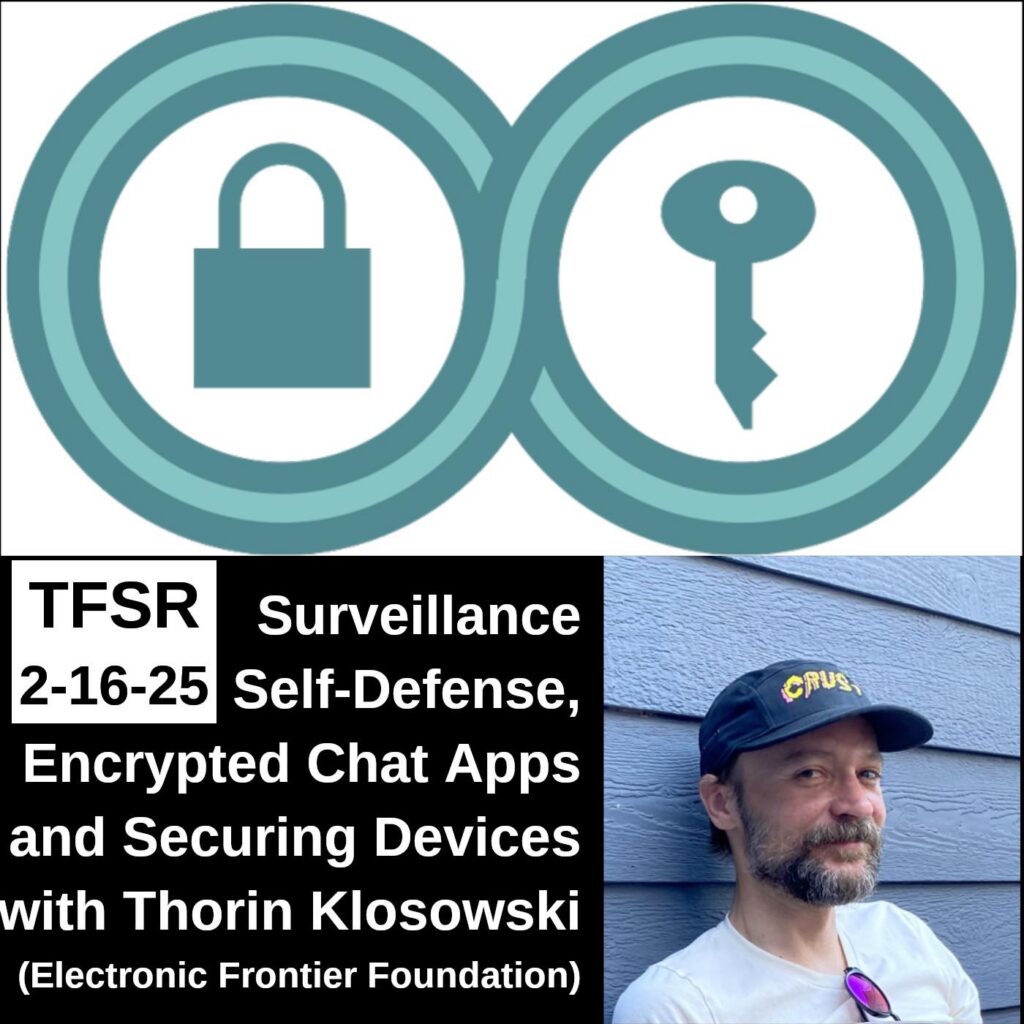
This week, a conversation with Thorin Klosowski of the Electronic Frontier Foundation about some basic tools and ideas for keeping our information a little safer online and the Surveillance Self-Defense site, ssd.eff.org . We discuss device encryption, tor-browser, vpns, encrypted messaging apps like WhatsApp, Signal and Telegram as well as password vaults. I’m hoping this’ll be the first of a few interviews to try to make digital security concepts a little more accessible.
First up, you’ll hear a chat with organizers of the 2024 Heart of the Valley Anticapitalist Bookfair which ran its first iteration in Corvallis, Oregon from January 19-21st. A zine of their experiences will appear on that blog soon. [ -> 00:24:18 ]
Then, you’ll hear a brief segment updating listeners on the conspiracy case against six anarchists and antifascists in Russia known as the Tyumen case (for where it initiated). The six anarchists, some of whom barely knew each other, were tortured into confessions of conspiracy to further anarchist ideology and damage the Russian war machine. [ 00:24:34 – 00:32:53 ]
Following this, we spoke with Aster, a European anarchist involved in the counter-surveillance and anti-repression project known as the No Trace Project which works to share information about known methods and cases of state surveillance. The project does this in order to improve and expand our collective knowledge, tools and abilities at evading state crackdowns as we organize and act. This interview was conducted via encrypted messages and Aster’s portion is being read by an unrelated volunteer. [ 00:35:47 – 01:05:18 ]
If you plan to visit their site, we suggest at least running a VPN (riseup.net has a free one) and using an anonymized browser. One method is to download the tor browser (find your device/operating system at ssd.eff.org for some tips) and visit the NoTrace Project tor address. Their website can also be found at https://NoTrace.How
Finally, you’ll hear Sean Swain’s reading of names of people killed by cops in the USA during October of 2023. [ 01:09:50 ]
This week on the The Final Straw you’ll hear me speaking with Cora Borradaile, who sits on the advisory board of the Civil Liberties Defense Center and works around issues of tech security in movements and is an associate professor at OSU.
We discuss the use of phone cloning by US Marshall’s and other law enforcement while engaging protestors in Portland, OR. We talk about UpTurn’s recent report concerning widespread use of cellphone extraction tools to copy and search the contents of cell phones captured during interactions with cops. Finally, we talk about Keyword Searches, where (often without warrants) google hands over information from peoples google searches to law enforcement.
Sean Swain Update
We’ll also be presenting a segment by Sean’s fiance, Lauren, about his current silencing and the injustice of his case. More on president-in-exile Sean Swain can be found at Swain2020.Org and SeanSwain.Org.
We’re happy to share the rest of our conversation with Michele Gretes, director of the Digital Security project at the Civil Liberties Defense Center, and Cora Borradaile, who is on the board of the CLDC. For this podcast special, you’ll hear the two discuss different tools for more secure, encrypted communication that is available on various platforms to folks organizing. They publish guides on CLDC.org/Security. We discuss the end-to-end encrypted alternative to Slack (Keybase) **, pgp email encryption (particularly the enigmail tool), Signal Messenger, problems with Whatsapp, Cryptpad, Jitsi, Wire, VPNs and The Onion Router,the TorBrowser, OnionShare, Zoom, Protonmail and some of the challenges of running longstanding movement infrastructure such as the RiseUp collective does (plus their file sharing and pad services). Check our show notes for links to some of these projects.
** Keybase was just purchased by Zoom. See the CLDC article.
This week, we continue our look at sex, work and the state with guest, Norman Shamas. Norman Shamas is an activist and educator whose work focuses on human-centered information and digital security and privacy. Now, Norman is not a lawyer but shares their insights about the legal situation around FOSTA, or Fighting Online Sex Trafficking Act that passed into law in the U.S. last year and it’s implications for sex workers, for those trying to fight sex trafficking and for people communicating desire without coercion or monetary exchange, folks looking for a hookup. This interview was conducted for our Error451 podcast, an occasional project focusing on digital security and tech from an anarchist perspective, but because of the prescience of Norman’s words, we wanted to share it as an episode for the airwaves. Later in the interview we talk about Norman’s writing a bit, including issues around queer dating apps and how they’ve been used to persecute folks for their sexualities and genders in various parts of the world and how we can pressure app developers and platforms to take the security of their users more seriously.
For the full conversation including links to articles and subjects we talk about, as well as this week’s Sean Swain segment, check out our podcast version available at thefinalstrawradio.noblogs.org. Subcribing to our show is free and easy if you have a computer or a smart phone. There are some instructions up at our website under the “podcasting” tab at the top of the page.
If you’re in New York, there are rolling demo’s at the Brooklyn Metropolitan Detention Center where it was discovered that prisoners have been held with limited heat and electricity for days now during this time of record-breaking cold, as reported in the New York Times on February 1st. To keep up on actions around this, one can check out IWOCNYC, the New York City Incarcerated Workers Organizing Committee where demo’s are being announced. If you’re concerned for the health and safety of the over 1,000 prisoners at the MDC Federal jail but can’t make it to a demo, the group Sunset Park for a Liberated Future has called for a phone zap. Those wanting to participate can call Warden Herman Quay & Associate Warden David Ortiz at 718-840-4200. You can also call
Nicole McFarland, US Marshall Assistant Chief at 718-840-4200 ext. 41740.
“I’m a resident of NYC and am very concerned about the situation at MDC. People are living in intolerable conditions without heat or hot meals. This is unacceptable and a violation of human rights. I believe this poses serious harm to the health and safety of people at MDC and fails to meet Eighth Amendment standards prohibiting cruel and unusual punishment. What is your action plan to stop this immediately? What do you commit to in ending this suffering of people in your custody?”
This week, we’d like to share a conversation had a little bit ago with Kali Kaneko, from LEAP. Leap Encryption Access Project, like pEp featured in our prior Error451 interview, is an open-source project meant to ease… access to encryption (and it’s a project). At a point in the past, LEAP had an interest in shifting paradigm of email but is now focusing mainly on distribution, upkeep, and improvement of it’s VPN service, Bitmask. Bitmask is partnering with Riseup Black and Calyx (and hopefully other trustworthy projects) to expand access to free, psuedonymized web traffic with ease.
Here’re a few links Kali sent my way for sharing and further investigation:
On this episode I’m joined by Hernani Marques, a hacker and member of the pEp Foundation, talking about Pretty Easy Privacy, a concerted attempt to make adoption of end-to-end email encryption easier and more ubiquitous through automation of key-making and management through partnering with programs like Outlook and Thunderbird. To learn more about pEp, check out the foundation’s website and follow or get in touch with Hernani via their website, vecirex.net.
– pEp.foundation (Core technology & community entity of pEp)
– pEp.software (All usable pEp software, commercial and not, and all Free Software)
– gnunet.org (P2P framework for secure decentralized applications, including – for pEp – messaging)
– sequoia-pgp.org (new OpenPGP library from former GnuPG devs)
Reach Out
If you have a topic or guest suggestion for Error451, find us via our contact page on our website and drop us a line. To hear past episodes of the podcast, click the link in these shownotes or find them up at our website or in our podcast feed. Subscribing to our show is free and easy.