
This week, we’re sharing two segments.
Appalachians Against Uranium
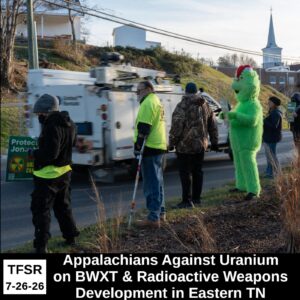
First up is a conversation with two activists of Appalachians Against Uranium in eastern Tennessee about the expansion of a nuclear weapons development in Jonesborough in the Tri-Cities near the border with North Carolina, Kentucky and Virginia in the Blue Ridge Mountains. For the interview we speak about the legacy of the nuclear industry in the region, health impacts on locals, some of the companies (like BWXT) involved, concerns of pollution and building off the work of past and ongoing civic activism in the region. Find our guests online at their website or find them on bluesky for further information.
If you missed our prior interview talking about other and related elements of the nuclear industries in the US, check out the chat with M.V. Ramana from our July 19th episode, found at our website.
Eastern TN Nuclear Links
- Scott Perez article on “economic hostages” available thanks to Dine CARE
- Dr. Michael Ketterer’s filings on behalf of ECAN (Erwin Citizens Awareness Network) with National Regulatory Commission related to, among other things, levels of radioactivity in the Nolichucky River: https://www.nrc.gov/docs/ML2231/ML22319A251.pdf
- Eastern TN Community Coalition: ETNCC.org
- wise-uranium.org
- Plowshares Movement wikipedia
- A book about the Transform Now Plowshares action in Oak Ridge, TN
The Ulm 5 Case in Germany
[00:50:00]
After this, you’ll hear a recording from May 14th, 2026 of journalist Roser Garí Pérez speaking in Freiberg, Germany, about the the case of the Ulm 5: five activists from various countries held in pre-trial detention since September of 2025 in Germany on charges of taking action against an Elbit Systems Deutschland factory in that country. Elbit Systems is an Israeli arms manufacturer whose products bring death to people in Palestine. The defendants have experienced long term isolation, extraordinarily long pre-trial detention without the option of bail. This segment appears in episode 104 of B(A)D News from the A-Radio Network, and was submitted and recorded by Radio Ausbruch from Freiberg
As a note for US listeners, the use of the term protocol in this segment can be translated to mean taken notes. You can keep up on the case, find how to write letters or send support, at https://ulm5.info/ and find updated writings on the case by Roser Garí Pérez on their instagram or their author page at The Left Berlin
Announcement
Support Request by 2020 Uprising Prisoner Khalif Miller
We received correspondence from Khalif Miller who was arrested in Philadelphia. Acording to his GoFundMe, “Khalif was held on pre-trial detention for 2 years and eventually sentenced to 5 years in Federal prison. As he was on probation at the time of his indictment he was additionally given a 1-10 year state sentence for probation violation.” According to his page on UprisingSupport.org, Khalif had this to say:
“I was working, I was trying to get my business up and running, I was going to school. I was doing things not just to help my family, I was trying to help communities. The day that I went to the protest… the night before when I was even making my signs. I spent 4 hours just making signs and writing down a bunch of people who were unfairly killed by police officers. This is something I really feel passionate about.
People say all the time, you can do anything you want in America. You can be whatever you want to be. Growing up, I heard it but I never really believed it because I felt like my resources were limited. The world has so many possibilities. I would like to teach that. That’s one of the things I would like to be able to pass along to the younger generations when I come home.”
Check the show notes for links to how you can write to Khalif and how you can offer him support during this long period of repression.
Write letters:
Smart Communications / PA DOC
Khalif Miller / #QQ9287
SCI Forest
PO Box 33028
St. Petersburg, FL 33733
Send books:
Khalif Miller
#QQ9287
268 Bricker Road
Bellefonte, PA 16823
. … . ..
Featured Track:
- TFSR by The Willows Whisper
- Certain Kind of Bounce by The Willows Whisper
. … . ..
Appalachians Against Uranium Transcript
Camille: I’m Camille. I use she/her pronouns.
Sam: Hi, I’m Sam. No pronouns.
Camille: I am a concerned individual and do some organizing with AAU, Appalachians Against Uranium, mostly centered around Johnson City.
TFSR: Great. Can you say a bit about AAU? Does it have a long track record, or is it an informal grouping? I’m sure a lot is in the name, but what is the purpose of the group? What do you do?
Camille: Yeah, of course. Appalachians Against Uranium is a fledgling, fairly new group. There’s been some other kinds of resistance against militarized nuclear projects in the area, but mostly focused on watchdogging, county commission zoning procedures, and government bureaucratic processes. We wanted a grassroots, fairly public-facing organization that could do other kinds of organizing that’s more direct and less mediated through government institutions.
TFSR: Cool. Let’s talk about what AAU is worried about. Can you talk a bit about what is going on in Jonesborough and what organizations or companies are engaged around it?
Camille: Absolutely. In Jonesborough, there’s a long-standing munitions plant that has been making depleted uranium munitions, largely anti-tank munitions, for decades, as I understand it. But this facility was recently bought by BWXT, that’s Babcock and Wilcox Technologies, who have an expansion where they just started earthmoving about a month ago. That expansion is geared towards producing what they call “high-purity depleted uranium,” which is a nuclear warhead component. They also have a facility in Erwin, Tennessee, which is just 30 minutes away from Jonesborough, between Johnson City and Asheville. That is where the National Fuel Service is located, which has historically been making two things. One is naval propulsion fuel, such as nuclear fuel for naval reactors in aircraft carriers and submarines. And then what they call “down blending,” which is taking high-purity uranium and turning it into low enrichment uranium for civil power generation. They also have an expansion slated to make high-enrichment uranium purification, and if they got it off the ground, it would be the only place in the U.S. doing that.
TFSR: There are a few things going on there, and this conversation is going to sit after the conversation with Ramona, which covered a lot of them. So in this instance we’re talking about a specific corporation, BWXT, which has its hands in civilian power-related nuclear energy as well as the elements of the military-industrial complex. We’ve talked about warheads, and we’ve also talked about depleted uranium, which in the conversation with Ramona we were talking about how anti-tank munitions are not considered nuclear weapons in the same way as a warhead is. So that’s interesting. In Erwin there is pre-existing infrastructure you were talking about, which is an expansion of the pre-existing depleted uranium plant that’s in Jonesborough. Can you talk a bit about some of the history of this region’s relationship with nuclear power, whether it be so-called atoms for peace or so-called atoms for war?
Camille: Going back to the Manhattan Project and the initial construction of nuclear weapons and nuclear power in the U.S. Oak Ridge, the so-called secret city just outside of Knoxville, was one of the epicenters of that. They focused on the uranium enrichment piece of that project, which is just about an hour and a half to two hours down the road. A big part of why these projects are being located here seems to be that proximity. They are making high-purity depleted uranium to send to Y12, which is the national security complex in Oak Ridge that stores enriched uranium and is involved in warhead construction. They make the high purity depleted uranium and ship it to Oak Ridge, where it can then get assembled or sent to other government facilities.
On the other side of this, you have the TVA, which operates a variety of nuclear power plants, and they are the only nuclear power plants that are producing plutonium and tritium, which are byproducts of power generation that then get used in nuclear weapons. It’s significant that if you’re doing power generation that’s producing those byproducts, you need what they call unobligated uranium. Because lots of uranium, depending on how you source it, especially if you import it internationally, will have restrictions so it can’t get used for weapons manufacturing.
BWXT is notable because they produce unobligated uranium proximate to TVA power plants that produce tritium and maybe plutonium. The proximity of TVA power plants that produce nuclear weapons byproducts to Y12, where these items can be stored and potentially assembled, creates this whole ecosystem of nuclear weapons and militarized nuclear technology.
TFSR: So Y12 is privately managed by a contracted company relating to national security that’s in the Oak Ridge area, right? You’ve mentioned the TVA. My familiarity with the Tennessee Valley Authority is in relation to the industrialization and electrification of parts of the South and Tennessee, particularly in the Roosevelt era. Large, massive national and industrial projects throughout the country got federal funding. If anyone’s seen “Oh, Brother, Where Art Thou?“, there’s a valley that’s flooded in order to make a large hydroelectric dam there.
I think that the legacy of this “public utility” has a public-private partnership and has a deep effect on the communities in which it’s based is interesting. Can you talk a little bit about it? Why is all of this nuclear infrastructure being put at a high elevation in the eastern part of the country, in Appalachia? What does that say about the surrounding communities and the view that the government has about the quality or the worth of those communities?
Camille: My first thought with TVA historically has also been growing up near TVA dams and having hydroelectric generation and then these recreational dams and this idea that it’s in some way about flood control. But you start looking into the history, it was ultimately intentionally flooding some communities in order to produce electricity and mitigating flooding in other communities. By controlling the dam even in real time, you have the ability to control how much water you let through and how much you keep back to affect which areas experience flooding and which ones don’t, which is wrapped up in classism and environmental racism: being able to concentrate and displace these kinds of effects onto less powerful, less desirable communities.
The TVA getting into nuclear power is in part like how some companies doing power generation expand into different forms. But I think the nature of TVA as this weird public-utility-private hybrid set it up to be more likely than most random private utility companies to be producing tritium and nuclear weapons components in that way.
Sam: I would like to add something to the relationship that these companies have to this area and to the people here. When I was learning more about this issue and learning about the politics of uranium generally, I was introduced to the concept of economic hostages through the writing of Scott Perez, who wrote some articles for Diné-C.A.R.E. It feels very prescient here that these companies are really promising economic development. They’re promising high-quality jobs. There’s this idea that they’re going to be able to come in here, poison the water and the air, which we’ll get into, and people will put up with it in the name of economic development.
TFSR: How does this new expansion relate to the existing eastern Tennessee and southwest Virginia infrastructure? If you could name some of those locations where some of these related facilities are. Oak Ridge, for instance, has already been named and we’ve talked about Erwin and Jonesborough a bit.
Camille: There are a couple pieces of this. There’s the BWXT piece, and then there’s the broader nuclear piece. I talked about the broader side with TVA and Oak Ridge/Y12 outside of Knoxville.
In terms of BWXT, the big thing is that they have a de facto monopoly on naval reactors and naval fuel, which is to say, basically every modern U.S. submarine and aircraft carrier has a nuclear reactor as its power source, and that reactor is almost certainly built by BWXT. This operation for the reactors is centered out of Ohio, Indiana, and Virginia. They have a facility near Akron, Ohio. They have a facility near Evansville, Indiana, in Mount Vernon, which is near the Illinois, Kentucky, and Indiana tri-state area, and then they’re headquartered in Lynchburg, Virginia. That’s making reactor components. They do so-called advanced fuel development. Lots of weird, cutting-edge fuels that are supposed to be inherently safe for small and modular reactors. Erwin, with their fuel fabrication, factors into that process, both with the plan to start doing high-purity uranium enrichment there—that is what you need to make that fuel—and with the fuel fabrication that they are already doing.
I was going to say also that there are only two sites where private sector companies are authorized to handle high-purity uranium, and they’re both BWXT sites. It’s the Erwin site and the Lynchburg site. Part of why this high-purity enrichment facility is being located there and why you have this whole cluster in the region is because there are tremendous security concerns around how you handle, transport, store, and guard high-security uranium, and BWXT is the only company that has managed to obtain and hold those security certifications. This is also why I think it’s important to oppose, because it’s not something that’s trivial to relocate elsewhere. It’s one of only a handful of sites where it would make sense to add this kind of operation right now.
TFSR: Now that we’ve located some sites where the processing is happening for these various purposes, maybe this is a good time to talk about the dangers to the local communities? If there’s been a long history of places like Erwin and Oak Ridge, there’s probably some documentation—as much as is allowed to be documented outside of national security, top secret, or whatever—of people who have been living in those communities. The impact of either immediately working in those facilities and handling the materials or just being in their communities, having them stored and moved around. Can you talk about what those health concerns have been? What’s understood of the outcomes?
Sam: I’m going to preface this by saying that this is a pretty difficult field of study. There is, as we would expect with this kind of thing, currently minimal available research. A lot of information has been repressed, and I personally am not a scientist. With that said, I’m going to do the best that I can.
I’m going to focus on Erwin and areas specifically downstream of Erwin. We know from the Erwin Citizens Awareness Network (ECAN) in Erwin that there is definitely some sense that something is very, very wrong. I don’t know if this is really common knowledge, especially in the wider Tri-Cities area. But there has been some citizen science research, and there are some reports. The data that does exist is incredibly worrying.
In 2010, Dr. Michael Ketterer started studying the pollution situation in and around Erwin, doing pro bono work for ECAN. He found highly enriched uranium in the Nolichucky River and the Davy Crockett Lake. This is coming from the Nuclear Fuel Services (NFS) site. The levels that were found in this 2010 report were significantly elevated above what we expect to occur naturally. They were not above what is federally permitted for uranium in tap water, but they were violating the wastewater permit that the NFS site has.
There has been more research since then. There has been uranium and plutonium found in soil water. As recently as 2023, it was found in the dust in the attic of an Erwin resident, which also points to these compounds being released into the air. We know that this NFS site has been leaking into the water and into the air, so that is affecting counties downstream. It is also potentially affecting Asheville and other places within the airshed.
When we combine knowing that this plant is absolutely leaking with death rates, it becomes even more worrying. There are two reports from the Radiation and Public Health Project. They have a bunch of numbers. I’m not going to read a bunch of numbers; I’m just going to give you one of them. From 2014 to 2018, in ages zero to 74, the death rate for Unicoi County was 61.4% above the national average, and for Greene County, it was 50.6% above the national average.
Death rates are high in all kinds of places for all kinds of reasons. What is most damning here is the curve of the change in death rates over time. Both counties were actually close to the national average between the 70s and 80s. They spiked in the 90s, and they have been climbing since. So this could absolutely be consistent with cumulative worsening effects over time that we expect from pollution like this.
One other thing that I forgot to mention is that uranium is a heavy metal. Like other heavy metals like lead, it bioaccumulates. It builds up in ecosystems. When it’s being released into the water, it isn’t just flowing downstream and being diluted. It’s being absorbed into the bodies of living things in that ecosystem, stored there in place, and then released again when they die. This obviously should be very, very worrying information. Clearly, it’s not conclusive, but it should be 100% a reason for a complete stop of nuclear activities in Erwin and significantly more research. Instead, BWXT, when they confront this information at all, are saying that what they’re doing is safe, it’s fine, and it poses no risk.
TFSR: Which is probably why the CEO lives right next to the processing facility, drinking the water right out of the pool and everything.
Sam: Yeah.
Camille: One thing I’ll add is just that while you can say that the evidence is inconclusive, there’s basically never conclusive evidence with this kind of radiation-based death, short of acute accidents and incidents. Even in the highest level of recognized nuclear accidents, the regulatory and institutional bureaucracy tends to deny effects with shocking gall, and so this is pretty good evidence. One of the major things that ECAN is pushing for is a pause on active activities and new construction for an environmental impact study, which could look at cumulative impact. Lots of government reporting ignores cumulative impact, but everything we know about radiation and radiation-based increased mortality says that this is a linear relationship to exposure over time. So there’s every reason to think that there would be a slight time lag after the operation started and then death rates climbing the way we’ve seen.
Sam: You also are possibly going to expect a geographical spread over time.
Camille: In terms of that geographical spread, I’ll also say that Knoxville is downriver from this. The Nolichucky river flows into the French Broad river, flows into the Tennessee, flows into the Mississippi, and while there’s an amount of pollution getting dispersed, also part of what that means is you are going to have random people probably dying as a result of this pollution, but in ways that statistically aren’t going to show up. Which is why I think there are lots of people in a broad region who have a stake in this and may just not know it or recognize it.
TFSR: An easy example of that could be when we’re talking about heat deaths. The way that statisticians can look at the impact of heat deaths or COVID. Even if something is not directly immediately attributable, either because the science is new or there is no understanding of this potential active cause, one way of assessing is to compare death rates from one time to another in a place during a time of year and seeing the needle moving. Even if it’s not that people are dying of cancer of the lymph system necessarily, they might be dying at a higher rate of something that relatedly puts pressure on another part of their body system that doesn’t actually get them to the point of that, but suddenly they’re getting attributes of this early stage that’s applying pressure on other body systems or what have you. Right?
Sam: Yeah, absolutely right.
TFSR: It’s okay if you don’t have information on this. But that’s enough, that should probably piss people off. In terms of these locations, the first thing that came to mind when you started talking about the water supplies and being downstream is Hurricane Helene. There is a huge amount of crap that went into the Duke Cole Ash Pond near the airport around here that nobody’s talking about and that’s been fought for a bunch of years, and I’m sure that it overflowed into the river during the flood. That was maybe the least immediate of a lot of people’s concerns, but it’s just not been discussed. Or the PCB piping company that’s down on the French Broad.
When a climate emergency-related event happens, for instance a flood that will run more material into a water supply, into groundwater, or into rivers to be carried through other communities, or even just an acute accident by people who are working in a facility, do you have a sense of what kind of footprint, besides the water supply, can be made? I’m wondering about fallout if there were an accident around a facility that is actively engaging in nuclear power.
Sam: One figure that comes up quite often is a 50-mile airshed. This is brought up often by people when talking about the Jonesborough plant and dust produced in depleted uranium manufacturing. There’s this idea that a 50-mile airshed around this area can potentially be affected. I don’t have as deep knowledge about the scope of accidents here, simply because realizing what is already wrong has been horrifying enough, and the mundanity of it all that has been happening for decades is really just horrific. There is also the specter of accidents, and I think that’s important to consider. But sometimes that is used to distract from what is happening right now.
Camille: An anecdote that I think exemplifies BWXT’s environmental approach is that there was a spring near the NFS site in Erwin that local residents were using for drinking water that theoretically shouldn’t have been contaminated by their processes, but it was. There was an extended period of time where local residents were drinking this irradiated water and getting cancer and other things at really high rates. And when this eventually came to light, the response was to put a chain-link fence around the spring and warning signs, rather than address why radiation was getting into the drinking water there; it was to simply bar off that spring.
Sam: Another anecdote that comes up for me is that part of the scientific inquiry that Hetterer has done involves measuring the unpredictability of the water table. Generally, the way that pollution spreads, especially pollution that is so small and can have such a disastrous impact at such tiny levels, is really unpredictable. Within the geographical region it is hard to say exactly what might happen, that’s the reason why people maybe don’t think about it. But the Tri-Cities should still feel like they have a personal vested stake in this issue.
TFSR: That’s very well put. Thank you, Sam. Besides what we’re talking about, the dangers of the everyday operation, there’s the danger related to the extraction, which is maybe a separate discussion, but I think it’s one worth getting into at some point. There are a lot of, for instance, Diné activists that have talked about defending their land in the southwest of the so-called U.S. from this type of extraction, this legacy of health concerns that have come in the shadow of that work.
There’s also the question of what this production is for. What is this going to be used for? If they’re expanding these facilities to process weapons-grade and weapons-related nuclear materials, either for warheads or for depleted uranium shells, can you talk about the horrors of nuclear war that are known? There haven’t been very many warheads that have been dropped in world history. We have a couple of examples from the U.S. doing it in Japan, but I wonder if you want to talk about the reasons outside of the local community for people to be concerned about participating or allowing this to go forward in their community or anywhere.
Camille: During the Cold War, the U.S. built these huge nuclear arsenals, and all kinds of people did the numbers, and you could kill the entire population of the Earth many times over with them. As the Cold War wound down, we started to get some minor gains on disarmament, and in 1993, there was a huge treaty signed with Russia to start taking enriched uranium out of warheads and downblend it. They call it the Megatons to Megawatts Program, using it for power generation, which has all kinds of issues but did lead to starting to chip away at nuclear warhead arsenals.
These expansions seem to have worked through the stockpiles enough that the state is invested in starting up new production to maintain and grow those warheads to maintain the ability to kill the planet over the course of the next decades or century. I think it’s hard to imagine any use of a nuclear weapon that doesn’t lead to billions of deaths. And complete extinction is fully within the realm of possibilities.
Even with depleted uranium, which, as you said earlier, is a nuclear-adjacent weapon, it’s just not what we think of when we say nuclear weapons. All of the kinds of concerns that we’ve been talking about locally with pollution and with inability to directly prove cause of death are going to be happening anywhere the U.S. is waging war. And because those people aren’t U.S. citizens, because they’re probably brown, Muslim, or otherwise marginalized, there’s going to be even less standing in any way to recognize that people are dying as a result of the U.S. using weapons that are putting radiation out into the environment.
I’ve not done a tremendous amount of prep there. I mostly tell people that nuclear war is bad.
TFSR: Yeah, that’s great, and it needs to be a point of heavy discussion like it was during the Cold War era, but it has gone out of conversation for the most part. Now that we’ve got an administration that’s looking to spread its arms production as much as possible and profit the companies that are a part of the military-industrial complex and reinvigorate this specific element, we have to restart the conversations about this as a possibility. Why is it bad, and how do we resist it? I think this is important. The work, the research, and what you’re talking about are really important on a bunch of different levels. So I really appreciate this conversation. Can we talk a little bit about some of the companies that are involved in this expansion of infrastructure?
Sam: Yes. So I am going to list some entities that are involved in the Jonesborough construction. This is just the information that I have to share at the time of recording. BWXT is contracting to Edgewater Technical Associates for this construction project. This is a nuclear industry building contractor that has offices in Los Alamos and Carlsbad, New Mexico, Oak Ridge and Johnson City, Tennessee, New Ellington, South Carolina; and Richland, Washington.
They are subcontracting out to Evans General Contractors, which is a general industrial contractor that has offices in Charleston and Greenville, South Carolina, Charlotte and Raleigh, North Carolina, Atlanta and Savannah, Georgia, Dallas, Texas, and Jacksonville, Florida. They are contracting engineering to a firm called Thomas and Hutton. This is a southeast regional engineering firm that has more offices than I care to list in Alabama, Florida, Georgia, North and South Carolina, and Tennessee.
The final thing that I’m going to say is that the logistics and transportation for nuclear material itself are handled by Energy Solutions. This is a company that has its hands in a lot of nuclear industry infrastructure. They mainly do nuclear cleanup, but they also do transportation and logistics for nuclear materials generally. And the reason why I mention this is that the trucks are very, very easy to identify. If you go on their website and to their transportation and logistics page, there are pictures. And as soon as I learned how to recognize these trucks, I saw two of them the same day.
Just knowing what these look like, I feel, is very important. Especially if you’re in this region, or even if you’re looking somewhere else, to really ground this as a non-hypothetical thing that’s happening and to really start to understand how these materials are actually moving through our physical world and through our community.
TFSR: That company, just from a quick search, is headquartered in Salt Lake City and also in Charlotte, right?
Sam: Yes, there are a lot of corporate headquarters in Charlotte. I believe every company that I have mentioned has an office in Charlotte. This is also where the BWXT corporation is located.
TFSR: To get on to the next considerations question, we’ve been talking about the implications of this technology and this expansion with an eye towards “this is not something that we like.” We are not advocating any specific responses to these dire circumstances that are being created by the organizations that are involved in this. Or the agencies that are promoting it and profiting off of it. I am not, at least. With that said, this is not only a part of the energy infrastructure, which often sees environmental protest around the expansion of energy infrastructure and the impacts that it can have, but there’s a national security element in consideration with that. This is connected to the DOE, Department of Energy, but it also overlaps with the U.S. military and ideas of national security in terms of weapons production, national defense, and the Department of Defense.
I wonder if you have any information or insights about how people are considering ways of protesting, attempting to change policy, or applying pressure on companies, whether as shareholders or as members of the community that are engaged in these Department of Defense and DOE-adjacent or implicated industries. Are there any lessons that we can learn about ways to keep yourself safer or aware of the possibilities?
This last week, we just aired an interview about the Prairieland case and federal sentencing of people that were getting decades to up to 100 years for a circumstance where nobody died. This as opposed to the right-wingers on Jan. 6 that have been at different times offered money and had their sentences revoked, thanks to the kindness and largesse of the president, and have been invited by elements of the DOJ at points to actually file suits against the DOJ for challenging them in the first place.
I guess what I’m long-windedly saying is that I could see the DOJ and the federal government going hard after anyone who is challenging the nuclear program or who is threatening the big money and big danger that could be created in these “energy production projects.” I wonder if you have any sort of insights that you want to share with the audience about what that can look like, not being lawyers.
Camille: Disclaimers: I am not a lawyer. I am not your lawyer. None of this is legal advice. And also, the government is innovative in its application of the law and in its ignoring of the law to prosecute dissidents. There is no way to know how it might try to push charges. But we’ve done a small study on the Plowshares movement, which is an anti-nuclear, anti-war movement that has been happening broadly under the Catholic Worker umbrella since the 80s, but with actions as recent as the 2010s. There was an action in 2012 where three members broke into the Y12 national security complex to protest nuclear weapons. That’s a good case study in at least one version of what repression can look like.
They got charged with three things initially. One was a basic trespassing charge that later got dropped. The other two were a destruction of government property charge and a charge under the Sabotage Act, saying that essentially they were disrupting the United States’ ability to carry out war by breaking into that complex, and thus this constituted sabotage, which is a charge that carries up to 20 years or up to 30 years if the U.S. wants to say that it’s at war or in a state of emergency.
This is a weird World War II-era law that is ridiculously broad on the books. I will try to avoid going into the granular details, but it essentially defines almost everything as a war material. It’s arms and armaments, but also anything that might get used in that production, anything that might get used in the mining and extraction of raw materials that eventually might become armaments, and then any location where they might move or repair or maintain or store these materials. The law is basically saying if you intend to or could reasonably expect that you’re going to inhibit the U.S.’s ability to carry out war and in any way obstruct, interfere with, or damage these sites or materials, then it falls under the Sabotage Act. Notably, there is a conspiracy charge associated with that act. If multiple people conspire to do something that would be covered by the act, and then one of them actually carries it out, the charge applies to everyone who the government decides is part of the conspiracy.
This is really scary on paper, but also this is one of those laws that are on the books and could be applied in lots of ways, but it probably would not actually hold up in court at this point. The charge I was talking about from 2012 and three Plowshares activists going into Y12 was overturned in appeals at the Sixth Circuit Court, which, for reasons of precedent, applies to Tennessee. At that point the judges basically were like, “This is so broad as to be nebulous.” For anything to count, it needs to actually functionally disrupt the U.S.’s ability to carry out war. Breaking into Y12 did not actually change the ability of the U.S. to respond to an immediate threat. It didn’t really disrupt long-term supply chains, thus that charge got overturned.
All of this context around repression is part of why we’re drawing attention to BWXT because it is a private-sector company as opposed to a federal site like Y12, and the expansions, until they’re built, are not actively producing munitions. Ultimately, this is one of those hyperbroad laws that the government could try and push on virtually anyone, by the letter of the law. Any protest that disrupts a highway, any kind of anti-mining or anti-energy action, could be prosecuted under this law. But as is the case generally, the main restriction on the U.S.’s ability to repress activists is not the law. It is ultimately the legitimacy of the state and popular support for those activists.
My main takeaway here is that I think it’s essential that we have an anti-war movement. The U.S. foreign policy is as unpopular as it has ever been. There are all kinds of potential, and I think building a movement, taking care of each other, and finding ways to leverage power is absolutely essential. The more we build that movement, the more we can take care of ourselves and mitigate the ability for the U.S. to repress activists through these hyperbroad, nebulous kinds of charges.
Sam: Something that I would like to add to this sense of stakes is that we know that the extremely high cost of nuclear weapons has influenced international weapons bans in the past. This is a huge motivating factor in the way the treaties get written. Nuclear arms races are simply wildly expensive, and so countries will agree to not do them because of this. It is very possible that if this so-called nuclear renaissance proves to be overly ambitious, if it is more expensive or takes much longer than anticipated, it could have global impacts. The U.S. government may be much more inclined to pursue deals that limit nuclear arsenals. Obviously, fewer bombs are somewhat better for the stakes of nuclear conflict, but a little bit more significantly moving the needle, this will reduce demand in the nuclear industry.
TFSR: Clearly there are stakes that are being posed by the state and have been in the past when people have challenged its ability to expand the death machine. And understanding those stakes, people have stood up, participating in the various ways that they could or made sense to them. That’s one great thing about getting involved in a cause that you care about, that there are numerous ways that you can get involved. There are various skills that you can bring or develop, and there are a lot of different fronts that this stuff can get challenged with. In a lot of cases, as long as our movements are broad, that allows a lot more support for the more radical elements to not only exist but be supported by their other comrades.
I wonder if you want to name any groups that are already involved in this work. If there are resources that you want to point us to, we will put them in the show notes, or any ways that you might suggest somebody start thinking about their relationship to this or getting involved in the community that they’re in.
Sam: The first thing that I want to say is that if you are listening from Asheville, and you have sat through this entire episode, you could have already made it to Johnson City by now. It is really not that far to come and get involved on the ground here. You can check out the Bluesky account, Appalachians Against Uranium. At the time of recording, that is the best place to find link aggregation. If you have any information that you want to share, or if you are interested in getting involved, you can also email appalachians-against-uranium@proton.me.
Another group that is active in the area is the East Tennessee Community Coalition. They are pursuing a more litigation-route resistance to the Jonesborough expansion. You can find them at etncc.org. Finally, I want to shout out the Erwin Citizens Awareness Network. They don’t have a specific online presence that I can point anyone to, but if you Google them you will find evidence of their work over the past decades. They have been doing a lot of really incredible things. They’ve been doing, as I talked about earlier, some really awesome science and information about what is actually happening, and a lot of our data is coming from them. So a super cool group.
Camille: One thing that I’ll add is, even if you’re in a completely different region than what we’ve been talking about, one: BWXT has affiliate offices absolutely everywhere, and two: there’s a site, Wise- Uranium, which is charmingly Web 1.0 and also incredibly informative about all kinds of nuclear nonsense going on. If there is some other kind of nuclear project in your area, it’s really easy to be right next to these things and possibly affected by pollution they are putting out and not know about it. So if you’re interested in this, if you live somewhere we haven’t been talking about, I would go over to that website and just see what the nearest horrible nuclear thing is, because it’s good to be aware of these things.
TFSR: Sam and Camille, is there anything that I didn’t ask about that you want to mention right now before we end this interview?
Camille: One thing, BWXT has its hands in so many horrible things that it’s hard to get to them all. One that stood out to me is they are currently leading the bidding contest to produce a micro-reactor for the U.S. military. This is called Project Peel or Project Janus, depending on which agency it’s through. Small modular reactors are this weird category that, as I understand, includes anything under 300 megawatts. Project Peel is talking about a micro-reactor, which is 1-5 megawatts, with the idea being that this would be deployable by rail or by air, be about the size of four shipping containers, and they would be putting this onforwardoperating bases, army bases, maybe moon bases. Kind of wherever.
I think nuclear safety is largely a myth, especially when you talk about adding nuclear reactors to active war zones. I think the idea that you could model what’s going to happen if a generator gets hit is really ludicrous. If you watch the war between Ukraine and Russia, you see skirting against nuclear disaster, with sides accusing the other of storing arms at nuclear bases, with nuclear bases getting shelled or nearly getting shelled. Talking about adding nuclear reactors to army bases all over the place is just a massive accelerant towards pouring huge amounts of fallout into the environment.
TFSR: Yeah, thank you both so much for the work that you’re doing, the research, and coming onto the show to talk.
Sam: Yeah, thank you so much for having us.
Camille: Yeah, thank you.
. … . ..
Ulm 5 Transcription
Radio Ausbruch: You are about to hear an overview of an ongoing court case in Germany involving five activists known as the Ulm 5, who have been subjected to significant repression. The five are accused of carrying out an act of sabotage against the arms manufacturer, Elbit, in solidarity with Palestine. At an event in Freiburg on May the 14th, journalist Roser Garí Pérez from Berlin, who has been closely following the trial, gave a talk providing an overview of the case.
Roser Garí Pérez: On the 8th of September last year, five people allegedly entered the Elbit system in the city of Ulm, and there they allegedly broke some stuff to try to stop the genocide in Gaza, or at least, like they say in their opening statements, for an hour or a day. Since then, they have been in pre-trial detention.
They waited for the police; they didn’t try to flee. They filmed themselves and they waited for the police. The police arrested them and had them for 30 hours without being able to connect with a lawyer or their families. So basically they disappeared, and after that they were sent to different prisons, where they have been in pretrial detention. The normal rule for pretrial detention in Germany is that it’s supposed to be no more than six months. Now we are in month nine, and some of the people like Daniel are in horrible conditions with 23 hours of isolation. Other ones have 22 hours of isolation. One can live a little bit more because they are working, but that’s it.
Communication with them has been very restricted. All the letters are being read. There are restrictions, for example, forVi. All the letters have to be in German, and for the other ones, I think English or German. The letters, for example, for the Spanish citizen Leandra, cannot be in Spanish.
The visits are different for all of them, because the prisons have their own rules. Most of them just have two visits a month, 30 minutes each. So you have to think that at the very least, the people come from Berlin, and in the case ofDaniel and Crow, their families come from the UK or Ireland to visit them for 30 minutes. To arrange a visit takes a whole day of phoning the prison and trying to get all the permissions ready. And even though it takes so much time to prepare and people come from far away to see their loved ones, sometimes because of things like the translator not being there or arriving late, their visit gets cut short.
The phone calls are also a mess. First of all, they are very expensive. So, for example, the person that works has to work six hours to be able to pay for a few minutes of a phone call. They are also being hurt, and they don’t say when they are allowed to call. If they call, let’s say, their mother, and the mother is in that moment in a meeting and doesn’t see the phone call, that’s it. So, communications with them are very annoying. During the visits, there is always a policeman there listening to everything they say, and they are not allowed to talk about the case. It’s a little bit weird. I don’t know how it is in Germany. But the investigation was finished in December. These people should be out on bail, and they should be able to talk about everything, because they should not be in pre-trial detention. Everything is, to say the least, dodgy and horrible.
Then we got the trial dates. They have 11 lawyers. Most of them have two lawyers, and one person has three lawyers. In preparation for the case, the lawyers tried to talk with the judge and with the prosecutor about how it was going to go because originally there were 16 court dates starting the 27th of April until the end of July. They were trying to see what is going to be seen in each of the court dates, and they say communication was non-existent. They have no idea of what is going to be happening the next day and are not able to plan their defense properly.
After the first day, when the judge decided not to hear any of the motions of the defense team, I will get to that later, and a few other days when it has been going rather slow because the judge is not ready to hear any of the arguments or any of the motions. She decided to add 28 more dates. So now we have 44 dates going from 27th of April until the 8th of January. At that point, they will have been 16 months in pre-trial detention, so 10 months more than should be the rule. They are accused of breaking and entering, of damage to private property, and of using slogans of forbidden terrorist organizations, “from the river to the sea,”and they also say they have an antisemitic motivation because they wrote that Israel kills children, which is a reality.
So the case is going terribly wrong. First of all, the judge has moved this case. Instead of its being heard inLandgericht Stuttgart, which is in the regional court in the middle of Stuttgart,she decided to move it to the High Security Court of Stammheim. Stammheim is and will forever be connected to the alleged left-wing terrorism of the RAF from the 70s.Just the choice to have it heard there already sets the stage to paint them as criminals and basically terrorists in the minds of any German that knows a little bit of history.
When we got there, we saw that they divided the public from the rest of the court by a two-and-a-half-meter tall glass. The defendants themselves are behind a glass cage. When the press can take photos, they are brought in in handcuffs that are very tight. This is how they are presented to the press: in a glass cage, in handcuffs like dangerous criminals. That’s bascially what the court is trying to say.
The lawyers were presenting motions to sit next to their defendants because right now they have to speak with the defendants that are sitting behind them, so they cannot even see when the defendants want to talk to them through a microphone. When they are using that microphone, first the lawyers cannot follow what is going on in the court case, but also the defendants cannot hear what is going on during the court case. So if the judge is saying something and they are in that moment talking to their lawyers, they cannot hear what the judge is saying. They fought and they are still fighting for the defendants to sit next to them, as is the normal thing in Germany. But the judge is not having any of this and is saying that they have to sit inside the glass cage.
Another thing that the lawyers are fighting for is to be able to have somebody writing down what is going on, because in Germany there is no transcript of the trials, and the trials are not being recorded. The only thing that goes into the official protocol is what the judge decides that goes into the official protocol. For example, when on the first day the lawyers were making all these motions to sit next to their clients, she did not turn their microphones on, and none of the things they said, except one thing at the beginning, are in the official protocol. So another thing that they are fighting for is that the public could also write protocol. The judge doesn’t allow for the public to write a protocol because they say pens are sharp weapons in the hands of the public. I have to say that the public is surrounded by 16 heavily equipped armed security guards, and I really don’t know what we could do with a pen against those guys who, when the judges tell us to leave, threaten us with violence.
Those are the basic motions. Since then, and because this is a show trial and everything is preposterous, the lawyers have been trying to make the judge recuse herself because of bias. She has denied this and says she’s not going to recuse herself. There are five judges: the president, two professional ones, and two civil judges. The lawyers tried to make the five recuse themselves because the trial is not going in a fair way, and the defendants are already presented as criminals. That has been refused as well.
The only good thing about the trial, and this is where you come in, is the solidarity around the people. The room has always been full. We have 66 places for the public, including press. They were always full, mainly by people in solidarity. Every time the Ulm Five comes in, there is a standing ovation. It’s very nice, and the first few days we got away with a lot. There were some chants, like “free Palestine” and everything, which was very nice. But now the judge is very upset with us and has forbidden us not only to clap, chant, or sing but also to do silent applause. There is always a rally outside to explain what is going on. So the solidarity has been very good. For example, right now, in an hour, a full bus from Berlin is coming with 50 people, and there are more people coming from Frankfurt and stuff like that. So try to organize a trip and see it for yourselves. First to show solidarity. That’s the most important thing. And second, so you can see for yourselves what a show it is and how unfair it is. So get riled up and mobilize and spread the word.