
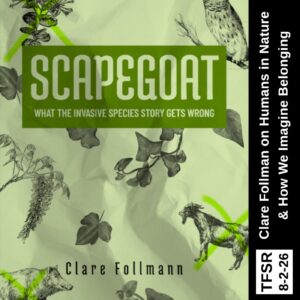
This week we’re sharing a conversation with Clare Follman, a writer, activist and gardener with a masters in environmental science about her 2026 AK Press book, Scapegoat: What the Invasive Species Story Gets Wrong. The conversation covers questions of ecological balance, belonging, linguistic clarity and the stories we tell about our relationship to the rest of nature.
. … . ..
Featured Track:
- TFSR by The Willows Whisper
. … . ..
Transcription
TFSR: Will you introduce yourself with your name, pronouns, and any other information about yourself that you would like listeners to know?
Clare Follmann: Sure. Hi, I’m Clare Follmann. I use she/her pronouns. I am an author and environmentalist located in Olympia, Washington. My writing engages with themes of ecology, language, politics, and philosophy. I like to poke holes in dominant or obsolete narratives and strive to both listen to and help uplift the voices and stories that have been too often cast aside, including those from the more-than-human world. My work focuses on finding and planting the literal and figurative seeds that will help support a post-capitalist society that prioritizes the well-being of people and planet.
TFSR: Cool. Thank you. We’re here to talk about your recent book called Scapegoat: What the Invasive Species Story Gets Wrong. In this book, you blend a discussion of language-use with those of environmentalism, politics, and a critique of “invasive species management.” Will you talk about the confluence of all these and how you arrived at this intersection of ideas?
Clare Follmann: I’ll start with the language piece because that’s one part of my book that people are really split on. Some people love how much time I spend talking about the way in which language functions to shape how we see ourselves in the world around us, and other people are really like, “Why is this an environmental or ecology book?” To speak a little bit about invasive species management as a discipline: if you explore it and research it to any depth, you’re going to find such a heavy critique of the language that is used to discuss invasive species. The definitions are slippery, but also there’s this obvious xenophobic undertone when talking about invasive species and species that are coming into new spaces that don’t belong here, alien and exotic, or other synonyms that are used to talk about invasive species. Aside from the inherent racism embedded in this sort of discussion, these words are very confusing. There’s so much discussion on how to clarify and pin down these definitions that are quite slippery. That’s why I really wanted to focus on language because it’s just such a common critique of invasive species management, and I felt that to really engage in the conversation and contribute in meaningful ways, I wanted to focus on how words work.
I really do focus a lot of time on semiotics and linguistics. But all that aside, what really got me started on exploring and critiquing invasive species management as it’s most popularly performed today, I was in a prerequisite course for my master’s of environmental studies class. It was on forest ecology, and we had this guest speaker named Lowell Diller, an ornithologist and wildlife biologist, come to talk to our class about the work he was doing, which at the time involved killing the barred owl to save the spotted owl. Some context: the barred owl is considered invasive where I live in the Pacific Northwest. It originates on the eastern side of the continent, and it moved and migrated to the Pacific Northwest because, as colonizers violently settled the continent, they created two routes, two pathways for the barred owl to move west. They violently suppressed and controlled birding practices of the indigenous people, and also extirpated beaver and bison. This allowed the boreal forests of Canada to grow and created these little pockmarked oasis green spaces in the Great Plains. That allowed the barred owl to move west, where the spotted owl was also facing side effects of colonization, namely logging was destroying spotted owl habitat. The spotted owl is a native species to the Pacific Northwest and requires great swaths of old-growth forest to thrive. Logging was destroying old-growth forests. When the barred owl moved to the Pacific Northwest, it competed to a degree with the spotted owl. It eats what the spotted owl eats, but it can eat other things as well. It lives where the spotted owl lives, but it can live in other places as well. It also has more nestlings per season.
Lowell Diller was doing this experiment to see if killing the barred owl would save the spotted owl. It was a plan to kill about 3000 barred owls at the time, and when he came to talk to our class, he had killed 70. What really struck me, other than this story, was that it has these undertones of a Greek tragedy, especially since the birds look very, very similar. What struck me about this story was that Lowell Diller himself was stricken, heartbroken, to kill the barred owl. He had spent his whole career learning to revere raptors, and now he had to be their executioner. He wasn’t shy to talk about his anguish, and he shared that the first day he had to kill one, he had a breakdown. That really struck me. He said, “I hate to do it. I hate to kill barred owls, but it’s the best plan we have available to save the spotted owl.” I remember thinking to myself, “I don’t know. You’re the expert. You probably know better than I do. You certainly know better than I do about this. But I wonder if there is a better plan available.”
That’s what started my interest in exploring invasive species management. During my research, I actually found a lot of plot holes in the general invasive species management story, but also specifically Lowell Diller’s story. This is where the intersection of politics and language and story and all that come to play. What’s so interesting about the barred owl slaughter story is that Lowell Diller, at the time of performing this experiment, was actually employed by a mega timber company in the Pacific Northwest. A little more context: when the spotted owl was put on the endangered species list, environmentalists and activists were rallying against loggers and the timber companies for being the main contributor to spotted owl decline. There was this long, nasty battle between them with treesits and tree spikes and rumors of spotted owl barbecues and T-shirts that said: “Save a logger, eat an owl.” It’s quite telling that after that big battle between environmentalists and loggers, Lowell Diller, employed by a mega timber company, was encouraged and funded to engage in this experiment to see if barred owls actually could be proven to be contributing to spotted owl decline.
This is the key story that I am sharing about in my book. I’m arguing that the barred owl is scapegoated, and we are distracted by the invasive species management projects of slaughtering the barred owl. Meanwhile, logging is able to continue wreaking havoc and contributing to habitat destruction, as long as we are focused on our efforts to kill the barred owl to save the planet. That’s the original story that got me interested in this particular topic. Then, as I continued researching, I found more and more plot holes and issues with this story that created this very compelling scapegoat narrative.
TFSR: As an outsider to that story, it’s strange to me that that would be the solution you would land on, especially for something that you love that much. The solution is we need to kill it. One of the things you talk about in your book quite a bit is that militaristic language and tactics are used heavily to interface with and to describe invasive species. Can you talk a little bit more about the current understanding of invasive species, when and how this came to be, an ways we talk about these species and these animals?
Clare Follmann: Absolutely. Invasion biology, this discipline that points out these particular species that may be contributing to an unbalanced ecosystem, has been a study and discipline for quite a while, but it didn’t really gain popularity until right after World War II. And this author, Charles Elton, wrote in his book, Ecology of Invasions by Animals and Plants. This book is absolutely full of militaristic and war metaphors. What’s also interesting is that as it was gaining in popularity, it then burst with popularity in this post-war era, the Nazis before World War II were very, very obsessed with the idea of invasive species management. It obviously had a lot of parallels to their bigoted xenophobic perspectives. Some of the studies and ways in which they classified and organized invasive species inform different techniques of their xenophobic ways of classifying and organizing people of different races. It’s got this very inherent war militaristic metaphor, which is a problematic metaphor. This is a metaphor that shows up in a variety of different disciplines, medicine is another example. It’s a problematic metaphor.
This isn’t to say that metaphors themselves are a problem. I love metaphors, and when metaphors are used in various disciplines, even science, there can be absolutely harmless metaphors and non-problematic metaphors. But when used in disciplines like science and disciplines that organize how you understand yourself and the world around you, there are certain metaphors that can be problematic. I’ll give an example of a non-problematic metaphor to help illustrate why the militaristic metaphor is so problematic when it comes to talking about invasive species. A non-problem metaphor in science is the billiard ball model of molecules, and it gets at the idea that molecules bounce off of one another like billiard balls. It’s a non-problem metaphor because we don’t actually think of molecules as if they’re fist-sized, colored balls with numbers on them. It’s easy to disentangle the metaphor from the fact. Whereas in medicine and invasive species management, it’s actually a lot harder to disentangle the militaristic perspective from what is actually happening. There was a study done where these scientists and doctors were interviewed about their perspective on the use of the militaristic metaphor when talking about the immune system, and a lot of the doctors and scientists who were interviewed were like, “It’s not a metaphor. That’s actually just how it is.”
But in fact, in microorganisms and invasive species, these are organisms, these are species, these are creatures that cannot engage in war by any stretch of the imagination. That is an anthropogenic activity. Invasive species were brought into a new place by people, and they are trying to live. That’s all they’re doing. They may be very well-suited to the area and thrive very well and destabilize ecosystems, but there’s no war happening. The thing is, because the militaristic metaphor is so hard to disentangle from what’s happening, it’s easy to look at an ecosystem and see invasive species and think, “Oh no, it’s polluting the genetic integrity, the pristine utopian native habitat. It’s invading. It’s mercilessly slaughtering all the native species. It’s a colonizer.” It is easy to see these species and have that metaphor be very persuasive.
Aside from the metaphor being hard to disentangle from what is actually happening, it also fuels some problematic mythologies, especially when you’re talking about the natural world. It has this inherent hierarchy that people are above nature and can or should command and control nature in some capacity. It creates this us-versus-them mentality. The biggest issue is that it’s predicated on this belief that people and the natural world are separate entities. That’s one of the biggest, most problematic mythologies of capitalism for ecological care. Because the militaristic metaphor is so persuasive and so villainizing, it creates a very biased and aggressive mentality of engagement with these particular species that is a very problematic way of thinking about any aspect of the natural world, especially today. That’s the main metaphor that is used when we talk about invasive species. It’s very popular. It’s very persuasive. It is biased, and it is missing nuance that would help inform a better way of ecologlical repair.
TFSR: This is an aside, but have you found that there’s any pushback in the scientific community to this language and way of talking about things?
Clare Follmann: Yeah. As I said earlier, the language used to talk about invasive species is the number one critique. Charles Elton with his original militaristic metaphor just informed rampant popular discourse about invasive species. It’s the number one critique of how people talk about invasive species, and there’s discussion of different terms and phrases to use to decrease or combat the militaristic metaphors. There’s this one metaphor that’s gaining some popularity that I like a lot better than the militaristic metaphor because it helps ground the root cause of ecological issues that exist beyond invasive species: the passenger-driver metaphor or the passenger-driver model of talking about invasive species. The passenger-driver metaphor basically gets at the idea that invasive species can be either passengers or drivers of ecological degradation or issues. But studies and research are showing that, by and large, these invasive species are not driving the ecological issues that they are being blamed for, but rather are arriving in the wake of pre-existing conditions of ecological damage and degradation that are being driven by some other system, something else.
We can go back to the barred owl and spotted owl example. The barred owl is arriving in pre-existing conditions of ecological degradation due to logging, which is negatively impacting spotted owl habitat and other native species habitat, and it is just trying to survive while spotted owls decrease. Another example, in California, there’s this ecosystem where there’s this invasive grass that grows really well in this ecosystem, and it’s because the ecosystem has very nitrogen-rich soil. The thing is that the soil hasn’t always been nitrogen-rich. It only became nitrogen-rich after they built a highway next to the ecosystem. And the air pollution from the highway increased the availability of nitrogen in the soil while also decreasing the native ecosystem’s resilience. These two situations were the conditions that allowed this invasive grass that was brought here by people to grow and spread and thrive.
TFSR: One thing I would be interested in, which you talked about in the book, was the way this militaristic approach affects the way people choose to “manage” invasive species, and that often the destruction of habitats that have had invasive species in them, to put it succinctly, is pretty terrible for everyone involved that live there. Could you expand on that a little bit more?
Clare Follmann: Yeah. As I was saying, the militaristic metaphor really fuels this very tunnel-vision bias, aggressive hatred of a particular group or species, who, I argue, are innocent victims of colonization and/or capitalism but are in many cases contributing negatively to the ecosystem or destabilizing the ecosystem to some degree or infringing upon native species. However, there are studies that show that the removal of one invasive species in an ecosystem at a time always resulted in a negative effect on the rest of the ecosystem and the native species in that ecosystem, or something to that effect. I was blown away by that too. It’s basically getting at the idea that these species in these ecosystems, invasive or not, are deeply entangled with one another. They have these relationships, even if in certain cases with invasive species, those relationships are not as beneficial to or reciprocal as one would want. But they still have these relationships. It’s never just cut-and-dried, like this species is only doing harm to this particular habitat, because ecosystems are so complex.
There’s this example of a habitat near where I live that was slated for development, and it was a habitat that had a lot of herons. It had a heron rookery in it. A bunch of people gathered together to try to stop this development from happening, and they were successful. I think saving the habitat made them feel a sense of responsibility to care for the habitat and to tend to the land. They went in to do some invasive species management removal, specifically removing English ivy, which is considered an invasive species where I live. A bunch of neighbors pulled this ivy out of the habitat, and the herons left. The thinking is that, of course, English ivy grows abundantly. It outcompetes a lot of ground-cover native species like wild ginger, starflower, and bleeding heart. But in this particular case, it also created a really beneficial and attractive habitat sense of cover specifically for the herons, because the herons would have their babies, and the ivy created this camouflage, this cover. The herons felt less exposed when the ivy was there. This is what the common thinking goes. When the ivy was removed, the herons felt too exposed, and they left and moved away. So yes, English ivy is outcompeting certain species, and at the same time, it is also, in this particular case, benefiting the heron. So it just really goes to show how interconnected and how complex the relationships that species have in ecosystems are, native, non-native, invasive.
TFSR: You bringing up this story reminded me of something else about the book that I really appreciate, which is you have a lot of sources that you cite and studies and other stories like that, which really helped frame things in a way where any place that you live, you could apply these concepts to. If one wanted to explore one’s own ecosystems and what’s happening there, I’m sure there are countless cases where there are less documented or less explored cases of invasive species management taking place at a local level. We can’t talk about everything that was in the book, but it’s really impressive.
Clare Follmann: Yeah, after writing this book and talking to people who are coming to my book talks or reaching out to me online, I keep hearing so many similar examples to this heron story. As I said before, it just underscores the inherent complexity of these ecosystems and also that an extremely aggressive and tunnel-visioned perspective when engaging with these species is harmful. Lots of ways of managing invasive species are very obviously, clearly, objectively harmful not just to the species they’re trying to eradicate, but also to other species as well, like poisoning and herbicides. I found this statistic that I did not include in my book because I didn’t know it at the time, but I found out recently that when herbicides or pesticides are applied, they only hit up to 10% of what they’re targeting. Only 10% of these poisons are hitting the invasive species. The rest are being spread across the ecosystem and hurting native species as well. You have a lot of different, varied examples of the ways in which invasive species management can ultimately negatively impact the ecosystem.That isn’t to say that maybe after a while, the eradication of the invasive species eventually will destabilize that ecosystem and generate more biodiversity, which is obviously the goal. But the ways in which we are organizing invasive species management through this very biased tunnel-vision perspective, informed also by a capitalist approach using the most quick and dirty methods like poisoning or bulldozing that sacrifice native species as well, is just not the best approach by any stretch of the imagination to tending to ecosystems and generating reciprocal ecological relationships.
TFSR: Can we return to the discussion of language for one more question?
Clare Follmann: Absolutely.
TFSR: There was a major point in your book, which was plastic language and how plastic words are wielded to manipulate spaces and concepts. Could you outline that concept for us and talk about how it’s weaponized in science specifically?
Clare Follmann: Absolutely. Plastic words is such a fascinating thesis, such an incredible topic. People who read my book, I hope they take a lot away, if nothing else, but plastic words is such a rich topic, and I hope people explore this concept more intensely as they read my book and apply it to different disciplines beyond science and invasive species management because it infects so many various areas of our lives.
Plastic words are a class of terms coined by this German linguist philosopher named Uwe Pörksen in the 80s. He was at this conference in Spain listening to this lecture in Spanish, he’s German, and he heard a certain type of word being used over and over again. At the end of the speech, he sat there, and he thought, “A lot was being said. I know a lot of words were coming out of this man’s mouth, but I don’t actually know what any of it meant.” That inspired him to start classifying the words that he heard, and he discovered that these are words that were born in the vernacular, and then adopted by science, and then they were brought back into the vernacular, stripped of their original meaning but infused with this aura and power and sense and authority of science and scientism. These are words like “development,” “progress,” “strategy,” “values,” “resource,” “manage.” There’s like 20 of them all together. You have a vague idea of what they mean, but the definition in any context is slippery and hard to pin down.
For example, “management” can mean its very inverse. In “invasive species management,” the word “management” is going to mean the very opposite of “economic” in the word “management” in “economic management.” These words also don’t invite conversation. They don’t invite contestation. They act as a word brick wall, where you just hit yourself over and over again on the wall. You can’t get through these words because they essentially mean something, but they point to nothing. This is what Uwe Pörksen gets at.
Here’s an example. I was doing research for a podcast, and I came across this incredible example from a timber company. They had this line on their website that said something like, “We strive to manage these resources sustainably while maintaining their economic, cultural, and environmental value.” I put emphasis on the plastic word. There are four of them in there. “Sustainably” is maybe not, or it wasn’t, a plastic word when Uwe Pörksen was coming up with them, but I would argue that it is now. This is a very boring sentence. It doesn’t say a lot. It sounds good and promising, like they’re doing a good job, they’re being responsible. It sounds responsible and good, basically. But the fact of the matter is this: the timber company has failed about 60% of its environmental inspections over a six-year period, and contributes tremendously to environmental pollution as it engages in its logging practices. So these plastic words promise that they’re doing, or they’re trying to engage in logging in sustainable ways, maintaining environmental value. But in fact, they’re doing the absolute opposite. This is a very clear example of the way in which plastic words can provide cover for business and industry to engage in problematic environmental practices.
TFSR: You had some pretty good studies in the book as well, citations of the frequency of some of these words in science papers, and frankly, ridiculous levels of usage.
Clare Follmann: It’s like 10%. T has the same frequency as words “a,” “the,” “from,” “at,” “by,” which are a type of word that create the structure of sentences and paragraphs and language. They have the same frequency as these pillars of sentences. I thought that was very interesting and alarming.
TFSR: And then the frequency of jargon words too, between that and plastic words, paints a picture of how inaccessible some of these publications are.
Clare Follmann: Absolutely. I really explain in my book about how the combination of inaccessible, inarticulate, unclear terms like plastic words and jargon words compounded with a very aggressive militaristic metaphor creates a very compelling but confusing narrative. We need to unpack this narrative and understand what is actually going on behind this militaristic metaphor and these inaccessible words.
TFSR: Why do you think that invasive species have been so potentially overprioritized when people talk about conservation?
Clare Follmann: For a few reasons. The main reason is that engaging in the Sisyphean conservation tactic of invasive species management allows broader systems of ecological degradation and capitalism to continue with no change. You can go out and weed ivy till the cows come home, all the while capitalism can continue functioning as it does. It does not invite broader systemic change, and it’s something you too, as an individual, can do in your very own backyard and feel really, really good about yourself for removing that morning glory or English ivy or buttercup that’s always going to grow back. It gives you the Sisyphean, hamster wheel sort of task that makes you feel you’re doing a good job without actually changing anything on a broad, important, sustainable, long-term scale, which is work and the systems change that we need if we are to really experience and invite a healthy living planet. Essentially, it just allows us to continue addressing the symptoms of a disease and think that we can achieve health without actually addressing the disease itself.
TFSR: Speaking of the disease itself, you had a quote in there that Amar and I liked: “I believe we need to create new societies that reaffirm that we arenature–onethat is regenerative, restorative, sustainable. This is the only way that we are going to survive as a species and as a living planet.” You talk a little bit about the current predicament that we’re in with capitalism and climate chaos, and then you talk through some proposed solutions and things you’ve seen people doing that help move us away from this view of nature and invasive species that we are currently in. Could you talk a little bit more about some of these proposed solutions and ways we can approach capitalism in our current framework?
Clare Follmann: Yes, absolutely. I’ll mostly focus on how these solutions can help us approach our understanding of ourselves in the natural world first, which then informs how we can approach capitalism. In my book, I spend a lot of time talking about solutions because I didn’t want it just to be a critique book. But I do spend some time talking about false solutions until I start talking about real solutions. Some false solutions, which I’ve hinted at before, are changing metaphor and changing language and changing how we talk and how we shape the story. It’s very important to change how we shape the story of invasive species management. But I don’t think that is going to change anything because our culture and the ways we act and think inform how we talk, and it’s not the other way around. I used to think it was that language and story come first and action follows, but now I think it’s the other way around.
One of the solutions that I propose is an anti-capitalist ecology or a post-capitalist ecology that prioritizes the well-being of people and planet. One of the places we can draw inspiration from to generate solutions is from this really beautiful study where researcher Laura Ogden and Nicholas Reo, an anthropologist and member of the Anishinaabe tribe, came together to interview members of the Anishinaabe tribe about their perspectives on invasive species. A lot of people they interviewed were like, “These are species and we’re concerned about the threat that they have to ecosystems and want to eradicate them in whatever way we can.” But by and large, a lot of the people who were interviewed spoke more about their issue with what they called “an invasive land ethic,” which they said was predicated on ideas of private property, command-and-control forms of engaging with the natural world, and this idea that people and nature are separate.
When I was reading that, I was like, “Oh, this is the militaristic metaphor they’re talking about.” They basically were getting at the idea that this invasive land ethic, this way of looking at the natural world through this particular lens, was far more ecologically damaging than invasive species. The way in which they think about and engage with and consider invasive species is extremely different. At least for the people who were interviewed, it’s extremely different from how the dominant militaristic perspective would have us look and perceive and think about invasive species. The members of the Anishinaabe tribe who were interviewed discussed how they approach invasive species with a sense of empathy and curiosity, and ultimately predicated on this inherent value and belief that they have, which is that all beings deserve respect. When an invasive species would come into the ecosystem, they would look to where that invasive species was from to better understand the relationships it has in its own home, which would then inform how they saw it trying to form relationships in its new ecosystem. They would eradicate the invasive species if it became overabundant, but they would incorporate it into various cultural practices to develop those relationships with the invasive species.
Then, as I said, there was also the sense of empathy. This one person who was interviewed said, “I feel bad for these invasive species. They don’t know they’re invasive. They were brought here, and they are just trying to grow and live.” That way of engaging and thinking about the natural world is informed by care and curiosity and respect that the Anishinaabe speak about, specifically that people are not separate from nature. It is a really important and inspirational way of thinking about the natural world and forming better tactics of ecological repair. That’s one possible solution specifically to invasive species management and our perspective of the natural world that will inform better invasive species management practices, better reciprocal forms of ecological repair and care. Ulltimately, it’s extremely difficult and underprioritized to engage in that level of care and respect, especially because it requires building those relationships and observing and engaging one-on-one in your ecosystem. This is something that people don’t have time to do in a capitalist society that requires so much time to be spent on obtaining funds to pay to live and work. Capitalism inspires such corner-cutting and quick-fix solutions that harm everything.
Ultimately, what I’m getting at is I don’t think we can really have solutions to the ecological crisis and so many other crises that we face today under capitalism. As I said before, we need to stop addressing the symptoms of the disease that is capitalism. I talk at the end of my book that the true solution to all these issues, including invasive species management and biodiversity loss and mass extinction, and climate crisis, is to push for a transition to a post-capitalist world that prioritizes the well-being of people and planet, wherein engaging in those forms of anti-capitalist or post-capitalist ecologies will be much more possible and available.
TFSR: To jump back to something you mentioned before about people having more time to engage with the ecosystems and species around them, I think that’s so powerful. When you get time to engage with other living things as individual beings instead of just the things, the bad invasive species. It makes such a paradigm shift to know them as individuals with lives and habits and a place in the ecosystems around you. It makes it so much harder to decide that you have to eradicate them if it’s something that you live with, and you see how their lives intertwine with other things. I really like that.
Clare Follmann: Yeah, actually, I had this lovely person share a story that they had. They used to hate English ivy. They would go to the woods, and it would make them feel physically unwell to see all the English ivy everywhere, and they just hated it. It ruined their appreciation of engaging in the natural world because English ivy is everywhere. It poisoned their experience of being in nature until they began creating English ivy woven baskets. In doing this practice, they developed this new relationship with English ivy. As they eradicated it to free various native species, to allow various native species to thrive in ecosystems, they developed this careful and considerate, respectful relationship with this plant, so that when they would go into forests instead of thinking, “Ah, I hate this plant. I hate it. Why is it here?” they would see the English ivy and think, “I have a relationship with this plant, and I can recognize the multifaceted aspects that this plant has to offer. And I am going to make some baskets later today.” That’s just such a beautiful switcheroo perspective from hating something to really becoming fond of something, and that something being an invasive species. He gave me an English ivy basket at my talk in Portland, and it was so sweet.
TFSR: Oh, cool. I guess they’re not necessarily demonized that much, but I lived with some Mediterranean house geckos, and that definitely made me think a lot differently. Because people wouldn’t say, “Oh, let’s get rid of them,” but that it’s a non-native species, and they don’t do anything bad. Like they chill by your house and eat bugs, and it was lovely to see their little family growing up, and they’re multiiplying and hanging out and eating bugs. Did you personally have any particular, either animals or plants or parts of the landscape that you connected with and changed your perspective on things?
Clare Follmann: Aside from all of them? I’ve really developed quite a relationship with barred owls. It’s a funny story. I was in this nature park near where I lived, and I’ve gotten quite good at doing barred owl calls. I was with an old lover of mine at the time, and we were walking through the woods at night, and he was talking about something, and I was hooting at the owls, and then he was like, “I should stop talking because it’s cool that you’re hooting at these owls.” After he said that, one of the owls I was talking to swooped down right over his head and brushed his hair, and then flew away. I’ve just spent so much time in the past hanging out with those barred owls. I saw them have a battle with the crows at one point. I followed them all over the forest one day. I have such a fondness for barred owls. They’re one of my favorites, and they’re so magical. Really, they’re gods of the forest, the way they look at you.
TFSR: I don’t think I’ve ever seen any, but they sound amazing.
Clare Follmann: Oh, they’re great. Their stomachs look like labyrinths. They’re beautiful.
TFSR: Cool. Well, to bring things back to a slightly more negative side of things. One ultimate goal for pivoting off this destructive and extractive path we’re on is the abolition of capitalism. But the road to doing so seems long and complex. Is there a way that you personally reckon with the complexity of the task or multiple tasks at hand?
Clare Follmann: Yeah. At the very end of my book I’m advocating for basically anti-capitalist revolution, I talk about various ways in which this seems possible and even likely to me. I’m hopeful, and that helps me think through the options and strategies we have. But I talk about the ideas of prefiguration and dual power, which, as I mentioned in my bio, are basically planting the literal and figurative seeds of a post-capitalist society that prioritizes the well-being of people and planet within this existing world, this crumbling capitalist world, so that the transition to a new and better world will be easier, and infrastructure will already be in place.
I spent a lot of time and actually had a discussion group going for a while where we talked specifically about the barriers that we face to a post-capitalist society that prioritizes the well-being of people and planet. Instead of just banging our head on these barriers over and over again or avoid them, how we can go over them or under them or around them and find other ways–not necessarily through them, but beyond them–to make this reality more possible.
I’m of the opinion that we’re experiencing climate chaos to an absurd degree, especially recently with the heat waves in Europe and France. The crises that we are going to experience are going to continue to unfold exponentially. What happens when crises happen? Rebecca Solnit talks about this in her book A Paradise Built in Hell, about the tendency for people to come together to care for one another, to support each other when crises unfold. In media, we have this idea that, as crisis, apocalyptic conditions unfold, it’s every man for himself. Everyone’s fighting with one another. Everyone has their own nuclear family unit that they stick to, and everyone else is the enemy. But in reality, when crises unfold, by and large, most often what happens is people come together to support one another and care for each other. These capitalist mythologies of rugged individualism, of every man for himself, us-versus-them, of climbing the corporate ladder, all these capitalist mythologies and goals and priorities make no sense and fall apart.
We realize in these moments of crisis that we need one another and we need this planet, and that’s all that matters at the end of the day. I don’t like when books talk about silver linings to the climate crisis. I see that all the time, and it really pisses me off. But here I am anyway, talking a little bit about that. My hope and vision for the world, the silver lining I see is that, as crises continue to unfold, more and more there’s going to be a reckoning and a realization and a broad movement and understanding that capitalism is what is causing this suffering for everything, and that we can push for a better world. I do think that will happen. But what we need to be doing now as we wait for that to happen, is think about the infrastructure that we need to support the communities that we live in during that transition, inthat post-capitalist society.
That’s where the conversations I have with my friends and family are. What’s the infrastructure we need? How can we secure it? How can we make that possible? That’s the most important question we can be asking ourselves and coming up with answers for today as the climate crisis and chaos continue to unfold.
TFSR: Or figuring out where your group can fit in when things reach a point where you have something to do.
Clare Follmann: Exactly.
TFSR: There was an article I read quite a while back about in Lebanon after the port explosion. There was a vegan group, and because people were having economic difficulties, they were doing educational things about how to eat well and healthy on a vegan diet because all these people were vegan out of necessity because they couldn’t afford meat or yogurt or things they were used to, which I thought was such a cool way of adapting.
You cited in the book a study from 2019 that was analyzing decades of data from, I want to say, the 1950s up until around 2008-2009. It said that states got more repressive following natural disasters, which was something I hadn’t read before. But it makes sense on a gut level of what’s experienced. Your point about being organized and figuring out what you’re going to need is a good counterpoint as a way we can preemptively be ready for that move from the state.
Clare Follmann: Absolutely. That study was specifically focusing on island states, but the takeaways can be applied to other situations as well. Basically, it was 10 years after the natural disaster, the state would have experienced a drastic increase in authoritative, totalitarian, or oppressive practices and tactics. Rebecca Solnit talked a little bit about this too. When natural disasters unfold, the state will try to increase control and pressure on the people engaged in the natural disaster, experiencing side effects of the natural disaster. This thesis that I’m playing with here, I can’t really prove exactly, but I’m getting at the idea that the state, what it fears is that people will recognize that they don’t need the state and they don’t need to be organized under these capitalist rules and priorities. When natural disasters come around, most people recognize the failure of the state and the failure of capitalism and the importance of one another and the natural world, and that is the priority. I’m playing with the idea that the state responds in more oppressive ways to crush those imaginings and realizations of the importance of revolution.
TFSR: That makes sense. You just wrapped up your book tour. I imagine you’ve been fairly busy. But do you have stuff you’re working on now? Or that you’re planning to work on in the future?
Clare Follmann: Now I’m taking a long break from book promo and from thinking about my book. Not that long, two months I guess. I’m going to visit some comrades in France in September, and I’m just gonna not think about anything for a while. But I have another book proposal that I’m pitching already. I probably should wait a little bit, but I want to get that one out there. All my books poke holes in the capitalist mythologies we think about today, and this one is exploring the idea of the modern capitalist home, and thinking about the mythologies that the modern capitalist home has us engage in, think about, and act in, like the separation between ourselves and one another, the ideas of rugged individual, the nuclear family, and also the idea that we’re separate from the natural world as well. How we engage in our home and the way in which we purchase products and sustain ourselves in the modern home is very inherently separate from the natural world. I’m also getting at the idea of the ways in which our modern homes are haunted by capitalist practices of extraction and exploitation of people and planet. How the products that we have in our home are haunted by those ghosts, and ways in which we can do away with this capitalist home and find a better way to come home together with one another and with the natural world. That’s what’s on the docket for the next book.
TFSR: I am excited to read that one.
Clare Follmann: I’m excited to write it. It’ll be a little less controversial than this one, which is both fun and not exciting. But I’m very excited to work on that.
TFSR: I’m excited to see whereyou go with home–both as a physical space and a concept that people inhabit.
Clare Follmann: Absolutely. It’s such an interesting concept. Also in fiction, the idea of the home is often representative of the mental state of the character in the story or book that the home is a prominent feature in. As the home falls into disarray, it means that the character’s mental state is also falling apart. So, what does our modern home and the way it is organized and structured say about our mental state as a society?
TFSR: Are you going to look at various other home configurations that exist either in radical spaces or intentional spaces?
Clare Follmann: Yeah. In this book, I touch a little bit on that. I talk a little bit about different land projects and communes and other ways that anti-capitalist or post-capitalist or non-capitalist attempts at living. I’m definitely going to explore that in more depth in my home book.
TFSR: That is very exciting, awesome! Thank you so much.
Clare Follmann: Thank you so much for having me. This was so fun.