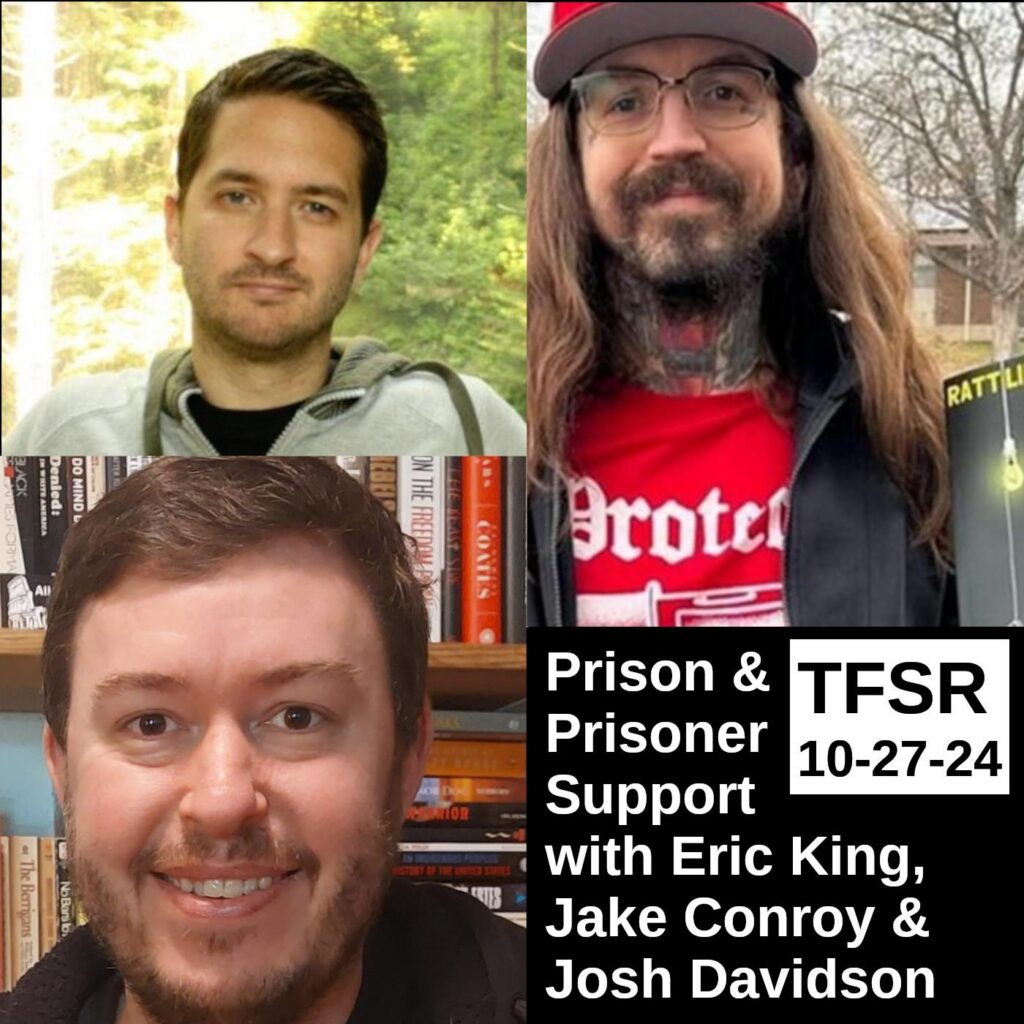
collage of photos of Eric King smiling with his book, Josh Harper and Jake conroy
This week we’re sharing a discussion recorded some months back in the pacific northwest featuring former political prisoners Eric King, who went in for actions in solidarity with the Ferguson Uprising in 2014, and Jake Conroy, who was convicted for coordinating successful anti-vivisection divestment campaigns against Huntington Life Sciences as one of the SHAC7. They are joined by Eric’s co-author of Rattling The Cages, Josh Davidson. We hope you appreciate the wisdom and passion of the discussion.
You can find Jake’s youtube channel The Cranky Vegan for a long-running and ongoing commentary on animal liberation topics. And you can follow Eric’s panels with other former prisoners and supporters on the instagram for Rattling The Cages and past media and articles by and about Eric (including past interviews we’ve done with or about him) at SupportEricKing.org and find more from Josh at linktr.ee/JoshDavidson..
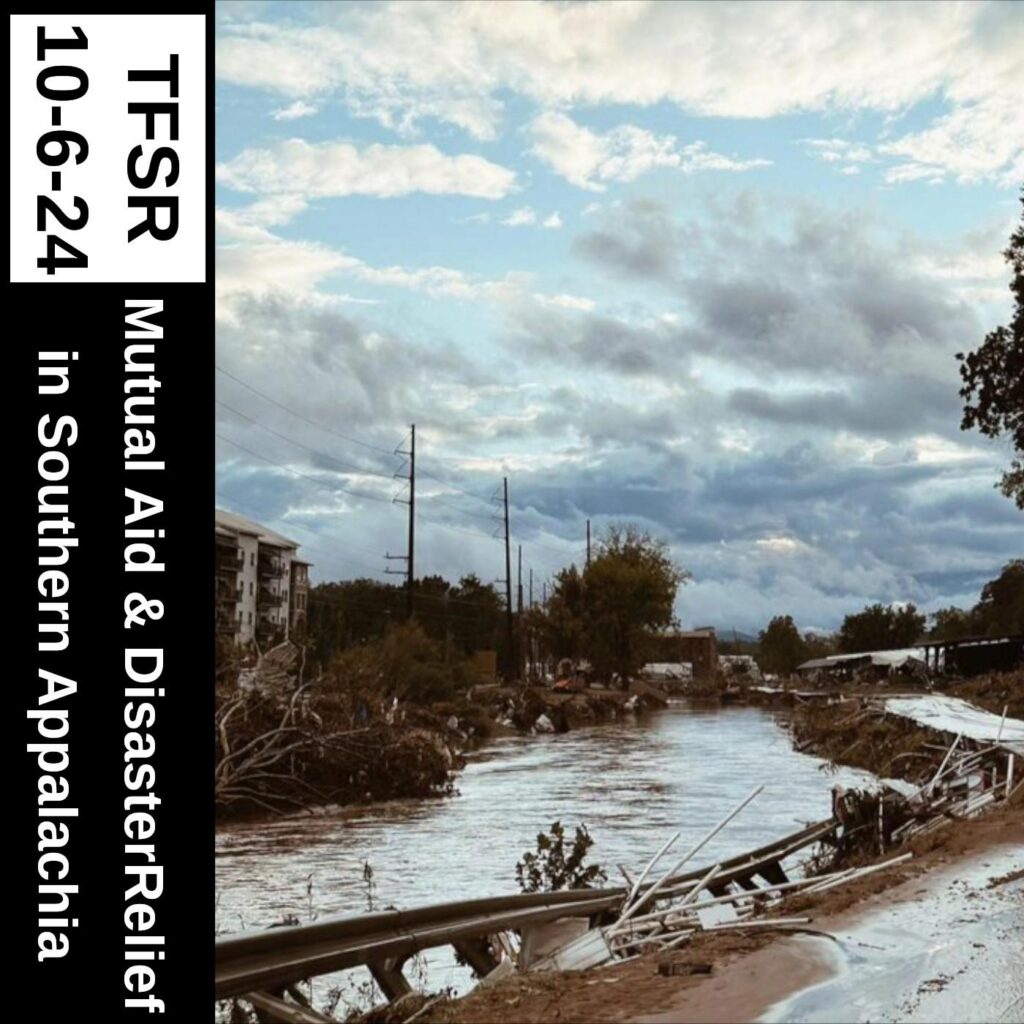
Over the first weekend of October, 2024, there was a deluge from two storms (including level 4 Hurricane Helene) descended on southern Appalachia, mostly on the eastern side which includes Asheville and other parts of western NC, eastern TN, south eastern Ohio, and northern Georgia. At the point of this recording there are over 200 known dead and hundreds missing, portions of the region continue to be without electricity or cellular service, and where the toxic mud and water linger and separate people from medical and community care. This episode, we’re speaking with two people who’ve lived in the region and have been helping other residents distribute storm relief.
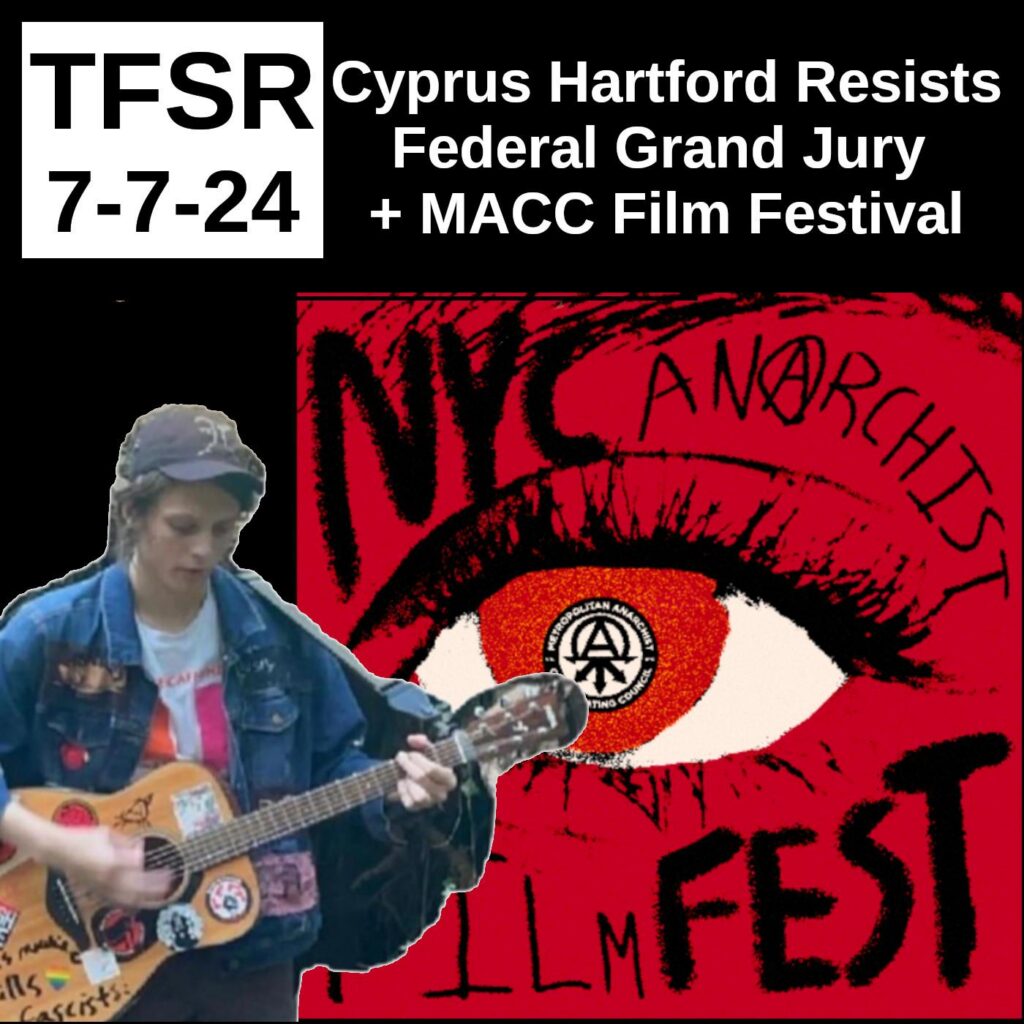
This week we’re featuring three segments. First up, you’ll hear a conversation I had with Asphalt, a supporter of a recent federal grand jury resister in Charleston, South Carolina. [00:04:53 – 00:36:28]
After that Cyprus Hartford, the grand jury resister, speaks for herself and reads her statement of resistance. [00:36:28 – 00:40:39]
Finally, you can find an interview that Ian did with Marisa Holmes and Molly of the Metropolitan Anarchist Coordinating Committee about their recent anarchist film festival. [00:42:32 – 01:01:29]
Then you’ll hear Sean Swain’s review of the presidential debate [01:02:06 – 01:09:16]
By way of introduction to this first segment, I’d like to remind people that none of the people speaking about grand juries here are lawyers, but we are sharing information we’ve gotten from lawyers and legal experts to the best of our abilities. I’m going to read a bit from the website NCResistsTheGrandJury.Wordpress.Com:
What is a Grand Jury?
In the federal legal system, the grand jury is used to decide whether someone should be charged (“indicted”) for a serious crime. The grand jury hears evidence presented by the prosecutor: the U.S. Attorney. The grand jury uses subpoenas to gather this evidence. It can subpoena documents, physical evidence, and witnesses to testify. The “special” federal grand jury, created in 1970, can be used to investigate “possible” organized criminal activity rather than a specific crime. The California legal system also has grand juries, but it is optional whether criminal prosecutions are initiated by grand jury indictment, or by a complaint by the District Attorney and preliminary hearing before a judge.
How is a Grand Jury Different Than a Trial Jury?
Unlike the “petit” jury, which is used to determine guilt in a trial, a grand jury consists of 16 to 23 jurors who are not screened for bias. The purpose of the grand jury is not to determine guilt or innocence, but to decide whether there is probable cause to prosecute someone for a felony crime. The grand jury operates in secrecy and the normal rules of evidence do not apply. The prosecutor runs the proceedings and no judge is present. Defense lawyers are not allowed to be present in the grand jury room and cannot present evidence, but may be available outside the room to consult with witnesses. The prosecutor and the grand jury members may not reveal what occurred in the grand jury room and witnesses cannot obtain a transcript of their testimony.
How Has the Grand Jury Been Used by the State?
Because of their broad subpoena powers and secretive nature, grand juries have been used by the government to gather information on political movements and to disrupt those movements by causing fear and mistrust. The grand jury lends itself to being used for improper political investigation due in part to the prosecutor’s ability to question witnesses without regard for rules that prohibit irrelevant, unreliable or unlawfully obtained evidence. Those called before the grand jury may be compelled to answer any question, even those relating to lawful personal and political activities. That information has been used by the government as a basis to conduct further surveillance and disruption of political dissent. When used against political movements, the grand jury causes fear and mistrust because persons who refuse to answer questions about their First Amendment political activities, friends and associates may be jailed for the life of the grand jury: up to 18 months. If a witness asserts their Fifth Amendment right to remain silent, they may be forced to accept immunity or go to jail for contempt. Even a witness who attempts to cooperate can be jailed if minor inconsistencies are found in their testimony. Such a perjury charge may stand even when the grand jury fails to hand down any indictment for what it was ostensibly investigating.
The grand jury is a complicated and opaque process, by design. Our movements have decades of experience resisting grand juries, and there are resources available to learn more and support those who resist.
If you have been contacted by federal law enforcement, the National Lawyers Guild has a national federal defense hotline at 212-679-2811.
. … . ..
Featured Track:
Setting Sun (instrumental) by The Chemical Brothers from Setting Sun
This week we had the opportunity to connect with Vanessa Bolin, who is an indigenous artist, community organizer, and activist who has been helping with flood rescue and rebuilding efforts after Hurricane Florence in Lumberton, NC, which is in Robeson County. In this interview we talk about what still needs to be done in this area, how to help out, some important parallels between post hurricane relief and anti pipeline organizing, and the importance of foregrounding marginalized voices in mutual aid efforts.
Mutual Aid Disaster Relief is also coordinating a bunch of efforts, you can learn more about this group at mutualaiddisasterrelief.org or look them up on any social media platform. If you have 4-14 days spare and want to get down to Robeson County to help out, especially if you have proficiency in Spanish and skills in logistical coordination, you can send them an email to get networked in at WeKeepUsSafeVC@protonmail.com.
To connect with EcoRobeson, the group which is doing anti pipeline work in Robeson County that is mainly affecting already disenfranchised people, you can follow this link.
Somethings we’d like to mention:
When Vanessa talks about the struggles of the Dine people (who are sometimes known as Navajo) where she mentions uranium mining, this is a huge issue that spans many generations. You can visit Black Mesa Rezistance, which is an organized effort in Black Mountain and Big Mesa (also known as Arizona) on the part of the Dine and Hopi people to defend themselves and their existences. You can learn more about this effort at https://blackmesa.rezist.org/ and follow the links for further material to learn about the history and present day projects and struggles.
And finally, for a look into some of the truly amazing legacy of the Lumbee Tribe in so called NC, we at The Final Straw recommend the book To Die Game by William McKee Evans. This book details a resistance movement at a time when Lumbee youth were being targeted for conscription into the Confederate army, and how they along with a diverse coalition of other resistors, eluded capture in the swamps of eastern NC for over 5 years. You can also read about this in the book Dixie Be Damned, along with many other lesser reported moments of resistance in the American Southeast.
Announcements for Prisoner Support
Jalil Muntaqim
Jalil Muntaqim, former member of the Black Panther Party and Black Liberation Army is facing the parole board in November as his August visit was postponed due to clerical issues. He’s going to be getting a lot of pushback from the Policeman’s Benevolent Association, Fraternal Order of Police, Corrections Guards associations and the rest of the gallery of reactionary so-called unions for cops. Those groups are on alert, as we’ve seen with the tug of war around the release of Herman Bell, any time an aging political prisoner, especially one accused of involvement in the killing of a cop, comes up for parole. The parole boards are often made up of former judges, D.A.’s, Prosecutors and law enforcement, forming an added blue wall for prisoners facing parole boards. So, Jalil needs us to write letters of support for his release. Although some of the links are dead from the earlier parole push, you can check this IGD link (see our shownotes at thefinalstrawradio.noblogs.org for the link) for a list of achievements Jalil has since his incarceration.
Also, Jalil’s birthday is October 18th, so feel free to send him a separate birthday greeting!
Also, also, check out our website to hear past episodes featuring interviews with Jalil conducted by buddies at Prison Radio on CKUT in Montreal.
To support Jalil, follow these instructions passed on from National Jericho NY:
Write a letter in you own words in support of parole for Jalil, address to:
Senior Offender Rehabilitation Coordinator
Sullivan Correctional Facility
325 Riverside Drive
Fallsburg, New York 12733
BUT SEND TO:
Nora Carroll
The Parole Preparation Project
168 Canal Street, 6th Floor
New York, NY 10013
The subject line should be “Anthony Bottom 77-A-4283”
We are making an effort to include letters of support for Jalil that are personalized and from people who are familiar with him and his work. If you want further instructions for how to write a strong, personalized letter of support, please email carroll.nora@gmail.com.
Also, please send a copy of your letter to Jalil for his files:
Casey is an anarchist political prisoner who also has a parole hearing coming up, his one and only for his 12 year stint for the stabbing of the president of a university in Missouri. Casey recently got married to a woman being held in another Missouri prison. He’s studying calculus so he can go to school to be an aerospace engineer once he’s released. He goes before the parole board November 2018. He’s unsure of exactly when he gets out, but knows he isn’t eligible until November 2020. He’s currently saving his money (and asking for help) to afford a cheap vehicle when he gets out in order to transport himself to work and school. His intentions are to parole out to the St. Louis area and attending a community college until he gets his basic credits and can transfer to a university. His eyes are set on the Missouri University of Science and Technology.
Casey suffers from depression and has a history of schizophrenia. he describes himself as socially awkward and says he often feels misunderstood. He has a kind heart and he looks forward to getting out relatively soon and getting to see all of those who have shown him support over the years. He thanks you all.
Casey was recently transferred to the Farmington Correctional Center in Farmington, Missouri. In November, he will go before the parole board for the first and ONLY TIME and he needs your help!
Thoughtful and professional letters to the parole board by people who care about Casey and are willing to offer support to him during his transition back to life outside of prison can make it more likely that Casey will be released.
*Even though the letter should be addressed to the parole board, all letters should be sent directly to Casey and he will deliver them to the parole board:
Casey Brezik #1154765
Farmington Correctional Center
1012 West Columbia Street
Farmington, MO 63640
Anarchist prisoner Sean Swain is still being silenced by the state of Ohio and could use your letters. He’s potentially in the process of being transferred in an inter-state deal which will make his life way harder. Sean has communicated that he was at one point on hunger strike and is extremely isolated. You can write to Sean at :
Sean Swain #243-205
Warren CI
P.O. Box 120
Lebanon, Ohio 45036
It’s suggested that concerned listeners call
ODRC Director Stuart Hudson (614) 387-0588
Governor’s Counsel Kevin O’Donell Stanek (614) 466-3555
Callers should voice concern over Sean’s health, access to communication and the blocking of counsel from his recent RIB hearing that threatens to transfer him out of Ohio.
On IGD you can read the list of demands specific to NC prisoners that Joseph Stewart wrote back in July. He was transferred after the outside published his statement in support of the strike and has intermittently been left off of prisoner support call-ups so he can surely use some supporting letters at Polk CI where he is currently housed. You can write Joseph at :
Joseph D. Stewart
#0802041
Polk CI
Box 2500
Butner, NC 27509
Three other prisoners in NC, are held within the Hyde Correctional Institution, a facility in Fairfield, NC, are being threatened with retaliation for their active support and organizing in solidarity with the national #PrisonStrike. They’re facing threats of administrative repression, as are any other fellow prisoners connected to the national strike. More info in our show notes
From a statement by the Revolutionary Abolitionist Movement (RAM) and Vaughn17 Support in Philly:
On Feb. 1, 2017, after a series of peaceful protests yielded no results, incarcerated comrades took over a building at James T. Vaughn Correctional Center in Delaware to demand slight improvements in their treatment. After a 20-hour stand-off, the prison’s response was to literally bulldoze their barricades and figuratively bulldoze their demands, retaliating with constant beatings, destruction of prisoner property, and denial of food and medical care.
Furthermore, the state has accused 17 of the incarcerated with egregious offenses even though these charges have no basis in reality. The state’s response shows once again that any prisoners standing up for themselves, to regain dignity and achieve decent treatment, is a threat. And the state will collectively punish everyone and anyone to hide its barbarism. The only role of prison guards, wardens and the Department of Corrections (DOC) is the perpetuation of slavery and subjugation.
There is a call for court support for the 17, who will be attending trail in small groups, at New Castle County Courthouse, 500 N. King St., Wilmington, DE 19801. The first trial starts on Monday, October 8th and the last is slated for February 11th, 2019. People in the area interested in helping volunteer for court support can learn more by reading this IGD article.
A pdf of a poster with addresses, pictures and info on the 17 prisoners pulled into this case can be found here
This week we are presenting audio from the Callisto Collective, which is a local collective “addressing conflict, abuse, assault and everything in between” by utilizing autonomous models of resolution, especially in closer knit communities of affinity. This workshop is called Conflict Resolution for folks who do Anti State Organizing.
In this workshop, they talk about many things, including anarchist critiques of Non-Violent Communication, which is a developed process in use mostly by leftist organizers, possible tools for dealing with conflict, and also some discussions on yogurt (stay tuned…). This workshop was originally presented at the 2018 Asheville Anarchist Bookfair at Firestorm Books.
This was an extremely interactive workshop, and to protect the anonymity of participants I had to cut a bunch of material out. This sometimes makes the audio a bit disjointed to listen to, but I hope you’ll enjoy it all the same.
Before the workshop tho, we want to plug certain hurricane relief efforts going on in town. As you are probably aware, the coasts of North/South Carolina and Georgia as well as many regions off the coasts are being hit right now with a quite sizeable hurricane. Appalachian Medical Solidarity is helping coordinate disaster relief efforts, running supplies inland to the coast and supporting those who are doing on the ground relief efforts. Donations of supplies can be sent to Firestorm Books at 610 Haywood Road in West Asheville.
Things which are needed include:
Pop top canned foods which are high in calories that people can eat cold and without utensils
Wool socks
Anti-fungal spray
First aid supplies
Any and all baby supplies
Adult diapers
Toilet paper
Flashlights and batteries
Travel size personal toiletries
Hand soap
Charged battery packs for cell phones and cell phone chargers
Gasoline
If you would like to help but cannot send supplies, you can donate to relief efforts in Asheville by going to:
If you are going into affected areas as a relief worker, it’s very important to be networked with local efforts and to foreground the work of locals and directly affected populations. If people are interested in reading further about cultural competency in disaster work, we would suggest further reading by the Mutual Aid Disaster Network, which is available on any social media platform. You can contact Appalachian Medical Solidarity through their Facebook page, and they are coordinating efforts on behalf of those affected by hurricane flooding both on the coast and in Asheville.
. … . ..
Finally, we would also like to plug a phone zap on behalf of Jason Renard Walker, a Texas inmate associated with the 2016 prison strike and who contributed to the Fire Inside zine. He has been subject to an increasingly intense campaign of harassment from staff at the Telford Unit, who first issued him with a fake case for threatening a member of staff, and then sent him to lockup, preventing him from even being able to attend his own hearing for the so called case. The prison strike timeline has officially ended, but repression related to the strike is only just ramping up. For a full article on this case you can visit the full article here.
. … . ..
The music which we used in the intro is the instrumental version of the track “7” by Frank Waln, who is a Sicagnu Lakota rapper and hip hop artist. His work is very searchable on any streaming media platform.