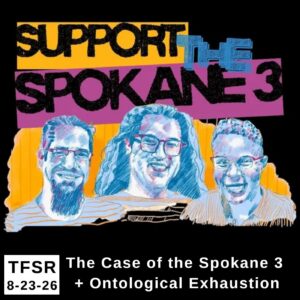
This episode features two segments.
The Case of the Spokane 3
On June 11, 2025, there was a demonstration of hundreds of people in Spokane, Washington to defend two young asylum-seekers, Cesar Alexander Alvarez Perez and Joswar Slater Rodriguez Torres, who were kidnapped by ICE while appearing for a scheduled check-in. The next day, the Trump administration’s DOJ sent out a memo to all districts to prioritize prosecution of anti-ICE protestors and publicize the repression. Months later, 9 people were brought to Federal trial, with 6 of them taking a non-cooperating plea deal. The remaining 3, refused to back down and were taken to trial and were convicted of conspiracy.
For this episode we’re joined by Hadley, a member of the Spokane 3 Support Committee to speak about those defendants ( Justice Forral, Bajun Mavalwalla II, and Jac Archer ), their case and struggle for justice. A great, local media outlet named Range Media has been covering this case in detail, check it out at https://www.rangemedia.co/spokane-9-protests/ . Finally, stay tuned for a press conference this coming week after some next legal steps are taken by the defendants.
Ontological Exhaustion
After that, you’ll hear an interview by audio comrades at Radio Ausbruch out of Frieberg, Germany, with an interview of Marina Christodoulou on her essay “TOWARD A GENEALOGY OF ONTOLOGICAL EXHAUSTION: becoming indignant-to-life ( ontological indignation ) before becoming exhausted-to-life ( ontological exhaustion )“. Check our shownotes for links to the original essay and more from Ausbruch, which is a fellow member of the A-Radio Network of anarchist and anti-authoritarian radios and podcasts.
. … . ..
Featured Track:
- TFSR by The Willows Whisper
- Beatbuster by The Willows Whisper
. … . ..
Spokane 3 Transcription
Spokane 3 – Transcription
Hadley: My name is Hadley. I use they/them pronouns. I’m in Spokane, Washington, and I’m a member of the Support Committee for the Spokane 3.
TFSR: Cool. And just because it has been in the news and people would have been paying attention to your region, how is it going briefly with the fires? Big question.
Hadley: Thank you for asking. It’s been pretty wild. At this point, the fires are almost completely contained. The smoke has cleared, which is really a blessing, to be able to breathe clean air. Unfortunately, there are about six or seven hundred people who have lost their homes. Over 60,000 people were evacuated in total over the course of 24 hours. It was really intense. I would add that it was also really beautiful to see how the community came together and engaged in a lot of mutual aid efforts. But definitely, we will be on a long road to recovery.
TFSR: Anyone who listened to last week’s show will have seen a couple of links in the announcements to a couple of projects. If you have any other projects that you want to point listeners to that’s worth supporting, I know that between this and the tornadoes in the Midwest, there’s just a ton of terrible things happening everywhere thanks to climate chaos.
Hadley: I think the one mutual aid fund that I will pump locally if you’re trying to move some money to Spokane is the Spokane Immigrants Rights Coalition. They had a mutual aid fund that already existed for immigrants and refugees who were facing instability now because of Trump’s targeting of immigrant families. Unfortunately, that means there’s a double layer of vulnerability for folks who now may have lost their homes or may be evacuated, because they may not feel safe going to public services which are being regulated by cops, sheriffs, and the National Guard. It certainly doesn’t feel safe for a lot of folks. So it’s also the reason we were out protesting, so it’s on topic, but that group is doing a dedicated mutual aid fund for families that are impacted by fire, and doing a lot of outreach and case management for families that are impacted right now.
TFSR: We’re here to talk about the Spokane 3. Can you speak about these three individuals and about the case?
Hadley: So the Spokane 3 are Jac Archer, Justice Forral, and Bajun Mavalwalla II. They are three of nine folks who were originally indicted last June on charges of conspiracy to impede or injure federal officers.
Those charges stemmed from a protest that happened on June 11th, 2025 at our local ICE facility in Spokane. We have an ICE field office, so it’s not a full detention center, but still a field office. That day, two young men who were asylum seekers in their legal asylum seeking process were called into a spontaneous check in.
They were well known and well loved members of the community and also had status to work, and were working. For one of them, it was their 21st birthday. They went into the check in with both of their legal guardians, and ICE detained them. They did not give a reason.
Since then, we’ve now learned through the court case that ultimately it was just a snap decision. The person said that the reason that they detained the two young men was because his boss told him to. There was no deportation order, and in fact, the state of Washington has now found one of the detentions was illegal.
That morning, the guardian knowing that this was an illegal abduction happening of the person that he was responsible for posted on Facebook and said what had happened and that he was going to sit in front of the bus that would be taking them to Tacoma, which is where our detention center is.
And he ultimately invited people to join him. This person was a former city council president in Spokane, so he was well known and had a strong Facebook following. That Facebook post got shared very quickly, and many people came down to the building, and quite a few joined him in sitting in front of the bus with the intent to try to delay the process of moving the young men and to hopefully have a conversation and pressure ICE to release them because we knew the detention was illegal.
I myself attended the protest. I didn’t arrive right away, but I was there maybe an hour or two after it started. There was coincidentally another protest scheduled nearby, so there was a large group of people gathering elsewhere that moved to our location, which made it for a totally spontaneous action that resulted in a very large protest. Over 120 local law enforcement were sent, including sheriffs and local police, who moved in to ultimately shut down the protest quite violently. Before the night ended, there were a number of people who blocked a gate on the south side of the building. The gate was for the parking area, and ICE agents were trying to leave with their cars. Of course, folks were worried that maybe they had the young men inside. People peacefully locked arms and were saying “let them go,” and “shame,” and things like that, and locked arms across the gate.
Those federal agents exited their vehicles and three more agents exited the building and just began to pummel and physically assault the protesters. They were shoved to the ground. There’s quite a bit of video footage showing this. Ultimately, they could not move the protesters, and they returned into the building and continued to ask for sheriffs and local police to try to help get them out.
Later that night, around 8 p.m. they eventually tear gassed us, despite Spokane Police Department claiming their was no tear gas .They also definitely shot smoke, pepper balls, foam rounds, and things like that. Over 30 people were arrested and a curfew was ordered, and in that sort of chaos they were able to extract all the agents inside, as well as the detainees. Unfortunately the aims of the protest were not successful, and did not stop the young men from going to Tacoma.But it was certainly a day that made me very proud about Spokane showing up to say how we’re going to protect our neighbors.
I do want to add that over the course of the protest, there were two vehicles that they tried to use to extract the detainees, the abducted people, and somebody went up to one of them and spray painted one of the windows. Some people removed the air from the tires of another one. Someone had a box cutter and slashed the tires.
A month after this protest, nine people woke up to FBI agents at their door, or pulling them over on their way to school, and were arrested on these conspiracy charges. Some folks’ conspiracy charges include the alleged property damage for what happened to the bus, and then there were folks who were included in the conspiracy because they linked arms or were filmed doing things that were considered “coordinating,” like using a bullhorn to shout safety expectations, passing around a clipboard to get emergency contact and bail information, and a lot of things that are sort of basic organizers’ standard operating procedure for protest safety.
We can go into in more detail as we keep talking some of the implications there, but there’s my attempt at a sort of quick overview of what has happened. Where things stand right now is unfortunate; of the nine folks who were originally charged by the federal government, six of them took plea deals. Those were non-cooperating plea deals, so we don’t have any reason to believe that they cooperated with the federal government or gave away information or anything like that, which has not been the case in some of the other oppression cases across the nation lately.
Those six, basically as long as they stay on good behavior for 18 months, will go to their sentencing and will be sentenced as a misdemeanor instead of a felony. But the felony isn’t off the table yet, so it’s still hanging over their heads.
Of the three who pled not guilty, that’s Jac Archer, Justice Forral, and Bajun Mavalwalla II, they went to trial in May. It was a two-week trial. I observed the entire thing, and unfortunately, at the end of it, the jury found all three of them guilty of conspiracy. Conspiracy is a complicated definition that includes basically five criteria, and if any of them were at place, the jury was supposed to find them guilty. All three of them were found guilty of different elements of the conspiracy, so not even the same pieces of the conspiracy, and none of them were found guilty of conspiracy to injure officers, it was property damage and impeding their jobs.
TFSR: I want to talk in more detail about the trial and those circumstances, but clearly, for people in the U.S., this should be on the forefront of what’s been going on since Trump 2.0 has started. There’s been a ramping up of detention and of kidnapping. There’s been increased funding for ICE, militarization of the terminology. You mentioned ICE showing up for this last-minute meeting when someone was going to fulfill their legal obligations for staying inside of the country on good standing with the government. There’s been all these bad faith approaches by the federal government under Trump 2.0, like worse than Biden, or worse than Obama. Can you talk a little bit about your experience, just to kind of remind people about the bigger picture of the context for when this happened in June of 2025? What other protests were popping off around the country, and sort of what we were seeing coming from ICE and CBP across the country?
Hadley: Yeah, absolutely. It’s wild to think it’s been just over a year, and how much things have changed and just how much has happened since then. I can especially speak to the climate in Spokane locally, which I think is a place that maybe not a lot of people know about. It’s the second biggest city in Washington, and just 20 minutes away from the Idaho border. Unfortunately, there’s been a really long history of this region being a foothold for white nationalism, Christian white nationalism specifically, and those roots are really important to recognize when addressing what we’re fighting against here.
Spokane is 89% white according to the last census, but our ICE and Border Patrol facility are operating as a big foot hold across the region and North Idaho as well. At that time, last June, we were seeing ICE begin these brutal and very visual active surges against communities, and in some ways Spokane wasn’t seeing that. We weren’t seeing the level of surge seen in Minneapolis, but those who were connected to immigrant communities knew that it was happening in this way. People were going in to their appointments, they were doing it “right,” they were following the rules, they were going into their check-ins, and then just suddenly being taken and not having any recourse.
In Spokane that week the protest that was about to happen (that coincidentally ended up joining the spontaneous action) was for a man named Martin Diaz, who ICE officers first faked a car accident in front of his house to try to trick him into coming outside, and then when they got caught doing that, later they assaulted him in his yard, they tackled him in his own yard, and then accused him of assault.
This was a protest in support of him, hoping that the jury would find him not guilty of assault of an officer. Not only are folks who are already in really vulnerable positions having the rules changed while they’re working through the process, we’re seeing these violent, scary, and brutal attacks happening against our community, and I think a lot of folks in Spokane who may have been watching the news were looking for a place to put their energy, and when they saw that opportunity and this call to action for these two young men it was answered like very quickly and very loudly. I think because what was happening nationally was very present in people’s minds.
TFSR: And just to say, staging a car accident in front of someone’s house on the hopes that they’ll be a good community member and check on people’s well-being is so disgusting.
Hadley: They like knocked on the door and were like, “Oh my God, we’re so sorry. We accidentally backed into your car. Can you come out?” I think it was a roommate who answered instead, so it created a buffer. But you know, those are the tactics. Just openly shady tactics.
TFSR: And you were seeing around this time in Los Angeles the resistance that was happening in the streets there, and there’s all this dialogue of people being ‘drug running terrorists’ and being sent to CECOT in El Salvador, and just how brutal and terrible it was. Or this might have been before the “Alligator Alcatraz” or whatever, but like this is so disgusting.
Hadley: The two young men are Venezuelan immigrants, and that was actively in the news because of Trump’s crazy targeting and abductions there, and the National Guard being deployed in Los Angeles and D.C. at that time. It’s hard for me to remember the precise timeline of what was happening at that moment. That was really active in people’s minds, and it comes into play when we start to hear, we started to learn in the trial about the response, like how local law enforcement were thinking about their response, the fear of being outmaneuvered by federal resources and being basically used as a ploy to get the National Guard into our streets was something that was really on the minds of the leadership in our community we now know, and influenced decision making a lot.
TFSR: Yeah, and their their willingness to sacrifice a couple of people that were trying to fulfill their legal obligations to that same state in order to diminish this invasion by the Trump administration; that’s that’s insane.
Moving on, you said the case only lasted for about two weeks? That seems like a really quick trial for the three. If they had taken a similar plea to the other six of the nine defendants, are there signs that they would have gotten the same sentencing, and they just didn’t want to sign something that said any sort of responsibility for something that they didn’t feel any guilt for, or what was their motive for going to trial?
Hadley: It’s absolutely the latter. The plea deal had been negotiated for all of them equally, there are legal people who were saying it was actually a really good deal. I don’t feel qualified to make judgment on that, but the Spokane 3, are three morally principled people who felt strongly that they they did not feel guilty, and they were not going to plead guilty, and that they didn’t want to cede the rights that are at risk in this moment. So it was absolutely a principled stand.
TFSR: I guess to talk about the conspiracy-setting element of the case, I assume neither of us are lawyers who are in this conversation, but 18 U.S.C. Section 372, I believe, is what conspiracy that they were convicted under. I wonder if you could, unless I got that wrong, talk about that specific conspiracy charge, its prior uses, and what you fear might be precedent for future prosecutions in the U.S.
Hadley: Fascinatingly, our protest was on June 11th, and on June 12th, a memo came out from the Department of Justice, I think, that directed local district attorneys to begin to prosecute folks who were protesting, and it was sort of that like part of that “Antifa” push to begin prosecuting folks.
I’m sure they had to draft that for a few days, but it certainly feels interesting that the day after we have this big protest that locks down the ICE facility for multiple hours, this memo comes out. We now know that our local district attorney, the original one, resigned. He received that order and he resigned. He has been interviewed now saying that he is, something to the effect of, “I’m grateful that I never had to make a prosecution I didn’t believe in,” which is pretty telling.
They then had to find somebody else, Pete Serrano, who is a Trump lacky who really really wants to make this happen. It’s conspiracy to impede or injure federal officers in their lawful duties, we could pick that apart, but I think ultimately what it requires is that there was some level of coordination. People were making a plan to impede or injure, you know, “to do the conspiracy.” It implies that there is a use of force, because it “is planned.” You can’t accidentally conspire, so there has to be an intent to forcefully impede here. Then there has to be some level of coordination. So people have to know; they have to knowingly do it.
What I observed over the course of the trial was, first of all, over a dozen law enforcement officers, ranging from ATF, ICE, local PD, or local sheriffs, all spending hours testifying about how afraid they were because of the crowd and the protesters, it appeared as if the prosecution really front loaded this argument of like, “let’s show the jury that the law enforcement was really, really scared, so that they feel that they were totally justified in the violence that they unleashed upon protesters; otherwise, we might be in trouble because the jury might actually think this is a First Amendment case. They might actually think this does look like folks are being persecuted for standing on their constitutional and peaceful rights.”
The judge did not allow our three to make a political defense to any degree. So folks were actually not allowed to talk about the First Amendment. They were not allowed to talk about whether or not the detentions were lawful. They were not allowed to talk about the fact that they were proven to be illegal afterwards.
They were only allowed to talk about their mindset. So people maybe could say like, “I thought that I was protected by the First Amendment.” Almost any time somebody said the word First Amendment, there was an objection, and so the judge really said the job of the judge is to decide what is law, and it’s the job of the jury to decide what is fact. What she meant by that was she only wanted the jury to decide whether or not these people did those elements of the conspiracy. You know, did they forcefully try to impede these officers, and did they know what they were doing, and did they coordinate with others to do it?
The way that they presented the evidence of the “coordination” was that they had two witnesses who were FBI agents who spent hours and hours reviewing drone footage and body cam footage and cell phone data, which was extracted because 30 people were arrested locally by PD. All of those cell phones were actually taken by the FBI for a number of weeks and subjected to investigation and extraction. A lot of conversations were taken by the FBI. In some cases, before our local police department even knew or signed off on it, we have now learned.
So the conspiracy really was those officers like looking at the red yarn on the wall, trying to connect folks like Jac Archer. What they really used as evidence of conspiracy was Jack’s long history of being an organizer in this community. They’ve worked for two different organizations: Peace and Justice Action League of Spokane and Spokane Communities Against Racism, that both do a lot of you know organizing. They’ve done plenty of public speaking. They’re well known. They’re trusted. It was natural that they took some leadership during the protests and making sure people were safe. They had a clipboard where they started to collect emergency contacts for folks, especially people who are willing to risk arrest. They were talking with people about the fact that choosing to sit in front of the bus was likely an arrestable offense. Although at the time we all assumed that that would be an arrest by local police and possibly a misdemeanor for “trespassing” or “obstruction” or something like that.
Nobody thought that this people were at risk for federal crimes. Jac then later picked up a bullhorn when the ICE officers began to try to leave through the gate, and it was clear that people were going to have to link arms. Jack grabbed a bullhorn and said to people, “If you’re going to be on the line, you need to be able to take a punch and not give one.” It was a clear like litmus test for you have to be able to stand here and know what’s coming and behave non-violently. That’s our commitment.
That was used against them to say that they knew that they were planning to risk arrest and that they knew what they were doing was a crime. But once again, not a federal crime, like you know, perhaps maybe a local misdemeanor for, maybe, staying out after curfew or a number of the things that organizers expect.
Justice’s charges did include being photographed by drone footage as removing air from one of the tires of the bus well after it was spray painted, we don’t know the person who spray painted it. No one knows them. They literally just rolled up, fully masked, on a bike, did it, rolled away.
TFSR: Super soldiers, you next.
Hadley: Make notes. It was beautiful. Because of that, Justice’s charges included the property, the conspiracy charges against them focused on the property damage and impeding property because they stopped the bus from moving.
Bajun’s charges are really interesting, because Bajun never met anyone. Bajun didn’t know Jac and Justice. Jac and Justice know each other already. Justice had also worked at Spokane Communities Against Racism for a time, but Bajun just found out about it I think through word of mouth online and showed up, and is arguably the tallest, most visible person on the line in a lot of video footage. I think that’s part of why they were targeted. But they’re holding arms and getting shoved and pushed. They’re accused of assault because they dared to stand back up against unknown armed and masked men that are shoving you and not identifying who they are.
Later, the government tried to argue that Bajun kicked a smoke canister back at the police. Ultimately, the thing that’s really concerning about this is that what they’re saying is conspiracy, are things like: using a clipboard to collect emergency contacts at your action, using a bullhorn to tell people what your safety expectations are, basically establishing yourself as a leader or a person of safety during an action is a “conspiracy.”
The act of linking arms was really, really focused on as part of the conspiracy because they used that to say that’s where the force happened. The prosecution stated that linking arms made your bodies bigger than one person, and that was thereby forceful and intimidation. Intimidation and force is a “predeterminating factor for violence.” They talked a lot about pre-threat indicators. Of course organizers and folks who have studied civil rights movements would say that when you are linking arms, you cannot use your hands to hit, and you cannot use your hands to protect your face. It is an act of vulnerability, and strength, by leaning on each other to not be pushed down. The prosecution actually argued that that standing up after police put you down is an act of violence. It’s an act of threat against an officer.
All of those things have sweeping implications for our risk assessment when we are organizing actions. Functionally, what it’s done, is to say that many of the standard tools that we use to keep each other safe, are now things that are arrestable offenses. The folks who have become practiced in those skills, who have committed to them as community organizers, as leaders of movements, who do this to keep each other safe; yes, taking calculated risks and sometimes choosing to risk arrest. Absolutely, I’m not underscoring the fact that there are people who made calculated decisions and knew what they were doing would put them at risk of arrest, but again, not these charges. This is a huge example of overcharging. Of course this is happening, our protest was just a month before Prairie Land. Now we’ve seen the Minnesota 15. I’m certainly curious how the fact that our prosecution was successful in getting this guilty verdict will influence Minnesota and some of the other cases that are still coming.
My concern as an organizer and someone who has practiced strategic nonviolence in all that I do, is if you can prosecute and criminalize disciplined nonviolence, then the people who teach and practice that and hold that expectation are going to either get arrested or have to start hiding because they can’t take that risk anymore. Like they’ll have to step back. If that happens, what’s left? People aren’t going to stop acting up, and that creates then more of these reactive protests and movements, which, to be clear, have a place. I am not casting judgment, they absolutely have a place, but if we lose the folks who have the skill in these tools that keep each other safe, what we’re going to see a lot more of are these disorganized and possibly more risky actions. Unfortunately, that’s kind of what our law enforcement was arguing…that if they allowed us to to do any of that, then the National Guard would come.
Our local law enforcement has been more hyper on shutting down these sort of actions. It’s just a deep concern that unfortunately it’s creating the conditions that the Trump administration wants to showcase as what people should be afraid of when they think of “Antifa” and protests. It is rewriting the history of what nonviolent civil disobedience means and has meant in this country, and unfortunately puts a lot of people at risk for what I think they thought was standard protest behavior.
TFSR: That’s very well put. Thank you. I am not a pacifist, but there is that JFK or attributed to JFK quote that “those who make nonviolent revolution impossible make violent revolution inevitable.” If the Trump administration has been looking for opportunities to create a casus belli out of one of these situations in order to expand the federal troops sitting in a city and taking it over in a Democrat-controlled state, then it would it would fall into that. I think that a lot of the resistance that was seen in Minnesota, just the amount of footage and the extent of that, hopefully, they’ve shifted their immediate plans in terms of how they’re capturing our neighbors and incarcerating them. They found that those sorts of like massive deployments are not working to their benefit. They are just further polarizing, not to their own benefit, the public reaction to troops in the streets. But in any case, it’s good when we do have brave people that are in the community that are willing to stand up, even with the threat of of arrest, in order to make the jobs of extracting and kidnapping our neighbors harder.
Hadley: Yeah, exactly. I am also not a pacifist. I think strategically, literally what other option are you giving us? If this is the road, what other option will people have in front of them? Continuing more of the sort of spontaneous and disorganized and reactive protests and actions, which unfortunately is the space that tends to create violence. I am a person who in my organizing, I really specialize in trying to do harm reduction from state violence. I do a lot of police negotiation work, I do a lot of police liaison stuff. Not because I enjoy talking to cops, to be clear, but because unfortunately, that is a thing that helps, that makes some people safer in some moments. I worry about what it does, when we’re trying to get more and more people engaged in the movement right now and get more and more people on the streets, so that they can get connected into a deeper level of community organizing. I don’t want this to scare people away, and I don’t want the story to be you should be afraid because the Trump is criminalizing writing down your husband’s name and number on a list in case you get arrested.
I want the story to be: the brave people will continue. The brave people did it, and they will continue to do it. But we have to be aware, and we might have to think smarter, think differently, and also, the fight’s not over to be clear. While my friends have unfortunately been found guilty by a jury, there is still some hope. This Friday, August 21st, 2026, the defense will file what’s called a Rule 29 motion, and it’s basically them arguing that the U.S. government did not make the case, like they did not actually present enough evidence to suggest there was conspiracy. It’s heavily along the lines of what I shared around how they mostly just front-loaded, like here’s a bunch of law enforcement, let’s justify that law enforcement had a right to be scared and do whatever they wanted that day. Let’s “prove” that these people knew that they were doing something that was an arrestable offense.
At the last day of the trial, during closing statements, the prosecution said a bunch of things that was totally new information, and some of it was absolutely false. I mean, they just lied, and because it’s the last word, there’s no space where you can stop and say, “I object. That just wasn’t true.” The Rule 29 motion has a lot of information that’s presented to the judge about how that was unfair. There will be a few weeks of deliberating, and then sometime probably in September, we expect the judge to come back and decide. She could just say, “I’m throwing this case out. The government didn’t do a good enough job.” If not, it will go into sentencing, and folks face up to six years, and I think it’s a $25,000 fine.
TFSR: Tojust take a quick look at the bastion of research that is Wikipedia, the two examples of prosecution that they give off of that Civil War era conspiracy to impede or injure a federal officer are a 2007 armed standoff in New Hampshire with two tax resisters, and prosecutions from the January 6 Capitol riot, and so I don’t know, in the mind of the lawyers, is there any sort of like tit-for-tat with the federal government trying to apply that to social justice, egalitarian movements, or maybe leftist movements?
Hadley: I would say yes. It’s been difficult because my assessment is that this judge is really hard on any political argument. That comparison has not been invited into the courtroom in the same way that you know, if I were a lawyer based off all my watching lawyers on TV experience, I would be arguing a case. It’s really fascinating. Richard R. Barker, I believe, is the name of the prosecuting attorney who quit because of the case, and that was one of the things he said. He said this has not been used since the Civil War, realistically, and it’s wild to see it applied here. Obviously, those are not his words.
TFSR: Except for two instances where people were literally pulling guns on federal officers.
Hadley: Yes, and you know, another thing is there was the Bundy case in the Malheur wildlife refuge standoff. They were allowed to make a political argument. I think it’s possible the conspiracy may have been like a subcharge in one of theirs, but I can’t quite remember if that’s true and I don’t think they ended up going to trial.
It’s been harder for them to get the conspiracy across. I believe David Huerta was the first person under Trump 2.0 to get the conspiracy charge, just before the Spokane 9 originally got it, and the jury didn’t end up indicting. They dropped it, and so it’s been harder to get through, but you know, realizing that the Bundys were able to make a political defense and use the First Amendment in their defense and say that they were being targeted and they were standing on their rights, and our folks were not, is frustrating.
I also want to name that Trump announced his “slush fund for Jan Sixers” while our trial was going on, which was just salt in the wound. Like imagining people getting a payout while our folks are having GoFundMe’s to pay for basic needs, because they should be able to spend their time with their families right now instead of driving up debt for lawyers.
TFSR: So you mentioned six years is what they’re potentially facing. You mentioned that it was August 21st. Where can listeners read more about the case, find out how the defendants are doing, and how to support them through this process.
Hadley: We have asupport committee website at Spokane3Support.com. We try our best. We’re all volunteers, but we’re trying our best to keep news links and things updated there. But the most important place is really the support section, where we have links to the GoFundMe’s for the three folks, as well as a way that you can write a note. Like if you want to send a quick note of support, we pass those along to them. We expect that we need to wait, this whole process is such a waiting game. So it’ll be at minimum three weeks before the judge looks to make her decision. It’s possible we may be looking for character letters and things like that, but right now we’re just gonna have to wait and see.
I also want to shout out that if you’re somebody who is like, “wow, I really want to know more about this,” Spokane benefits from just a really really awesome independent media group called Range Media (rangemedia.com), and they followed the case every day. They have a dedicated page on their website where they have a lot of reporting, both about the protest and the trial, and we’re really grateful for them and just how how heavily they’ve covered it, because it’s given us a lot that we can refer to. So I definitely encourage folks to check out Range; they’ll be releasing updates for sure.
TFSR: Thank you very much. Is there anything that I didn’t ask about that you wanted to mention? Anything that occurs to you last minute? Any notes for the folks doing support in Minneapolis, or I don’t know?
Hadley: I think there’s a lot of language in the analysis of the trial that centers around the jury and this sort of concept of the jury of your peers, and all of the three defendants are people of color who are queer. It’s not a coincidence that it’s those three that ended up being the ones who chose to plead not guilty. I don’t mean that as any slight to the people who chose to take plea deals. I absolutely understand that folks have to evaluate that choice for their life, but you know, it’s just not a coincidence that we often leave the burden of the fight to folks who have the most vulnerable identities, and that the government is choosing to target people who live with identities that challenge the status quo of white supremacy and more.
I was definitely surprised by the jury because our district is basically all of Eastern Washington, which is like almost everything that’s not Seattle and along the coast. Basically, that’s a huge and mostly rural region. The folks that they selected were all from outlying areas. I don’t believe any of them were actually from the Spokane, like within the city limits. They screened out anybody who had said that they heard about the case, and I understand that that’s typical, but I hadn’t really absorbed that what that means is that functionally they’re just screening in people who are not paying attention and who are more likely to be politically apathetic or unengaged, because of whatever is happening in their own lives.
I think, that’s part of why it worked for the prosecution to just say, like, “we’re gonna present you a bunch of law enforcement that say ‘we’re really, really afraid,’ and a few recordings of some protesters who said that they knew that they were risking arrest, and hope that they don’t connect this to the bigger picture of what’s going on.”
There were jurors crying when they delivered the verdict. I hope it wasn’t an easy decision. I don’t want to undersell the fact that we were all there. While there were many places in the process where I was disappointed with folks who could have made a different choice, for example. We were there because the government chose to target these people, and that’s the strategy of fascism. We were there because there were prosecutors who decided that it was a good career move for them to do this, and that is where the energy needs to stay. I don’t ever want to take the focus off the fact that we were out there because we are standing with and for our immigrant neighbors, and we will do that for our trans neighbors. We will do that [speaker is struggling not to cry]… It’s hard, like, it’s been hard to watch this happen to my friends, but it’s not going to change that we’re going to keep fighting, and also no protest is over until everyone’s safe at home.
The support committee is committed to keep doing this until our friends are safe at home. I really appreciate the solidarity that we’ve found in other folks and communities that are facing similar anti-repression cases, and it’s a terrible club to be in. But it’s nice to feel the solidarity and support. I do hope that folks listening, if this is a case that they haven’t heard about, think about how they can uplift and share this and talk about it in their own communities because it is a really scary thing that’s happening. We need help combating the government narrative that these were violent, dangerous radicals who were out to harm officers who were “just doing their job.” That’s not what happened at all. These were good neighbors who knew their rights and went out to protect the rights of their fellow neighbors. For many people, it was their first protest.
One of my jobs has been to support folks in filing complaints against the local police with our ombudsman after that protest. I talked to so many people as I helped them file reports who had never been to a protest before, but they heard about it and they felt called to go. Frankly, that experience has now radicalized them. I talked to people who had a really great relationship with police, and then they were physically assaulted by them at this protest and now are actively going to city council to try to make sure that police aren’t allowed to buy more weapons to use against us. In some ways there’s still beautiful wins coming out of what has been a really dark chapter of our nation’s history.
TFSR: Thank you for sharing that. While we’ve used the term precedent a few times in this conversation and while it’s never going to reflect exactly the same in another circumstance, I hope that the experience that you all have built and what you’re sharing right now can be helpful the next time that this happens in a community, that they’ll have knowledge that they can reach to this conversation and then reach out to you all and say like, “what tools did you bring to the fore in organizing around this case, how do we build off of this and make our movement stronger?” Because this is not going to be the last time. It’s not going to be the last protest. It’s not going to be the last time that the federal creeps are coming in and trying to kidnap our neighbors. And it’s not going to be the last time that people resist.
Hadley: Absolutely. And 100%, if there are folks who are finding themselves facing this, you can get in contact with us through that website, Spokane3Support.com, and we’ve learned a lot of lessons. I think a big lesson has been that we all wish that we had talked about it more. I think we were nervous and believed a lot of myths that we could cause harm by talking about it. You know, lawyers tend to be very “shut up” kind of people, and generally, “shut up” is the right attitude when we’re doing a lot of this work. Because part of the game and part of the playbook of fascism is to control the narrative it has been really, really important too to have these opportunities. So thank you for the invitation.
TFSR: Absolutely, and thanks for the candor and thanks for work that you’re doing.
Hadley: Thank you.
. … . ..
Ontological Exhaustion Transcription
Ausbruch Radio: Marina, you describe a journey from irritation through outrage and finally exhaustion. Why is this initial irritation in particular this seemingly minor feeling of philosophical significance?
Marina Christodoulou: Irritation seems minor, because we usually think of it as a small annoyance, like a noise, a delay, a demand, or an interruption, but philosophical irritation shows that we are not closed beings. It means we are touched by the world, we are affected by it, and we are disturbed by it. To be alive, it’s to be responsive in that sense. So irritation is not only a bad mood; it is one of the first signs that there is a friction between the self and the world. If this friction remains small, it passes. But if it accumulates, it can become moral, political, and existential and ontological in the end. This matters because when irritation becomes deeper or stronger, it can become indignation or outrage. And indignation is not simply anger. At its best, it is a moral response—the feeling that something is wrong, unjust, or unworthy of human dignity. In this sense, philosophy does not begin only in wonder, as we usually say or know, but also in indignation. Plato, for example, shows both origins, which, for him, are actually the origins and the motivators of thinking in general and especially philosophy. Wonder opens us to being, as he’s saying, while indignation opens us to justice. So they are both very important. We need a balance between the two. If indignation eats up wonder, then reflection disappears. Philosophy gives way to frustration, desperation, numbness, violence, or mere reaction in the case that indignation is a wonder. This is also how broader reactionary or extremist attitudes and politics can arise, not from genuine thought but from exhaustive indignation that has lost its relation to wonder, patience, and judgment. This is how I see the origin of reactionary politics. Therefore, irritation is philosophically significant because it is the first small sign of our exposure to the world. It can lead either to reflection and radical action in its positive sense or, if it accumulates without transformation and change, it leads to outrage, resignation, and finally exhaustion.
Ausbruch Radio: You write that outrage can arise from irritation. So, do you see outrage as something positive, perhaps even something we need?
Marina: Yes, but only in a precise sense. Precision is important in philosophy. Outrage can be positive when it is a response to injustice. It means that something in us still resists and screams. It screams that this should not be accepted. Something should not be accepted. In that sense, outrage is connected to dignity and ethical life. A person who is never outraged may also be a person who has stopped expecting justice, a hopeless person. But outrage can also become destructive. It can become performative, addictive, or exhausting, especially when it is constantly stimulated by media and social media. And we also have the shock doctrine. We are shocked every day by media. So we do need outrage, but we need forms of outrage that can be transformed into action, solidarity, judgment, and care. And care can be energizing when people believe that action can make a difference. It can also develop into indignation, a necessary impulse behind protest, collective resistance, and the demand for change. This is the spirit of Stéphane Hessel’s influential manifesto Idignez-vous! of 2010, which was published in German as Empört Euch! and inspired the Indignados movements in several countries. When injustice is repeated and action appears to produce no result, indignation can gradually collapse into resignation, and this is the danger. People then feel not only tired but trapped in a situation that seems impossible to change.
Ausbruch Radio: Many people are familiar with this feeling. You get involved, whether locally or on a wider scale; you take to the streets time and again, campaigning for a better world, and yet hardly anything seems to change, let alone improve. Is this the point at which outrage can turn into exhaustion?
Marina: Yes. Very often outrage can sustain action when people believe that action matters, but when people protest, organize, write, vote, speak, and so on, and still see the same injustice as repeated, outrage can begin to collapse. It does not seem to disappear, but it becomes tired-outraged, or exhausted-outraged. As I write, this is a very painful moment because a person has not stopped caring. This is not the case. On the contrary, they may be exhausted because they cared too much for too long without seeing change, and this is the exhaustion that we see in contemporary politics. That is where political disappointment becomes existential fatigue.
Ausbruch Radio: What role does resignation play on this path towards ontological exhaustion?
Marina: Resignation here is a turning point. When outraged, one can still say that “No, this is wrong! Something is wrong!” When resignation comes, this transforms into a saying that “Okay, it is wrong, but nothing can be done.” It is not peace. It is not acceptance in a wise or serene sense, but it is rather often a quiet surrender after repeated frustration and repeated indignation that leads to no change. On the way to ontological exhaustion, resignation is the moment when the future begins to close. The person is no longer simply lacking energy; they begin to lose the feeling that action, speech, or hope can make a difference. So they quit; they give up on things in life and, in the end, on life itself as life as they are mandated to live. So it is a resignation from a specific form or a way of life, and since this is what life is for the person, it becomes a resignation to life and the being itself in general. This includes first indignating and then resigning from being oneself as well.
Ausbruch Radio: Marina, when you speak of ontological exhaustion, it sounds rather abstract at first. How do people sense that for themselves, or even for friends, that it is no longer simply a matter of too much stress or burnout but something deeper—an existential exhaustion, being metaphysically drained, one might say.
Marina: Yeah. One sign is that ordinary rest no longer feels sufficient. A holiday, for example, sleep, or a free weekend may help the body in a way, but not the deeper feeling of exhaustion. The person does not only communicate that they are tired; they begin to feel silent most of the time. They cannot keep living according to this rhythm, this role, and this world, this status of being, what being is for them. It may appear as a loss of horizon as well. The person still functions, but everything feels heavier. This heavy feeling. They can answer emails, go to work, meet people, and even laugh, but underneath there is a sense that the meaning has thinned out. They are not only stressed by tasks; they are tired of the whole arrangement of existence. This is the difference.
Ausbruch Radio: You describe ontological exhaustion as a social phenomenon. In your view, which developments of our time contribute to this in particular?
Marina: Several developments can come together. There is the pressure to be constantly productive. One is what we call “capitalism”—to be constantly flexible, available, and self-improving, selbstoptimierung [self-improvement – editor]. It is the leistungsgesellschaft—that is the “achievement society,” [sometimes translated meritocracy – editor] which is the society we have right now. We have to be constantly achieving something, and the constant self-optimization, which could be self-optimization or anything else, brings depression, burnout, borderline. These are all theorized by the Korean-German philosopher Byung-Chul Han in his book The Burnout Society or Müdigkeitsgesellschaft of 2010. There is also political exhaustion—the feeling that crises multiply while trust in institutions declines—and there is also ecological exhaustion—the sense that the planet itself is tired, damaged, and depleted. So this is not only a private psychological condition; it belongs to the rhythms of our societies in general.
Ausbruch Radio: However, one could also say that many people remain hopeful despite all the crises. Is there not, therefore, a danger that your theory paints too bleak a picture of our present?
Marina: That danger exists, and it is important to avoid it. Actually, I do not want to say that everyone is exhausted or that hope has disappeared completely. Many people, of course, remain hopeful, courageous, creative, and politically active, but the existence of hope does not cancel the reality of exhaustion. They can exist simultaneously. In fact, nowadays they coexist, and a person can be helpful and exhausted at the same time. They may still believe in justice, love, or change, but at the same time they feel deeply worn out and tired from the efforts of sustaining that belief. So my concept tries to name these tensions and not to erase hope.
Ausbruch Radio: What gives you reason to believe that people can find their way out of ontological exhaustion?
Marina: The first reason is that exhaustion is not only an ending; it’s not only the final step. Let’s say ‘the ending’ is the right word. Sometimes it’s also a revelation and a motivator for change. It shows that when you are exhausted, sometimes a revelation comes to you that you need to change yourself or to change the world. It shows that a certain way of living can no longer continue, and you feel it deep inside. That realization can be painful, of course, but it can also be very clarifying and motivating. The second reason is that even exhausted people often retain a faint form of resistance. They may no longer shout, but something in them still refuses to accept the world as it is. That small refusal matters a lot because it can become the beginning of another rhythm and another form of solidarity, and that is another form and way of living.
Ausbruch Radio: That sounds really interesting. I would hope that your concept of ontological exhaustion is put to good use for politically active people who are eventually experiencing precisely that. To conclude our conversation, I would like to ask, based on this possible diagnosis, how might one address this specific form of exhaustion?
Marina: This is actually a very important question and a very good way to conclude here because I would use the concept first as a language of recognition, not as a label of weakness. We need the term. We need to know that political exhaustion exists. Politically active people often hear that they are burnt out because they did too much. That may be true, but it is not the whole truth. They may also be exhausted because they have repeatedly confronted injustice without seeing enough transformation. Not just because they did much. Their exhaustion is not simply personal; it is also ethical and political, and it’s important to understand that something is not simply personal or a failure. That is something that is because of society.
So the first step is to distinguish between tiredness from activity and exhaustion from blocked meaning. Activists do not only need rest; they need to feel that their actions still belong to a possible future. That means movements need sustainable forms of political life, as, for example, shared responsibility, rotation of tasks, spaces for grief, realistic goals, and protection from constant outrage. This is very important. Political activists need protection from constant outrage and the right to step back without shame. So this is the first step.
The second step is that political communities need to stop glorifying sacrifice. If a movement survives only by consuming the bodies and spirits of its most committed people, it repeats the violence it opposes. Care is not secondary to politics, and care is one of the conditions of the politics. So this is also important to remember.
And thirdly, philosophy can help by doing what it once did very directly, giving names to lived experience. This is the importance of language and the importance of terms that I mentioned before. A concept is not only an abstract tool; it can help someone vindicate that what I feel is not merely my private failure or my private feeling—it belongs to a world, a history, and a structure. That recognition does not solve everything, but it can open a path.
The fourth and very final way is that the answer cannot be only individual resilience. We hear a lot about resilience nowadays. We should not ask exhausted people simply to adapt better to an exhausting world, to be resilient. The deeper task is to change the world’s rhythms: how we work, organize, protest, rest, care, and imagine the future. Ontological exhaustion is addressed not by telling people to endure more and be resilient, but by making other forms of life possible. These four steps are very important.