This week, we’re sharing a recent interview with Cal Robinet, an anarchist, union electrician, and fire arms instructor involved in the union and LGBT Ray Rainbolt Memorial Shooting Club. Cal is also a member of the Minnesota 15, who were federally indicted following Operation Metro Surge and taking their challenge to court, charged under 18 U.S.C. § 372 “conspiracy to impede federal officers”, the civil war-era statute that has been deployed against other, non-violent anti-ICE protesters as we saw in Chicago with the Broadview 6 and in Washington with the Spokane 3. We would direct folks to Minnesota15.org for further reading, updates and ways to support the defendants.
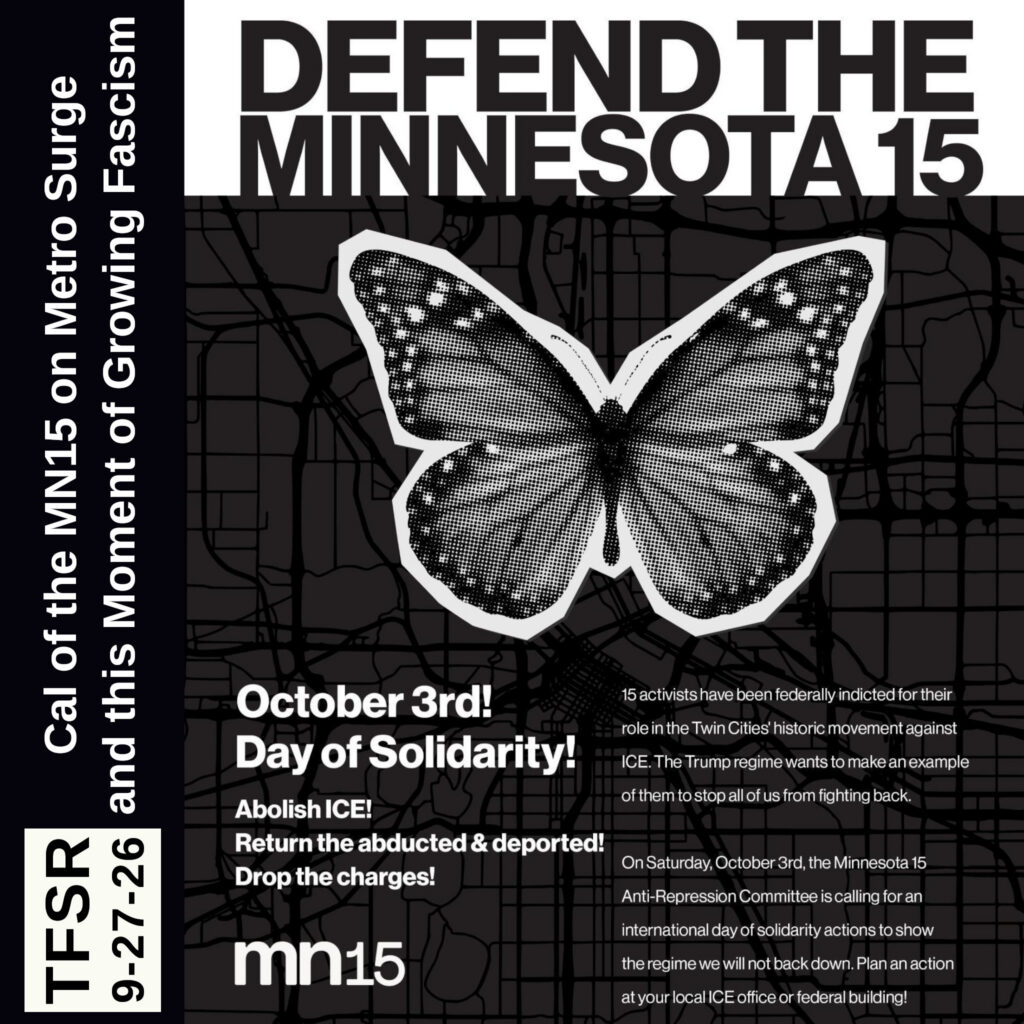
Of note, there is a call for a day of solidarity with the defendants on Sunday, October 3rd wherever you are. More at the support site, or find a pic in our show notes related to this.
Links:
- Fundraising for legal expenses: https://chuffed.org/project/186570-minnesota-15-legal-defense-fund
- Unicorn Riot interview with Cal: https://unicornriot.ninja/media/minnesota-15-defendant-cal-robinet-speaks-out/
- Co-defendant Cameron Kennedy of the MN15: https://www.youtube.com/channel/UCeHbMlHDec5NmJfiQXMYGXQ
- Unicorn Riot coverage from Feb, 2026 on the Cold Water Springs encampment: https://unicornriot.ninja/2026/indigenous-activists-occupy-land-near-fort-snelling-plan-to-stay-until-land-back/
- A history of Oceti Sakowin 7 Council Fire: https://unicornriot.ninja/media/the-original-oceti-sakowin-7-council-fires-at-mini-owe-sni-ft-snelling-landback-occupation/
- UR playlist of videos about ICE in Minneapolis: https://www.youtube.com/playlist?list=PLhO_NX0M3_7gLdXZKDKXL7Hd7ZnB9QDbj
. … . ..
Featured Track:
- TFSR by The Willows Whisper
. … . ..
Transcription
TFSR: Would you please introduce yourself with whatever name, pronouns, location, and affiliations that you’d like to share with the audience?
Cal: Hey everyone, my name is Cal. I use they and he pronouns. I live in Saint Paul, Minnesota, and for affiliations, I’m involved with a lot of different groups but the key one right now that I am under charge for is my affiliation with the Ray Rainbolt Memorial Shooting Club. It is a union and LGBT shooting club based in the Twin Cities that’s been active for over a decade and has been involved in community advocacy and organizing since it started.
TFSR: Do you mind if I ask a couple of follow-ups on the Memorial Shooting Club, the Ray Rainbolt? Who’s it named after, and why does it feel necessary to create something that is explicitly for these political and identity elements within a firearm safety or practice group?
Cal: Sure, yeah. Ray Rainbolt was a Dakota man who was involved with the Teamsters general strike in Minneapolis in the ’30s, as well as community organizing against far-right and authoritarian forces such as the Citizens Alliance and the Silver Shirts of America, which was the original fascist mobilization that happened in the United States in the 30s. Rainbolt was the leader of the Union Defense Guard, which was an organization within the Teamsters that did a lot of safety and security work for their strikes and their union, and was very active in all kinds of social movements back then.
This is where we draw our name from, and it also is a header towards the political direction as well as the basis in unionism that we started with. We started primarily as a union shooting club, but eventually became a queer shooting club because when you’re queer, all your other friends are queer and they invite all their other friends that are queer, and then all of a sudden you have a gay shooting club. I’m not mad about that at all. We tend to attract a lot of women, queer people, elderly people, young people that have never touched a firearm before or have never had any experience with this, or it was never a part of their family growing up. We also have a lot of people who are from these backgrounds and identities that have been lifelong hunters, that have been lifelong sport shooters. There’s a number of us that are really active in competitive shooting, and training for that kind of competition is part of the core of what makes our organization a little bit more focused and a little bit less, I don’t know if LARP-y is kind of a mean way to say it, but it helps keep our organization a little bit more focused on skill building, skill sharing and teaching and learning with others.
TFSR: Cool. Yeah, I appreciate that, as well as the welcoming spirit of that. For folks outside of the U.S. context, where guns are less a part of the popular culture, it may seem a bit extreme to have a shooting club that people participate in. Even within a large part of the U.S. context, it’s expected that it’s certain people who participate in this sort of activity. I think it’s wonderful to see a welcoming spirit of education and community support for people becoming more comfortable and safer in their practice around things like firearms. This is also a kind of thing that, under the current administration and with the Republican Party, there’s a criminalization of the idea of queer folks with guns. As if, saying a quiet part out loud, they think that certain parts of the population should not be proficient with these tools, right?
Cal: Right. Some people, who come to our club, only want to learn how to make a gun safe in case they find a gun outside on the ground, how to unload this thing. They really have no interest in shooting at all. There are some people that come because they really like cowboy guns or they’re collectors of World War II firearms. Whatever it is, we are here to provide a space that’s safe and welcoming for people to learn, and we want to make sure that…
In the United States, the Second Amendment has never been applied equally throughout the population. If you think back to the 1870s, the Chicago Lehr und Wehr Verein was a socialist organization, a militia that wanted to make sure that the people of Chicago had access to arms and that they were able to carry them. They got smacked down by the Chicago PD and lost the Supreme Court case about what it is that the Second Amendment actually means. It was decided then that the context of the statement of ‘a well-regulated militia’ means specifically that the state guard (which is another organization that maybe is extremely strange to people outside the United States). Each state has its own militia organization that does a lot of disaster relief and civil service kind of stuff. It’s not necessarily solely the militarized police. These organizations take a lot of rural people and very young people. I don’t want to glaze them too much, I think that the aspect of the militarized police is something they do, but it’s not necessarily like gendarmerie. It’s a lot more civil service than that.
However since the 1870s, there’s been a lot of legal cases regarding the Second Amendment and what it means, and Presser v. Illinois was overturned in the Bruen decision. Many people’s understanding of the popular context of what the Second Amendment actually means is more true now than it was back then. And this is only a decade old. This is kind of one of those aspects of law that, interestingly, turned into the popular understanding as opposed to what it had technically meant. So I don’t know. It’s a very strange United States gun law. A lot of people talk like they’re experts and they really know what’s going on. But the truth about firearms law in the United States is that it’s extremely complicated. Very minor changes or issues can net people very extreme criminal charges.
It’s also true that a lot of times firearms law is used by liberal politicians as a substitute for drug law to perpetuate mass incarceration. A lot of times, these laws are enforced in an extremely racist way, and as we consider what it is that makes our communities safer, liberal politicians will want to push these kinds of laws as a way to back-door bolster the carceral state, as opposed to actually working on community safety initiatives like making sure that everybody has food and housing and access to social services.
Radicalism is a word that really means grasping at the root. And if we’re going to grasp at the root of these problems, we need to take a deeper look at what it is in society that creates violence. It’s not the tools that create violence; it’s the broader structure and access to the ability to live a good life. So, that’s my two cents.
TFSR: Yeah, I appreciate that. I think listeners would have just gotten a little bit of a taste of your perspective on the world and where you’re coming at this from. But if you could talk a little bit about how you describe yourself politically and how you got to this perspective, what values, organizing, and sorts of experiences do you connect with that description for yourself?
Cal: Sure. Well, I call myself an anarchist, and I have for quite a long time now. I first got involved in community organizing in the mid 2000s, doing anti-cult work. There were a lot of really extreme cults that popped up post-9/11,(in terms of American nationalism and the security state) that really kept hammering home authoritarianism and strict obedience to all these powerful institutions. I was still very young at the time and I didn’t have a really deep political understanding. I saw that happen and I decided that I had to get involved. But it wasn’t really until Ferguson that I started to take my organizing more seriously. It was always: I’ll step in when I can. But after seeing what happened to Michael Brown, I decided that I had to do something about it and not just abstractly live my values.
It was at that point that I got involved in radical labor organizing and anarchism. At that point, I hadn’t called myself an anarchist, but I met real pro-organizational anarchists that were attempting to build a better world. And I felt like the world had kind of lied to me about what that word was and what it meant. Ever since then, I have been involved in all kinds of groups and organizations throughout the decades, I suppose. I really value the interconnectedness of all of these social struggles and movements because I think that’s perhaps one of the greatest lessons that I’ve learned from Metro Surge. It’s not just single or individual actions that turn the tide. It’s the connectedness and working with one another and being able to collaborate that really turn the tide.
In my mind, an anarchist is somebody who takes democracy seriously, is somebody who wants to act collectively without an authority telling them what to do. It’s somebody who believes that we can resolve our problems together. It’s not a mustache-twirling bomb thrower like a cartoon villain. Anarchists have been organizing in the Twin Cities for a long time, and now, in moments of crisis, I see flashes of anarchist thought and ideas everywhere among people who would never call themselves as such. My goal is to get people to see the power of these kinds of ideas. It’s not to enforce my will upon anybody, and I think it’s an important perspective that everybody needs some sort of taste of in order to really understand.
TFSR: I’m sure that people will have caught this depending on their context; the Ferguson that was referenced is Ferguson, Missouri. In 2014 it was marked by many as the beginning of the movement for Black Lives or Black Lives Matter at the time. Metro Surge is the name of the DHS and ICE invasion of the Twin Cities at the end of 2025. Jumping forward to Metro Surge, you’ve spoken elsewhere about your arrest, but I wonder if you could share with the audience some of that experience of what that felt like, what happened.
Cal: Yeah, so I had no idea that any of this was going to happen. I woke up one morning with six stars in GTA, rolled out of bed, heard a crash, and then some yelling. I was like, ‘Oh man, the cat knocked a glass over, and this is gonna blow over.’ But the yelling kept happening, so I got out of bed and stumbled towards my front door because I was definitely not fully awake. I turn in the corner, and I see a half dozen people, full military gear, body armor, helmets, machine gun suppressors, all staring me down, guns pointed at my head. They tell me, ‘Get on your knees, hands above your head,’ cuff me, and tell me to walk over the broken glass to them. And that’s when I noticed the Homeland Security media crew. They sent a media crew out to film my arrest and zoom in on my mostly naked body there, trying to catch my young roommates and me looking afraid.
My house is a house of trans refuge. This is a place where we put up young people leaving bad situations, bad states, abusive familial dynamics or relationships, so that they can move to the Twin Cities, which is a very welcoming place, to try and build a life for themselves. I think that they targeted our house with this kind of force intentionally to try to make propaganda about us. That’s why they sent a film crew. That’s why they held my young roommates at gunpoint on the couch. That’s why they sent multiple helicopters after me, a surveillance van, a bunch of SUVs. They eventually threw me a pair of sandals from the shoe rack that weren’t mine and walked me out into the rain.
It was a bit of a cold rain that morning. I was out there in my underwear. They marched me at gunpoint again into an SUV and I noticed all of my neighbors out there, with their cameras and their whistles, and they were filming to make sure that everything was going to be all right for us. They spent some amount of time ransacking the house, opening every door, every drawer. They smashed their way into my firearm safe storage closet, threw everything that was put away into a pile on the floor. They stole some electronics and eventually they had to leave. I’m not sure what caused them to leave, but I will note that more and more neighbors kept showing up, and in other places where people were arrested, in particular, my co-defendant who lives in Powderhorn, which, for context, is one of the most active neighborhoods in the Twin Cities, claiming, “we got to get this guy and get the f… out of Powderhorn.” I wouldn’t be surprised if something similar had happened here.
Eventually they gave me a pair of pants and a hoodie and brought me into jail, the federal courthouse in downtown St. Paul. And again, they’re perp-walking me the whole time, making propaganda, trying to catch me looking afraid. Truth is, I’m not afraid of these clowns. They marched me up to the jail, and I’m thinking to myself, well, this has to be only about me. There’s no way that they went that crazy hard if this was just a routine arrest. But as they march me through the cells, I see one person that I recognize, and I think to myself, ‘Oh, well, that’s interesting.’ They get me to the fingerprinting to take a DNA test from me, and I see another person I know, and I’m like, “Oh, maybe this is a little more than I thought.’ And then I hear from down the hall Irish folk tunes being sung very loud. All right, well, they got everybody. We’re all in this together now. That was my friend Emmett, the musician.
Being in jail was honestly kind of funny. There are a lot worse things that could happen than being in a room with a bunch of your closest friends for six hours, cracking jokes, singing songs. Eventually they put handcuffs with belly chains and leg cuffs on us to march us downstairs, and Emmett led us in a rendition of Colonel Bogie’s march from Bridge on the River Kwai, and put us in another holding cell. And then they bring us out into the courtroom, where they determine conditions of release or not, and the government tried to have us held indefinitely through trial. They also tried to introduce evidence at this point, which is not how any of this works.
This is another recurring theme you’ll see: the clown show in the prosecutor’s office. You know, the majority of people in the prosecutor’s office quit during Metro Surge because they wanted nothing to do with what was happening. In fact, we have some former prosecutors on the defense team now, if that tells you anything. We had a bit of a back and forth. The government wanted to impose ridiculous conditions of release on us, but the judge eventually decided that the condition of release was no bail, so that was awesome. There was a condition of no protesting on federal property, which has already been overturned, to my understanding. And then there is still the condition of no contact with co-defendants, with the one exception of my one roommate and me because we lived together. He was not at the house at the time of the raid. That was my extraordinary rendition. I think that’s how they call it, where they just snatch you and run away with you.
TFSR: Sorry that you all have gone through that, and also that your household had to suffer through that. That sucks. I believe you when you say ‘I’m not afraid of these clowns,’ but also that’s got to be a jarring circumstance, if not for yourself, then for the people around you you care about.
As a member of what’s called Minnesota 15, I really appreciate you taking the time to speak to me and to the audience, and I’ll do my best during this conversation to not ask questions that specifically relate to the elements of your indictment, since the case is ongoing. But as to the case of the MN 15, according to the support site Minnesota15.org, y’all are charged with ‘conspiracy to impede federal officers’ related to meetings and protests taking place during the winter of 2026 during the so-called Operation Metro Surge. Listeners of our recent interview on the case of the Spokane Three will recognize that same rarely used Civil War-era charge faced notably by the Spokane Three and some of the January Six rioters, also used in the Broadview case that never actually became a case, as the indictments were dropped by the prosecutors.
Can you talk generally about who the 15 are, if you’ve announced a collective defense, and what generally the state is claiming in this case?
Cal: Yeah, among the 15, 11 of us are current or former labor organizers, which is super telling on what it is that the state fears and who they want retribution against. Eight of us are currently very active in our unions and our workplaces. Some of the other people are community organizers. Some people are not particularly connected to the rest of us, but the state is trying to make this gigantic conspiracy web thing that they can try to nail everybody for whatever minor issues they might find with other groups of people, and this is kind of the way that conspiracy as a legal construct is formed. If you and I, Bursts, wanted to talk about how a vending machine works so you can steal a candy bar, and then one of us later did it, we’re both liable for this. Any kind of speech or investigation or whatever towards any kind of overt act makes everybody guilty. But this always has to be run through a jury to see if they determine that to be any kind of important enough concept regarding criminality.
All of us are charged with felonies. This can carry up to six years in federal prison. A couple of people are charged with some extra stuff, but ultimately these charges are all nonviolent. I think that it’s super telling that the head of the prosecutor’s office is unable to describe any harm that came from any alleged actions.
What they’re really doing is not charging us with actual crimes. What they’re trying to do is to put the entire movement on trial. Because if we are guilty, then literally tens or even hundreds of thousands of other people are also guilty, right? The kinds of things that we are accused of doing, such as having meetings and going to protests, are things that maybe even a majority of the Twin Cities had done. The whole point of these charges is to get people to shut up, to get people to stop protecting their neighbors. It’s to get people to be silent and fall in line. And the conspiracy to impede or injure is a joke; it’s throwing something at the wall to see what sticks. I don’t know if you’ve read the whole 94-page indictment, but my close friend and co-defendant Eric Davis, who is a professor of religious studies, told, I believe, the Guardian, ‘I know what it looks like when a student is trying to pad out a paper to make it seem like they have something to say, and that’s exactly what’s happening here.’
TFSR: Yeah, AI is pretty long-winded too.
Cal: [laughs] Sure is.
TFSR: Beginning at the end of 2026, the Trump administration led what’s known as Operation Metro Surge in the Twin Cities. The operation was led on the ground by a white nationalist and then commander at large of Customs and Border Protection, or CBP, Greg Bovino, who had overseen operations in Los Angeles and Operation Midway Blitz in Chicago. These activities by Gruppenführer Bovino’s ICE and CBP operatives were designed as a Blitzkrieg of vengeance against Democrat-run locations, and they seemed to come with a special vengeance against the communities that sparked the 2020 George Floyd uprising. Can you talk about the impression of the approach that Trump and his goons brought to the Twin Cities, and the culture of resistance that your home brought to the streets?
Cal: It was a very cold winter. I will say it was one of the coldest we’ve had in a long time. The day of the general strike was less than 20 below. That’s about negative 30 for our Celsius friends. Temperatures like that are something that not everybody really has a context for. It just sounds cartoonishly bitter, and that’s because it is. You can get frostbite in less than 15 minutes with exposed skin, but people of the Twin Cities didn’t let that stop us. We had a general strike that day that had actions all over the city. There was a big march downtown. There was a protest held by faith leaders at the airport, and there was also a protest outside the concentration camp, and that’s one that I’m not allowed to talk to you about because it’s related to what’s in the indictment.
When you’re talking about what happened here and why it happened here, I think there are a couple of important reasons why the Twin Cities were targeted. First thing to note is that our undocumented population is less than 2% of the population. This is extremely low. It was never really about immigration. Immigrants have just been the scapegoat for all of the problems that the administration can’t resolve. Another very common one is trans people, and so very notable you see a lot of queer people in these community self-defense efforts, taking charge because we know that we’re next on the list, as well as unionists, anti-racist activists and faith leaders and all these other groups that you see in the Niemoller poem. We’ve learned from history on this one.
Why the Twin Cities were targeted in particular is, number one, the obvious one: Trump has specifically said out loud that Tim Walz, our governor, was his political opponent in the last election and Trump promised vengeance against his political opponents. I don’t know why people aren’t talking about that more. That’s something that he’s just blatantly saying out loud. But more important than that, I think, is because of what happened here in 2020 during the George Floyd uprising. The Twin Cities put together a massive protest and community self-defense effort, where we saw a lot of the seeds of what happened here being planted. All of the neighborhood organizing committees, the community patrols, because there was a lot of white supremacist violence that came to our city from outside of it. A lot of these kinds of efforts went dormant after that and were brought back to the surface during this last winter.
I think it’s interesting that the state is trying to enact vengeance for what happened then, because what happened then is also a major part of the reason that we were able to act and organize in ways that we are now. That we’ve learned from these lessons. They escalate, we escalate. That we’re not going to step down and let these mass secret police just do kidnappings, beatings, executions, these random terrorist acts in our streets. That we will defend our neighbors, we’ll protect our people, we’ll make sure that everybody is fed and clothed and safe, because this is something that we all recognize that we’re in together.
TFSR: In a recent interview that you gave to the CNT, you mentioned that the history of the land on which the Whipple Federal Building stands is a concentration camp for Dakota and other Indigenous people in the area. Last February a new Indigenous encampment came up at Coldwater Springs. I think there had been a history of other protest camps there. Could you briefly speak about the history, as you know it, of that site? The connections through the history of the federal occupation, maybe who the Whipple Building is named after, and who some of those resisting people are, and what they’ve done.
Cal: The history of the Minnesota Territory was partially a result of westward expansion and partially a result of the Louisiana Purchase. It’s very notable that the two large indigenous nations that this land belongs to are the Dakota people and the Ojibwe people. Throughout the 1800s, there were a series of conflicts between native and settlers that resulted in a number of wars. The federal land of Fort Snelling was a forward base for settler forces. It was placed at the confluence of two important rivers: the Minnesota River and the Mississippi River. Both of these rivers were major routes of trade for both indigenous and settler communities. By taking that land in particular, they were able to force people into trade with an industrial economy. As the genocide continued, eventually the federal government built these structures which are often cited as early modern examples of what we know as concentration camps. They took all the people that they could and forced them to live in these tightly controlled areas and then starved them to death and killed them.
It’s something that we saw back then and it’s something that that land is being used for again today. People need to understand and recognize this history, because this doesn’t just come from nowhere. I think that among the more sophisticated opposition forces that we see, they also understand this history as well. ICE chose that one building in particular to be their headquarters for multi-state operations. In other places, in Richmond, Virginia, for example, you see that ICE’s headquarters are literally just an old strip mall. But they knew what they were doing when they decided to use this federal land for this purpose, and we shouldn’t forget that. We shouldn’t let it pass us by.
For the May 1st actions that the Workers Assembly here was doing, my group, Ray Rainbolt Memorial Shooting Club, put forward a demand to include, as part of the demands, the return of the federal land of Fort Snelling to the Dakota people. We need to remember this history and see ourselves as a part of it.
TFSR: Cool. And as far as the more recent protest actions and prayer camps and such, I can link some stories from Unicorn Riot that cover that in a little more detail and carry the voices of some of the folks that were participating in that.
Cal: I also just want to say, as somebody who is not a native person, you should listen to native people on this. These are just things that I have learned and understood, and I would encourage people to seek out more culturally specific and primary sources on these because it’s very important.
TFSR: Let’s talk about the case of the Minnesota 15 in terms of its role as a political show trial. In the last year, we’ve seen the Prairie Land case, which is very different from this, but also the Spokane Three and the Broadview Six indictments, the Broadview Six being the case in Chicago. I wonder if you could talk about this show trial that’s going on against you and your 14 co-defendants, the intended chilling effect on community members and activists involved in demonstrations against racist U.S. ethnic cleansing campaign against our neighbors and our loved ones.
Cal: The role of political show trials that we’re seeing pop up all over the country is twofold. Number one, it’s to feed the base of the fascist movement in the United States. Many of these people are well aware that when they call us terrorists or when they say that they’re only deporting pedophiles and serial killers, that’s not literally true. But the point of making statements like that isn’t to speak to literal truth. It’s to try and fire them up emotionally and feed into their worst impulses.
I also think that the other effect that political show trials have is to try and silence those who would otherwise be speaking out against some of the terror and lawlessness coming from the federal government. There’s this wonderful piece in the Philadelphia Inquirer where they say that the point of the Minnesota 15 is to get you to shut up, and that’s one of the articles that I like to pass on to people when they ask me what is the real reason behind this: ‘Because it sure seems like you guys didn’t commit any crimes.’ I’m like, ‘Yep, we didn’t, and here’s what they’re really trying to do.’
TFSR: So the government’s operating on, or at least arguing for, literal conspiracy theory, an interpretation in many of these cases – Broadview, Spokane Three, Prairieland or the Minnesota 15 – that there’s a conspiracy between people opposing the actions of the Trump Gestapo. Sometimes it is named Antifa, a shadowy network of super soldiers in mech suits with a command and control structure, and funded by global financiers to undermine the American way of life. Sometimes it gets spoken about as an extension of the Democratic Party or anyone presenting opposition to the enactment of Project 2025’s goals or Trump’s whims. But anarchists generally have different understandings of how power can and should operate when confronting tyranny. I wonder if you could talk a bit about how the resistance to Metro Surge modeled different theories of change and organizing, and what people need to understand about the smearing of community defense as terrorism.
Cal: Yeah, I think that the first thing to recognize is that when we’re accused of being Antifa, the state is making up an organization that doesn’t exist. There is no such organization with a military command structure that tells its soldiers and operatives what to do and where to go, gives them financing, weapons, and military training. That this is all a complete farce, and a lot of that is people in the federal government being unable to think outside of their own context. We see them doing things like this in places all across the globe, like in South America, the School of the Americas, where they literally train people to do these things.
Community self-defense organizations have always been extremely diverse and come from different places. Many of them are people just using whatever resources they have on hand to try and protect one another. ‘Antifa’ doesn’t exist. Being anti-fascist, being someone who opposes fascism, is something that has always existed, and it’s something that I think hundreds of thousands of people in the Twin Cities are, and it’s also something that anybody of good conscience is. Opposing some of the worst crimes of the 20th century is just a no-brainer, and I think that most people are, at their core, anti-fascists. And when the federal government tries to criminalize that, it’s super telling on what their priorities are. They want to make it illegal to oppose things like concentration camps. They want to make it illegal to oppose things like summary executions. They want to make it illegal to oppose literal black bagging of children from bus stops – it’s really something that I have a hard time explaining to people who weren’t here. The level of violence and terror that the federal government chose to enact. But it’s something that, thankfully, people have been listening to and learning from. I’m really grateful to have this opportunity to share all that with you.
In terms of how resistance to Metro Surge worked: when Metro Surge started, we had this centralized hotline model that one organization had set up, but as ICE’s tactics evolved away from massive raids into smaller snatch-and-grabs, our model of community self-defense had to evolve as well. By their nature, we adopted a more horizontal structure, where every neighborhood has its own rapid response network and everybody was taking on tasks and projects that they felt suited to, not because they were told to, but because they had the skill, because they had the kind of material support that they needed, and because that was something that they were willing to take the risk on, and not everybody has all of these same things, right?
One really important lesson that we took from Metro Surge is that you should never be telling people not to do something. You should never be telling people that they need to do your thing as opposed to their thing, because they’re the ones that best understand their context and what they can bring. Maybe this creates a situation where there are conflicting goals and purposes, and in some ways, that’s actually a good thing because that means now two groups are doing this different kind of work. These groups don’t have to be stepping on each other’s toes. They can be taking on different projects in their own ways and what is more helpful and effective will be the thing that ends up attracting more people and more resources, and being more effective community defense.
TFSR: There’s something very similar to the St. Paul Principles about that.
Cal: Totally, 100%. This is the beauty of anarchist principles. I think I said it earlier in this interview. I am an anarchist, and I believe all of these things on principle. But so many people in the Twin Cities are not anarchists, and came to these anarchist principles because this is what worked. This is what functioned. This is what protected our neighbors. And that’s something that the state really fears. They fear this idea that people will learn that they don’t need the state anymore. They can stand up, protect, feed, clothe and house one another, and that we don’t need these systems of power, systems of extraction, systems of exploitation, to take from us as we do this.
TFSR: This is a different approach, maybe to the next question. Just a sort of concentration of what I was trying to get at. You mention how community members adapted to what they were seeing from ICE and Border Patrol in terms of snatching up their neighbors and loved ones. You can see a similar adaptation following Metro Surge from federal law enforcement. I think that federal law enforcement, the immigration Gestapo, very clearly had their will broken in a lot of ways and had a huge embarrassment with how Metro Surge went. This does not mean that they’ve discontinued the activities that they were doing, but they’ve learned that when they engage in these very provocative public kidnappings that they are going to get a provoked response from community members.
Now, while they’re increasing the amount of deportations or kidnappings that they’re doing, it doesn’t have the same provocative effect on communities where those are taking place, and therefore it’s a lot harder for people to organize collectively. What was seen in Minneapolis and in Saint Paul, not without a lot of work, was folks coming together and coordinating around this public display. But without that public display, I guess it’s just harder to organize. So we’re seeing a ramping up of ICE activities in other places. I wonder if you have any comments, with the goal being ‘we want our neighbors to stop getting taken’ – do you have any thoughts about this shift in the way that they’re doing what they’re doing since Bovino got kicked out and since Noem is gone? How might folks consider adapting their resistance?
Cal: Yeah, it’s been a difficult couple of months here trying to deal with the fallout of what ended Metro Surge, which was our governor cutting a deal with Tom Homan, the new ICE guy. We don’t know what was exactly in this deal, but there are a couple of things that we’ve seen coming through the data on what’s different now than before. First off, we’re seeing a lot more collaboration between local and federal law enforcement. We’re seeing more raids that happen outside of daytime hours. More people are being snatched up at night or really early or late, and we’re also seeing more people being taken from jails or released into ICE custody. Some of the counties throughout Minnesota have made deals with the government in order to allow them directly into jail. But even in the ones that don’t, we’re seeing ICE just waiting outside of the jail for when people get released to pick them up and put them in a concentration camp.
There’s been a lot of movement around trying to prevent more concentration camps from opening. That’s been another really large project. There have been more rapid response groups active throughout the night as a response to that, and we’ve also seen ICE switch their focus away from urban and into rural areas. Rural rapid response groups are in many ways more difficult to put together because you don’t have that mass of people that can show up within a couple of minutes. But it is important for people to keep their eyes open for these situations and to know their neighbors in order to prevent any more harm from coming to people.
TFSR: I bring that up; it’s not just a Minnesota problem. ICE released numbers from July and August of 50,000 people each month getting taken into custody. I think the shift that you all have seen with the snatch squads, the changing hours, and moving to more rural areas has also been a shift nationally. Following the killing of Renee Good and Alex Pretti, the Department of Homeland Security launched two operations to target activist organizations (or at least this is my understanding from articles I’ve read): Operation Puppet Master and Operation Whipple Shield. Both were operating under a pre-existing Department of Homeland Security investigations program called Operation Keyhole.
Can you talk about what is publicly known about Puppet Master and Whipple Shield? Were people already concerned about attempts by the police to infiltrate community organizations? Who was targeted? I’ve heard talk of churches and labor unions. How was it learned that this COINTEL-style program was operating in the Twin Cities?
Cal: I think that a common misconception about these programs is that they were started as a response to any kind of community organizing or protests. But the truth of the matter is that these projects were launched in conjunction with Metro Surge. They were already trying to infiltrate rapid response groups, churches, and labor unions prior to anything happening, and it goes to show the priorities of what this federal government is really trying to do.
These programs infiltrated all kinds of organizations. I don’t know if you’ve seen the image with the wheel with a dam in the center, and then the bicycle shop Grease Pit and the AFL-CIO and all of these different groups as being part of a conspiracy. I think that most organizations in the Twin Cities expected something like this to be happening. Maybe not to this extent. Maybe not in all of the places where it was happening. But to just understand that we live in a surveillance state, all of us carry tracking and recording devices in our pockets everywhere we go: these phones that we don’t have full control over. Flock cameras are a thing. Some of the spying that we’ve seen from the federal government, particularly on my house, is that there are multiple days when they just staked out my house for the entire day, taking pictures of everyone coming and going. They got me going to McDonald’s for a burger. This is the level of following that they’ve been doing. They followed me on the bus to go to the No Kings protest.
I think that a lot of people who have a naive idea that only dangerous organizations are being targeted really had a reckoning once it came out. They sent undercover agents inside the CWA (Communications Workers of America) union office, infiltrated churches where they are explicitly barred from entering, and attended meetings of climate justice groups like Sunrise. All kinds of just absurd targets that they tried to construct this idea that they were planning violent terrorist attacks against the federal government. I think that it was shocking to some people, but many people already operated under the idea that anything we’re saying could be recorded, and we have to just be acting right the whole time. I think that even in that indictment, there’s a shocking lack of any kind of criminal activity in there. Most of it is people going to meetings and arguing about how to plan things.
TFSR: What are some next steps in the case that you can talk about, and how can people support you publicly?
Cal: I was just thinking about this when I was doing that written interview with the CNT the other day, people in Madrid asking how we can support you guys. I always tell people inside of the United States, please talk about this with as many people as you can. Do statements of support. Throw fundraisers and watch parties, whatever. Please donate to the Defense Fund. But most important, more important than any of those other things, is that I want to make sure that people are still out there doing ICE watch because this fight isn’t over. The federal government is still kidnapping people. It is still wrecking families. It is still throwing people into concentration camps. There are still other cases going on right now. We all saw what happened in Prairieland. All those people are in jail right now. There are people at Delaney Hall who are on hunger strike right now. I want to make sure that everybody is still staying in the fight. And it’s good to say we defeated Metro Surge, but ICE is still out there. This was one battle, and it’s not over.
In terms of people who are not in the United States, I think my advice to them is to do some power mapping, do some thinking about ‘what ways does my life intersect with power structures within the United States’. We saw in the Iran War, Trump very foolishly meddling with the global supply chain and what kinds of downstream effects that can have for different groups and people. The right kind of labor action, the right kind of pressure to international organizations or embassies or what have you, can really make a difference in some unexpected ways.
I wish I had specific answers – “you should do X, Y, Z” – but nobody knows your local context better than you. You can get 15 people in a room to try and figure it out together. It’s going to spread that knowledge. It’s going to spread that experience. It’s going to make sure that things keep happening when someone gets sick or has to go take care of their kid or whatever it is. So yeah, stay out there. Keep organizing, keep your whistle on you. Make sure that this doesn’t pass in silence. Check out our website, Minnesota15.org.
TFSR: Thank you very much for having this conversation. I appreciate it, and good luck.
Cal: Thank you.